Tuesday, April 17, 2012

Creeping Oregon Grape (Mahonia repens)

photo: Paul Slichter
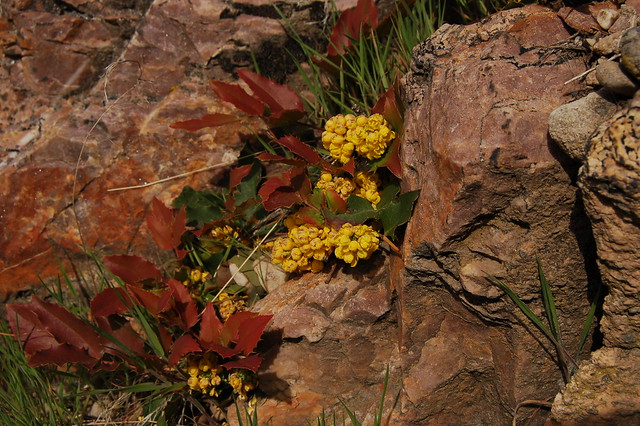
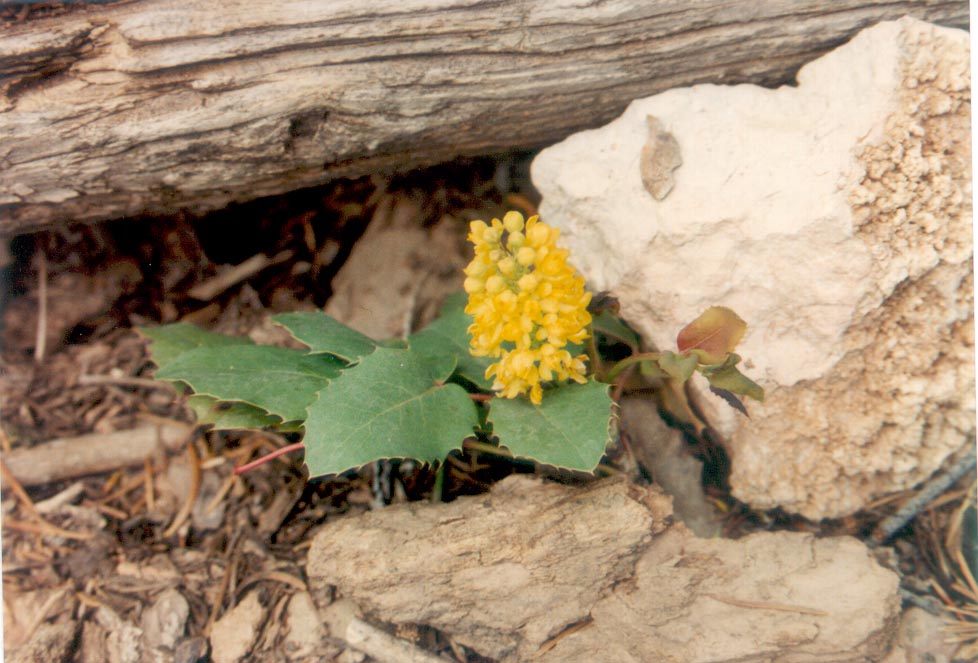
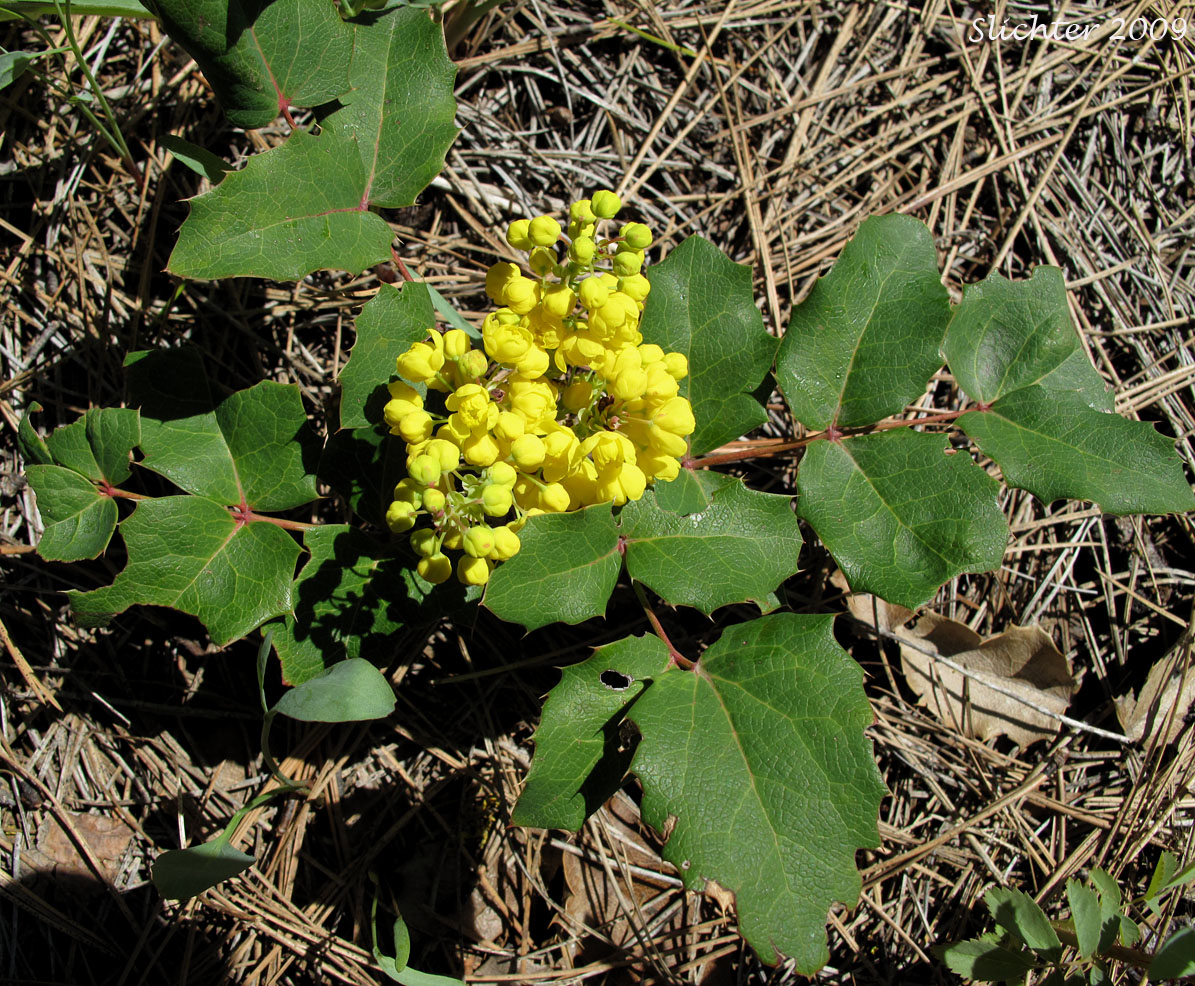
This is one of my favourites for placing under a woodland garden setting where not a lot of water is going to be used. Most woodland gardens we think of as a lush shaded cool spot with this long list of delicate moisture loving herbaceous plants like ferns, Meadow rue, etc. I put Creeping Oregon Grape in with a dry forest floor setting, though it'll take the moisture anyway as long as it's not a bog. It's name is a give away for it's habit for spreading slowly by underground rhizomes. For me it has always stayed low to the ground, but it'll get rather bushy to a couple of feet or so with just the right garden conditions. The photo above is how mine looked with a mat of pine needle straw which not only is decorative but also keeps the weeds down to that the effect is simply the beautiful living mat of the holly like leaves of the Mahonia repens. The fruit is blue much like that of the commonly tall planted Oregon Grape. Obviously it is not a grape but the clusters remind people of the look of concord grapes.


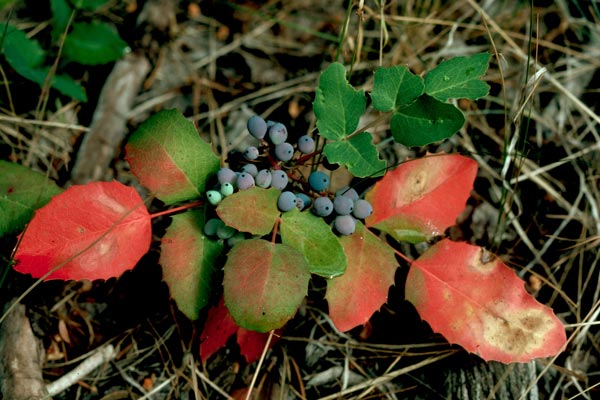
In the winter time they also add a new twist to the look as the leaves themselves will turn red to burgandy. Although some of the leaves will fall off in dormancy, many linger on the plant. Speaking personally I can really only relate to my experience with them at elevation 4500' where winters were freezing and had snow at times. And yet even in the summer they thrived in the heat underneath the Chaparral plant community canopy where I planted them.


 Photo by Donald Kirk
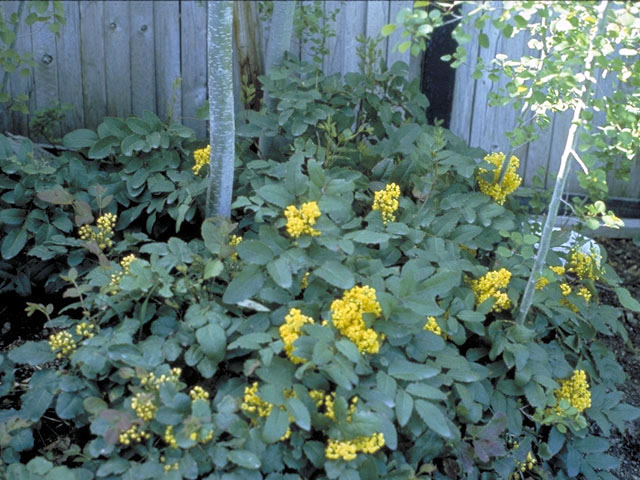
Here are the more mounding conditions if you have it under organically rich and maintained garden soils with regular water. Notice also that red leaf colouration I mention previously above. They look especially at home under conifers like Pine Trees. Notice also the contrast of the carpet of pine needles as a carpet under the Mahonia ?


Photo by Alder, Michael G.

For me however, I wanted them established with a mycorrhizal connections and eventually taking care of themselves when eventually connected to the grid I create underground which allows a plant community to take care of and maintain itself with little help from me. Take a look at some photos of what they look like and how they behave in their own natural settings. Often you can learn much by taking some mental notes from observing nature and replicating this in your own backyard. In the picture below, notice how it forms a nice carpet under the Ponderosa Pines.


Photo by Al Schneider


Looking at such scenes above should get your mental wheels turning as to planning and other architectural goals when you choose to layout a landscape theme. Here is it's native ranges. The light green reveals where it is native and not rare. The dark green indicates where it has a presence in specific locations in the other states and the light tan indicates it's once historic range. Frankly, this plant can be grown just about anywhere.


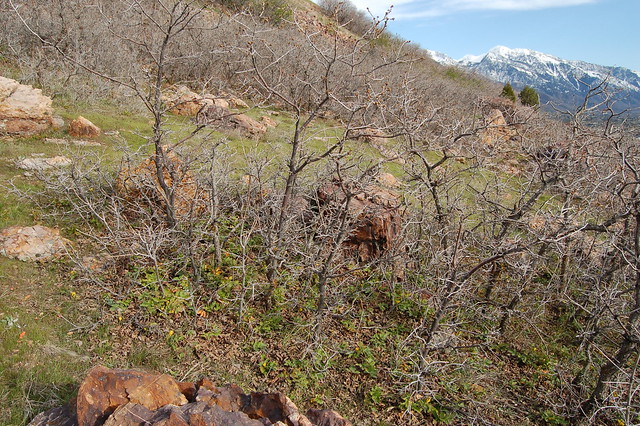
These next picture are strictly for the readers or gardeners to appreciate just how tough these little plants are and you need to realize that they wouldn't even exist here in these harsh settings were it not for mycorrhizae. These next pictures are also from the State of   Colorado in the southwestern United States in and around the Colorado Plateau regions where extreme heat and cold accompanied by often dry conditions during any temperature range make conditions for any plant a challenge for survival. This should be obvious as you can to tell from these pictures of plant in the dry adobe red sandstone which surrounds these plants in the photos. Very little organic matter here.


photos: JR Hartman Universität Greifswald


photos: JR Hartman
This next photo to the right again shows the toughness and ruggedness of this plant's ability to survive not only harsh weather geographical and climatic conditions, but also spring back with a vengeance after a wildfire experience. reminds me of just how powerful this plant's ability is to spring back from even fire destruction of habitat. I have a personal experience with this. I did something one day at my house in Anza, California that was dumb, stupid, retarded, whatever. I heated my house with wood burning stove. It was winter, cold and windy from a typical Santa Ana wind from the east this day, but it was sunny. It was in the afternoon that I was going to start another fire for the coming evening, but first I had to clean out the ash drawer. The box was warm but not at all hot to the touch. I took the ashes out as I had done previously to spread a light coat of ash under some of the landscape for the purpose of returning something back into the ground. So I figured I was doing my eco-green merit badge deed for the day. Most of what I dumped was ash and there were a few dark chunks of charcoal. 

photo: Mine
I went around to the other side of the house where I was planting some trees and clearing some brush. I looked up and saw big white billowing puffs of smoke over the roof coming from the other side. I ran a round the corner of our house and found a fast moving though only a few inches high fire making it's way through the understory of the Redshank and New Mexico Locust. I ran and got the garden hose and turned it to full blast. Put the fire out and fortunately for my backside it came to an abrupt end at the dirt road, thought sparks were being carried over to the other side and I had to run over and stomp out with my feet a small bunch of  dried foxtails. I dodge a huge bullet. I could imagine myself being in debt for the rest of my life, but only after I got out of prison. Not to mention the guilt of harming the property and lives of my neighbours for one moments stupid unthinking act. Only that road in the photo above acted as the perfect firebreak. The fire would have been on the right. *sigh*

Photo by Tony Frates
But this photo to the right here should illustrate Mahonia repens ability to spring back easily from a fire. Unlike the chaparral below, all of my shrubs and small trees were untouched by the flames, though some small New Meixco Locust clonal saplings did get weeded out which was something I was going to do manually anyway. Yet even in this almost catastrophic situation I could also view and experience first hand how a small fast moving fire could clean out and maintain an understory even in chaparral.


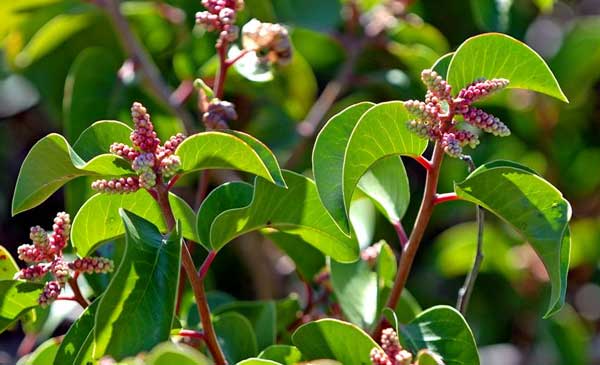
This next picture is the exact location of where this fire took place. The location where I dumped the ash is right there at the top of the drive and working down from there and to the left. You can see those same New Mexico Locust (Robinia neomexicana) and in the foreground amazingly is still a little Sugarbush (Rhus ovata) which also was untouched. The winds were blowing from right to left in this photo. The road it out of the picture, but it also is to the left. What an absolute stupid blunder that really could have been, not to mention the misery caused to my neighbours and others..

Photo by Plantentuin Esweld
This next picture illustrates what I did as far as enhancing the understory decor as far as a natural forest floor look. I went up to Idyllwild, where I use to live and obtained some old Ponderosa pine and Incense Cedar logs for decorative special effects along with some rocks from the Pinyon area above Palm Desert, CA which are a flat grainy plated hard granite stone from the washes and quite attractive. Planting anything in and around objects and in niches and crevices gives added texture and eye interest.


Hope this helps some out who need ideas for small spaces. Common larger varieties of Mahonia (Berbsis) are nice, but can take up larger space if you don't have it. When you are out walking in nature, take notice of details of how things grow, what shapes them, what type of community of other plants they grow with and always think about what is going on underneath the ground to make it all happen above it.

Friday, April 6, 2012

Strategies for Attracting More Hummingbirds to Your Garden

I miss really Hummers!
Photo by Ted Muller

California Fuchsia

(Zauschneria californica mexicana)

And you thought this Post title was going to be about some magical Elixirs to put in those feeders to intoxicate and attract more Hummers than you ever had before ? No this is about planting natives and attracting them that way. Okay, but maybe later I'll intro a clever 'natural' mix recipe at the end of my story that you MAY use for your own feeders.  California Fuchsia is a low growing perennial that is useful if you want to attract Hummingbirds.  After it's been established the first summer this red fuchsia flowering native plant can make it on its own. Up in the San Jacinto Mountians where I lived in Riverside Co California, we had very bitter cold winters at times and my California Fuchsia would die back to the ground. But it would return with a vengeance every spring/summer when the weather warmed up again. Interestingly, these plants would also bring some friends in the form of new baby plants, so they reseeded very well which is what I wanted anyway. Maintenance is like any native, just learn to prune it when it starts to look a bit rangy in spots. Never fertilize with chemicals, always inoculate with a good mycorrhizal - beneficial bacteria mix from any company out there that supplies such mixes. Do the homework.

Photo by Garden Coach

Mexican Lobelia Bush (Lobelia laxiflora)

This is another one of those beautiful red flower with yellow parts protruding from the inside out. Once again, this plant even looks as if it was created for the mechanical apparatus the Hummingbird uses for extracting nectar. A tough, long-lived perennial with vibrant red and orange tubular blossoms that hummingbirds really love and jealously guard. In fact they fought over mine. Again, this plant for me would die back in winter at my elevation of 4000' and I'd just cut it back hard to the ground, but down below in areas like Temecula/Murrieta CA they are green all year long. Of course pruning back any dead stems and seed pods. Likes sun, good soil and regular summer water. After five years in the garden, mine was a clump 2 feet tall and 4 feet wide. I had it next to one of my most favourite shrubs and my next shrub subject Cleveland Sage. Once again, don't fertilizer with chemicals, just inoculate with a good VAM mycorhizal inoculant.

photo: MickiP56 (wildscaping.com)


image: Bert Wildson - http://www.laspilitas.com
image: Bert Wilson - http://www.laspilitas.com

Cleveland Sage (Salvia clevelandii)

Salvia clevelandii is an evergreen shrub that reaches 1 to 1.5 m (3.3 to 4.9 ft) in height and width. To me this is the most aromatic of all the sages and there is another named cross variety which is even more aromatic and listed as Cleveland sage ('Aromas') and can be found at Tree of Life Native Plant Nursery on Hwy 74 in San Juan Capsitrano in Orange Co, California, or Las Pilitas Native Plant Nursery north of Escondido California.  It's the leaves that are always fragrant even when not flowering. They have ashy green leaves which are obovate with wrinkled ridges much like the fresh common sage you purchase in the stores for your own personal cooking and flavouring of foods. The leaves  will grow less than 2.5 centimeters (almost an inch) in length. Flowers are on 30 centimeters (12 in) spikes, with numerous whorls on a single stalk of upright light pinkish violet to a deep purple or even cobalt blue blooms which open in June–July.

My hummingbirds guarded this plant with a vengeance as well. And what is interesting is that most folks think that Hummingbirds are only attracted to REDS , but they go for the BLUE coloured flowers as well. Another side benefit was that I found on a hot summer day the air around the yard would permeate with the aromatic fragrance of Cleveland Sage. In fact whenever I often drove up and down the hill, I'd pick a sprig of sage and place it under my seat. My own version of those chemically scented Christmas Trees people hang on their rear view mirrors. I would also substitute Black Sage (Salvia mellifera) if  Cleveland couldn't be found. On a culinary note, I love cooking Pinto Beans - Chili with this same sage leaves. And as always  - once again fertilizers are not necessary, just inoculate with a good VAM mycorrhizae mix. You'll have to cut it back a bit every year as it to can get a bit rangy if left to itself. But by doing so you'll get a great next year's bloom. Great near pool locations also.


image: US Forest Service

Western Columbine (Aquilegia formosa)

Native to Utah, California and all the way north to Alaska, this woodland perennial produces 2 ft stems with 2 inch red-orange and yellow flowers in late spring. Although delicate looking, it is quite hardy. Without summer water it will die back. Mostly in the wild of Southern California I always found it in association with springs, seeps or streams and often in partial shade. Though it may go into a summer dormancy where moisture is low, however,  it will come back as it does where winters kill the above ground foliage. In each case it will return again in the spring. Partial shade will always be my recommendation for warmer areas. Where I live it's not an issue at all, the whole country is one continuous cool wet with cloudy or partially cloudy skies. Plant it in any woodland garden setting, good under oak trees. 

The flower almost looks as if it specifically was designed for the Hummers. It's another one of those spectacular plants that when in flower they guard with their lives. Another reason I like this plant is the foliage reminds me of Cilantro one of my most favourite cooking herbs. The foliage also has the look of woodland moist garden Maiden Hairs Fern or Meadow Rue. In any event there are a number of varieties that you should check out. Some wild some hybrids, but all kool looking. Arizona and New Mexico have a 'Yellow' variety while the Colorado Rockies have a Purple & White combination. Now check out some of the flashy hybrids in the seed packets at your local nursery. Here are some examples.


photos by Davis Densley


Rocky Mountain Columbine (Aquilegia caerules)


Aquilegia chrysantha  Arizona Columbine

I could go on and on, but you can Google pictures yourself and see the great variety and effort that others who have a deep love for these plants, especially when that love is specialized and concentrated on one type, the results are astonishing. There are so many kool things out in the natural world and they have the ability to allow one to escape from the insanity that the Media brings into our busy lives on a daily basis. Again, the Hummers like'em all. Incredibly, the Swedes over here often have no common names for many of these plants. In the stores and among regular conversations they refer to the name by it's scientific selection.

 Other Things You Want For Your Hummers A Humming Bird needs to collect Spider's web to build a Nest with.


I remember reading way back in the late 1992 or 1993 issue of an Arizona Highways Magazine that told of the The Sonoran Living Desert Museum in Tucson did a bit of house cleaning and rid the Hummingbird Aviary of some spider pests, but later on the nests failed and they wondered why the Hummingbird's nest building failed. Spider Webs were the reason. Here's a link to that story. Really kool.
 Here's an excerpt from the above link if it doesn't show:From Arizona-Sonora Desert Museum:
http://www.desertmuseum.org/visit/exhibits_pollinationgardens.php
Hummingbird Aviary by Karen Krebbs
    "When we first opened the Arizona-Sonora Desert Museum's hummingbird aviary, we had no idea whether or not any of the seven species of the birds on exhibit would breed and rear young. Since opening day, however, we've seen Costas, Broad-billed, Black-chinned, Anna's, and Calliope hummingbirds nest, lay eggs, and rear young. There have been a total of 114 nests built, 186 eggs laid, 116 birds hatched, and 102 birds fledged. No other zoological institution can boast of such success!" 
    "But this success has not come without a good deal of effort on the part of the exhibit keepers and the hummingbirds - especially when it comes to nest-building. For example, in 1992 we renovated the exhibit, clearing out all the plants and expanding and replanting the new space. Within a month of the renovation, several hummingbirds began to build nests." 
   "The nests were loose and quite fragile, and even experienced nesters were having difficulty. Most of the nests fell apart and we lost several eggs that fell out and broke. We scratched our heads for days trying to figure out the problem before we finally concluded that a primary component of hummingbird nests was missing spider webs!" 
   "Hummingbirds use spider webbing as a way to bind and tie their nests together. The spiders had yet to reestablish themselves in the spanking new exhibit. I immediately went out and collected webs from around the grounds, rolling them up on twigs, which I left in the aviary. I also collected 25 labyrinth spiders and introduced them. Within days the spiders were weaving their webs in the aviary and the birds' nests immediately improved".
~~~~~~~~~~~~~~~~~~~~~~~~~~~~~~~~

Another thing they love doing is finding a tiny ball of buzzing knats buzzing around your yard somewhere. Then suddenly darting in and out from nowhere attacking and eating them. And you thought they never actually ate or that all they did was drink nectar. They really love knats and other tiny insects that may be found and eaten inside the flowers themselves. So leave some of the bugs alone and in fact attract them to your yard. Create balance all around. It's also important to take note that when they are nesting and raising young Hummers, these young ones also need more protein  in the development stage at youth.

This is like a Hummingbird Thanksgiving Dinner


 Okay, now for my favourite feeder mix.

Hummingbirds don't require the already made up sugar mix with the added  Red Dye. They don't require it. That's more of a marketing selling point to capture the trade in Dollar$$$ from Human Beings who are prone(suckered) by eyesight advertising. Kind of like those dog food commercial that show a canned product that looks edible enough for the owner to eat. The dog doesn't care. If they like it it's because of smell and taste, but mostly they just wolf it down. Unless their one of those finicky lap dogs like my grandmother had, then forget it. Nothing pleases them.


As far as feeders go, they do seem to be attracted to the feeders with the RED Colouring on them. You know, the large plastic tubular flowers coloured red. Get one of those and you don't need a mix with flashy red dye that was prepackaged to please you. I use Raw Sugar as opposed to the white bleached sugar which is once again a marketing strategy from way back in history which gives the appearance of clean white and pristine product. Raw sugar is much better and I add another secret ingredient, or maybe not so secret. I use real Orange Extract. Just 3 or 4 drops. At other times I have added a drop of two of Mint flavour. But they appreciate flavour as we do. Nectar from flowers is not just plain old sticky sweet sugars, there is variety in flavour as out there in the plant world as well.

Here are some of the Feeder Models I use
Very popular model


Typical Popular Style

I put up those last two photos to illustrate a possible reality that you could experience in your own yard. I used similar feeders that could hold numerous birds, though not all were feeding at once. Take a look at this photo of my old place and the large wood covered deck and porch on the top of the hill there. I had 6 feeders strung all along the deck attached to the main outer beams holding the porch up from the house. The porch was 56 foot long and 15' deep. It was a big deck and we like sitting out there on the outdoor Rattan furniture enjoying the site, experiencing the sounds of nature and scents of the country air. Another two feeders were on each end of the deck, one in a Coulter Pine branch and another in a Torrey Pine branch on the other side. One day a friend of mine and I were sitting outside at about 7:00 am in the morning. It was warm and humid since it was the peak of the Monsoon Season coming up from Mexico. And I swear to you, we counted over 70 Hummingbirds and with great effort to make sure we were correct. The sound was like being near a giant Bumble Bee Hive. The cat was freaked out. Those pictures above are no exaggeration. I have no idea where they all came from or how they received or understood information about my Oasis of a place that day, but there they all were. One of the funniest things was watching the usual dominant King of the Roost resident male who was there all the time chasing visitors off his declared domain. He finally gave up in frustration and no doubt exhaustion and lighted on a small apple sapling that had volunteered years previous but did nothing but give this little guy his favourite perch for surveillance.

On another occasion week we had these two outsider Hummers who you could tell traveled and always did things together. They were really entertaining and funny and this resident male didn't like them. He chased them away continually. I called them "The Brothers". Okay, what do I know, they could have been husband and wife. But this one day they developed this strategy of one of them zooming in as a decoy and being chased off to the left while the other flew in from the right a took a big swig of nectar. Then he gets chased off to the right and the other who was the first decoy would zoom in back from the left and take his turn in a long refreshing drink. The scene went on and on. That was in 2000. It offered several entertaining moments when I came home tired from work or before I went to work each day. Here's the picture of the house and deck. It's a bit hidden by some of the shrubbery but you get the idea.

Photo: Mine
This is an example of my Rattan Papasan swivel rocketing chair with the heavy duty canvas cushion pillow in the middle. Perfect Deck nature watching chair. Man I miss that chair!!! Once again projects like these are not only an investment in your property, but an investment in your physical and spiritual health. Everyone in these later days needs an escape and there is nothing more relaxing and wholesome as creating a mini paradise right in your own backyard.

Thursday, April 5, 2012

Salome Cafe / Cactus Bar - Arizona

destroyed by fire, July 10, 2011

Salome Arizona looses a piece of history

The historic Sheffler's Cafe, recently known as the Cactus Bar and Salome Cafe were totally destroyed by fire in a mid-morning fire on July 10, 2011.

Salome Cafe / Cactus Bar

 It wasn't till December of 2011 that I actually found out about this sad news. I know it's an old story, but wanted to share some things about one of those spots folks consider out in the middle of nowhere that for brief moments when traveling in times past was a major part of my life when going on roadtrips. For 20+ years when traveling up to see friends and family in Prescott ('We Call It Preskit') Arizona we always made it a point of stopping in Salome and having a meal or at least some coffee at really the only cafe for miles around. Walking in side the place was like stepping back into time. Somewhere back into the 1940s time that is. The decor and everything else was authentic from that era. Unfortunately no doubt, so was the kitchen where the whole fire thing probably started. 
The building itself was an old styled Adobe with no doubt 16 inch thick walls. Never had air-conditioning as it had those thick walls and Swamp cooler which gave another real feel and flavour for the time warp thingy. The food was typical American country Diner food which never changes. Why change or fix when it's not broken - *grinning*  Salome is no doubt alot like other small towns with the usual big fish in the small pond who are always read about in local paper, the usual town characters and difficult to deal with folks on the outskirts who gets a visit from the local Sheriff once a year or so. 
I remember there use to be an old Texico Station across the street from the Cafe with much of the same old style desert town fixtures which stay the same , signage and all. Mostly along the old Route 60 highway you see a collect of once long time gone bustling roadside businesses long since dead, but Salome survived and folks seem to continue to make a go of it out there. No doubt helped by Snow Bird winter traffic which adds to the income of the area. There are alot of neat little towns or roadside stop communities along the way coming or going like Brenda, Hope, Harcuvar, Aguila or Wenden which is probably the next biggest town along the way. But if there was a capitol city to Harcuvar Valley it would be Salome, AZ & it's official Courthouse would be the Salome Cafe &Cactus Bar. 
When traveling through the area and often in the summer (July/August) we'd leave Indio CA around 5:00pm and by the time we'd hit the Colorado River there would be these massive majestic looking Thunderheads displaying their drive-in theater light show for us as we drove on to parts east & north. What an entertaining natural wonderment that was and by the time we'd hit the Salome/Wenden areas the rain would be pouring down. Sometimes so hard that you couldn't see a thing and had to pull over to allow the storm to pass. Once pulled over I'd wait for the lightning and downpour to ease a bit and step out into a desert atmosphere which was permeated with the heavy fragrance of the local common Creosote Brush. You've never experienced a natural refreshing exhilarating high until you've breathed deep and inhaled  the scent of rain soaked native desert scrub. 
I don't really know what it is about out of the way lonely places that I'm attracted to and want to live some day. I've kind of always been that way. I do hate the hustle and bustle of any city life no matter what that city is in the world. I admit it, I hate most all cities anywhere in the world. Now I'm stuck in a sort of industrial one with a lot of generic Scandinavian classless tasteless architecture built in the 60s and heavily influenced by old Soviet era Housing Projects. The longest I've lived in one spot was a small town called Anza California and that was 10 miles outside of that little town. Looked thru some picture archives and found some historical photos I'd like to share.
Many of the photos come from Steve Garufi who has some excellent bike riding adventures across the country, which Arizona being one of them. Here are his links:
http://bikeacrossamerica.net
http://bikeacrossamerica.org

It was originally called Sheffler's Cafe back in the 1950s


The next picture is more of what I remember it looking like


and the road leading to Salome, Wenden, Aguila & beyond 


US Route 60 passes through a lot of little communities


 Town Sign before coming into the town of Salome


Sheffler's Motel is still to be found across the street


Motel Motor Court Yard


Don't be fooled by this next picture of downtown Salome , it's really not as busy as it looks


Other things they do in Salome's Cactus Bar
Much credit for my info comes from the local News source there AZ Outback and there is also a Facebook page for the documenting of the rebuilding of the Salome Cafe & Cactus Bar here with loads of photos:

http://www.facebook.com/pages/Salome-cafe/147766048621261 

If you'd like to visit Salome Arizona but can't afford it or it's just too dang far out of the way, try connecting with Google-Earth and take a drive on Hwy Route 60. It's actually pretty kool as you can literally travel the countryside along that same route from Interstate 10, stop and pan the cameras around when you wish and in a virtual sense experience what we've been telling you about for the past ten minutes or so.

Enjoy!!!


Tuesday, April 3, 2012

Try New Mexico Locust in a Tough to Grow Landscape

New Mexico Locust (Robinia neomexicana)


Photo by Utah State University
I have already written a much deeper piece on it's ecology in the wild environment, but it has practical applications in the home garden or landscape where you may be in an area with challenging situations. My first encounter was in Ruidoso, New Mexico where our family went to a reunion and rented Cabins. My son Jared was about 4 years old at the time. I was actually pretty excited to find this tree as I had only seen it referenced occasionally in my monthly subscription to Arizona Highways magazine.It was a fun time because believe it or not it was 'monsoon season' for the southwest which is my favourite time of year when tropical moisture from Mexico works it's way north and creates those electrical billowing cloud thunderstorms you see across the wide open spaces. My son was excited and constantly pointing out all the Thunderstorm electrical flashes by saying to his cousin,  "Hey Rebecca, did you see that YightYing" He was only four years old and couldn't pronounce his "L"s. 
Needless to say I dug up a small inch high seedling which in actuality wasn't so much a seedling from seed as it was a tiny clone I cut out of some taller parent tree's rhizomatous root system. Yes they have a nasty habit of spreading underground and popping up with clones even 30' away from my own experience. Yet there is something kool about them. They look like they need to be kept in a lush environment, but can actually do well and be kept in check by an arid environment that is hot and dry. This was in summer of 1992 I believe and I'm thinking we drove over with my sister-in-law and her two kids. I remember because they were all including my wife bugged at me for pulling off and stopping at all these place I'd read in Marshall Timble's "Arizona Roadside History" & "Arizona Place Names". 
Whatever! 
 Anyway, I planted this tree in among some of the bush-like small trees native to our area called Redshank or Ribbonwood (Adenostoma sparsifolium) which I had thinned out as they tend to grow in dense stands. I found the right spot and almost immediately this little 4" high tree began taking off. So much so that it grew over 6 feet in height the rest of that year. Suddenly I wondered what I had gotten myself into, especially the following year when it spread and suckered producing more tree clones of itself. But it never really did get out of hand. I did maintain several trees in the area as that was actually my intention, but the vigorousness of the thing was a bit spooky at first. It has never grown taller than I'd say 12 or 15 feet as of last checking. I don't live there anymore but my wife and I flew back over there last year from Sweden to visit and we stopped by the place. Here is what it looks like today.


Photo by Kevin Franck
In the above photo, look to the left and up. In the foreground below this is a native Sugarbush (Rhus ovata) which is another one of those interesting almost maintenance free shrubs that takes care of itself once established. 

photo by Native Rival Nursery
 Next, once again, look to the left of the photograph and you'll get a better look of the original tree I planted along with a few of it's clones in the background.


Photo by Kevin Franck
If you knew the type of dry rocky decomposed granite soil that it's in and realized it doesn't get any water other than winter rainy season and maybe perhaps some summer monsoonal moisture now and again, then you'll appreciate what such trees can be a valuable addition to any landscape with similar challenging soil conditions. They also spread along the mycorrhizal networks under the ground connecting up to different species from their own like the Jeffrey, Coulter and Aleppo pines you see in the photo. In that scene below with the square rock wall layout is where I built up on a gradual slope a flat garden area with concrete mortar and granite river rock. The actually garden soil I trucked up from below. Seriously for gardens up there on that hill you need a lot of amendment if you want vegetables.
For a further deeper read on New Mexico Locust (Robinia neomexicana) please see my "Earth's Internet & Natural Networking"

Networking With New Mexico Locust