Showing posts with label Sugarbush. Show all posts

Friday, May 10, 2013

Native Chaparral Retakes Former Territory Occupied by Invasives

I discovered something remarkable when I attempted to document one of the rare cacti colonies left in San Diego County of Coastal Cholla cactus. I found a commercial center parking area landscape being invaded by California Native Plants ?
Native Plants = ( Laurel sumac - Toyon - Coyote Broom - Sugarbush - etc, etc, etc)
Invasive Plants  = ( Star Thistle - Wild Mustard - most Non-native Ornamental Landscape Plants from retail nurseries - etc, etc, etc )
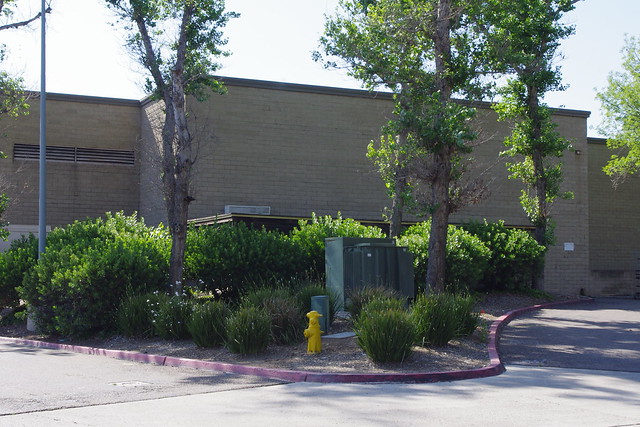
Photo Credit: Mine!
While venturing over to a rare colony of San Diego Coastal Cholla near Rancho San Diego, I couldn't resist taking these shots behind the Vons Store in the Rancho San Diego Village on Hwy 94 & Via Mercado south of El Cajon CA. After all I had to park here to be able to walk over to the Cholla colony. The Chaparral shrubs in this landscape behind the Vons are California Holly or Toyon (Heteromeles arbutifolia)  which are mature enough to produce winter berries and apparently reseeding themselves everywhere along with other Chaparral species of plants within this commercial complex's landscape. You might also take note that these trees are a hydrid cottonless Cottonwood variety from back east and they are struggling terribly. To be honest, many homeowners in general are incorporating native landscape plants in surrounding neighbourhoods as are other's into their commercial landscapes. Unfortunately, this should have been done decades ago. Originally this area caught my attention as I was driving through because of an adjacent large piece of still wild property along Hwy 94 which contains a massive colony of San Diego Coast Cholla (Cylindropuntia prolofera) which unfortunately is in one of those ever so gradually sloping properties along a major highway and ripe for development one day in the future. But the Chaparral plants were clearly fighting back with a vengeance as far as the vacant lot next to the Rancho San Diego Shopping Village was concerned. There are some simple reasons to the chaparral plant intrusion into this exotic landscape and the environmental reasons for the success should provide a valuable teaching lesson here.

Photo Credit: Mine!
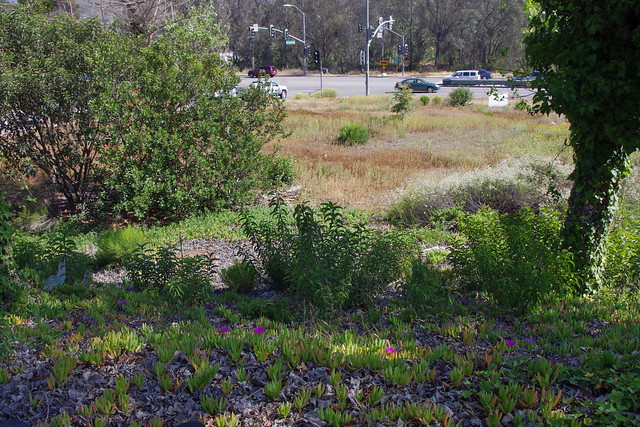
Laurel Sumac (Malosma Laurina) aggressively making inroads on the Sea Fig ice plant bank. Much larger more mature parent plants of both the Toyon & Laurel Sumac in the background are no doubt donating the necessary seed base for the reoccupation of former wild native plant habitat.
Photo Credit: Mine
Here is a side view of the bank next to the parking lot with the immediate volunteering of Laurel Sumac retaking it's former prime real estate. Though you may not see them, behind all of these are several California Holly (Toyons) also making an aggressive run on the exotic commercial landscape.
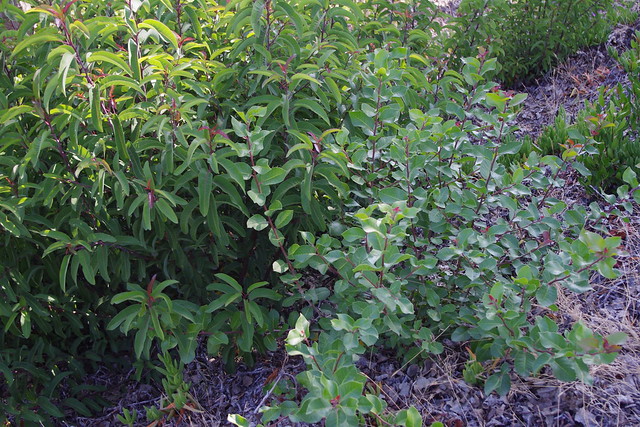
Photo Credit: Mine!
This scene was a pleasant surprise. Two cousins, Laurel Sumac on the left and Sugarbush (Rhus ovataon the right. I have never in my life seen them growing side by side in the wild. Not that they don't elsewhere, I've just never seen it. Generally Laurel Sumac is associated with the lower growing coastal sage scrub, while the Sugarbush is mostly inland and mixed with taller bulkier chaparral shrub species at higher elevations. Very kool! I guess they have to meet at the border of their terrains somewhere.
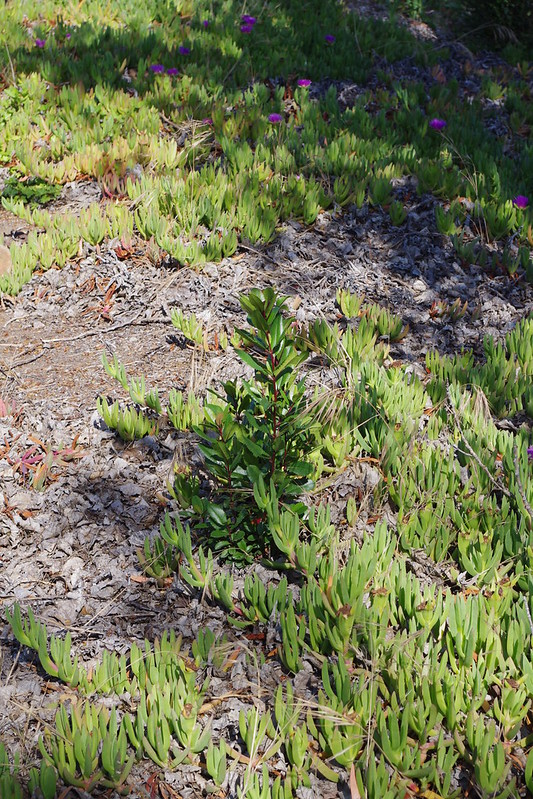
Photo Credit: Mine!
This is a young California Holly or Toyon (Heteromeles arbutifolia) seedling above appears to be in very healthy condition. It's beautiful and if the commerical property owners and their landscapers are smart, they'll leave it well enough alone. The main reason this Toyon sapling is gaining such a strong healthy looking foothold here is because water rates are outrageous in Southern California and as the drought lingers on will most likely increase water rates which will change irrigation habitats. Here the Sea Fig is incapable of choking out native plant competition. So the drought is actually helping the native plants to retake former lost territories. A smart landscaper will use that to hs advantag. Allow natives to grow, thin out some and sculpt the others in a natural artistic form to provide a pleasant nature landscape with will mostly be maintenance free and watering requirements to be greatly cutback.
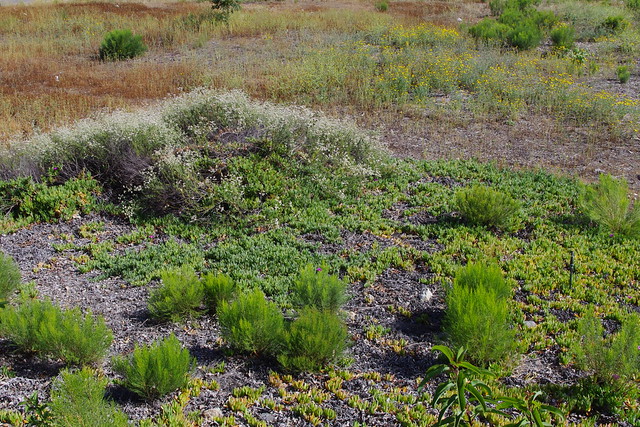
Photo Credit: Mine!

Photo mine May 2014  

Coronado Hills in San Marcos
California -
Cocos Fire
This is Coyote Broom or maybe Desert Broom both are able to make an aggressive come back and actually do well when humans disturb the wild sites. The little bright green shrubs sure are pretty are they not ? Here they are invading open patches of the non-native Sea Fig more often seen as a wild naturalized plant along the sea coast of commonly used on most all banks and hillsides of freeways and other commercial infrastructure. Generally Sea Fig in the landscape settings are more densely filled in, however because of the drought I believe this is why the Sea Fig is loosely thinned out which has allowed all these native to encrouch back into their former territories. Many call it Iceplant because of it's water storing succulent leaf design and structure. It has been used as a wildfire protection because of this water storing ability, but the reality is that it has given homeowners a false sense of security because it will burn ferociously, especially when it is decades old. This is because years of thatch have built up inderneath the top greener portions of the plant sprawl unseen to the average person. The photo on the right is from the (May 2014 Cocos Wildlfire in San Marcos) where numerous home were built on extremely steep hillsides on impossible accesses where the landscapes were planted with borders of Sea Fig in the illusion that this would be a good defensive border protection in case of wildfire. But finally, below is the main reason I came here. The parking lot scenaro was just an added benefit.

Image Mine - May 2013

Photo by James Gallagher, Sea and Sage Audubon
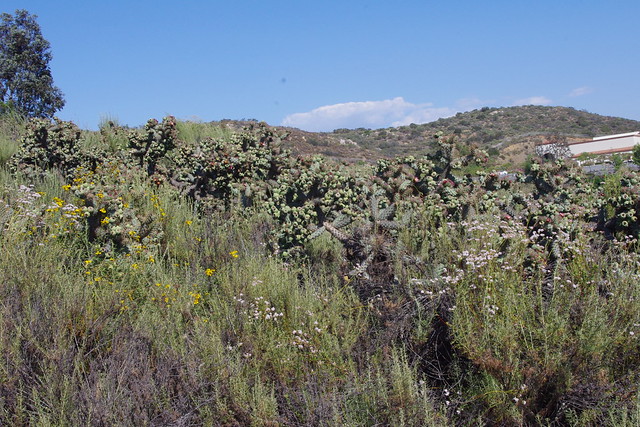
And here is the whole original reason I came to this parking lot in the first place. In search of documenting San Diego Coast Cholla colonies which are rapidly disappearing because of prime real estate development in and around all of the San Diego city & county areas. Interestingly, the Coast Cactus Wren like the one on the right have also become a rare sight as a result of habitat loss which must include cacti colonies. I did find one nest in the arms of one of the Cholla plants, but no birds. It may well have also been a Mourning Dove nest. But enjoy the Cholla post.
(Cylindropuntia prolifera) San Diego's Coastal Cholla Colonies Still Thriving on some Wildlife Islands within the city

Wednesday, April 18, 2012

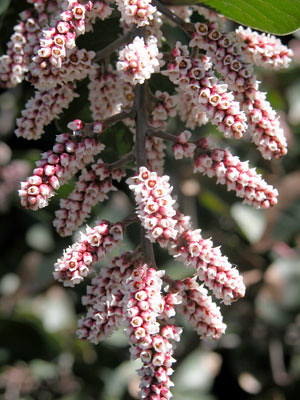
Sugar Sumac or Sugarbush (Rhus ovata)


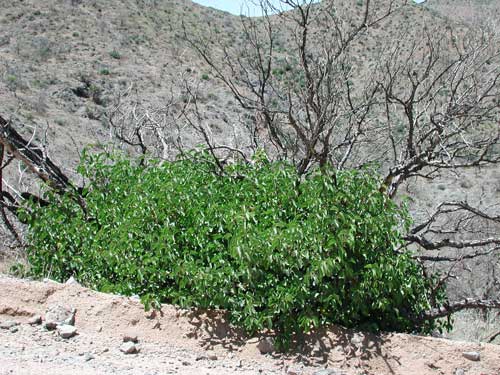
There are a number of views in the back-country towards the mountains and high deserts of southern California or even the mountains and high country of Arizona/New Mexico where you might see this often ignored and taken for granted beautiful chaparral community which when all other shrubs seem drought dormant and rangy looking, this one stands out as a rich shiny waxy green bush with taco shelled shaped leaves. Take a look at some common shots you may now recognize but have ignored in the past as you sped by down the road no doubt on your way to 'Party Hardy Marty' at 'Blow-Sand' in Ocotillo Wells, 'Glamis Sand Dunes' or onto 'Martinez Lake' at the Colorado River near Yuma, AZ

photos: Lee Dittman
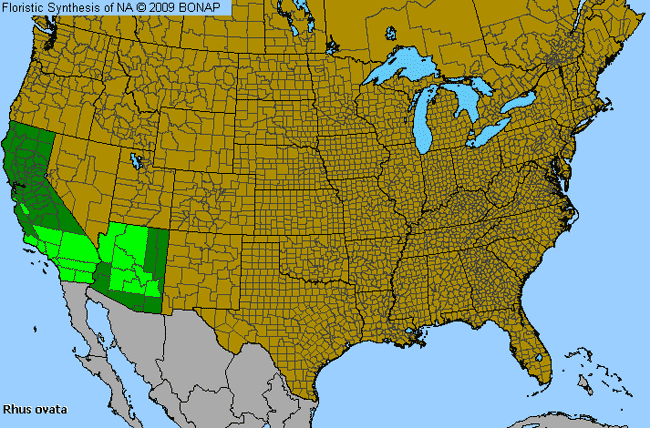
Here's it most common distribution


Like many natives, this one has interesting colours and ornamental value as far as variety of colours and growth as the year progresses. Here are what it looks like before bud break or bloom. 


Here it is in flowers which are finally in bloom.

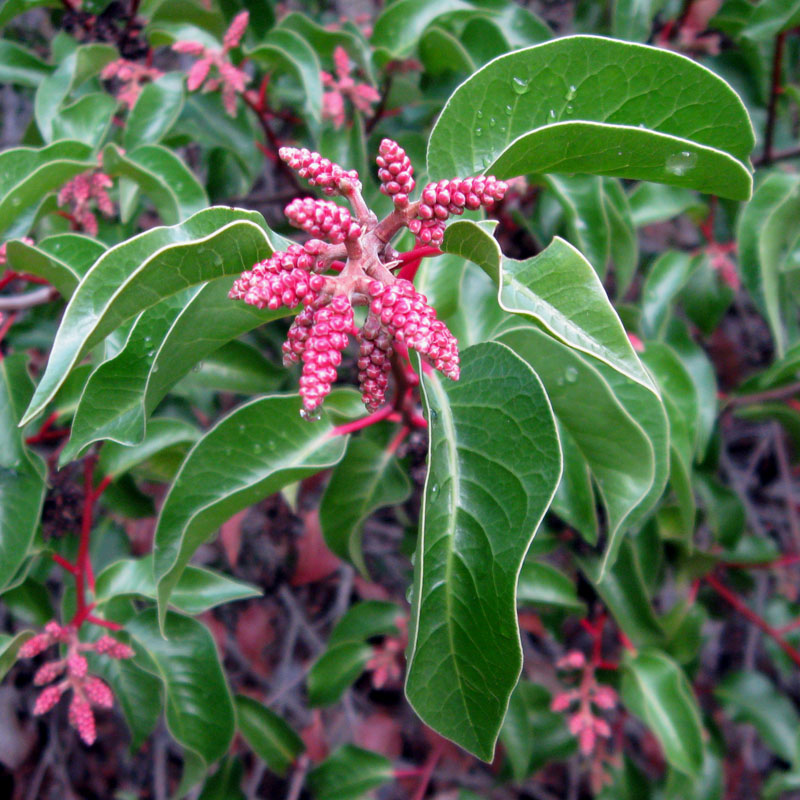
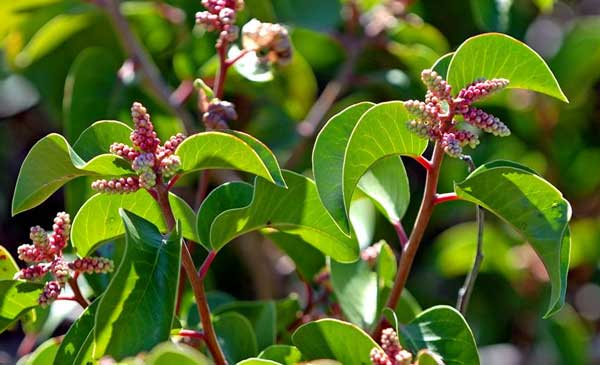
And finally here it is with fruits or seeds. For those familiar with it, it should remind you of  the  Lemonade Berry Seeds which is a related cousin.


As another one of those important qualities, this is yet another shrub that will spring back from a brush fire. Many non-native ornamental plantings will not do this. You have to go purchase more planting stock and that will take more than twice as long to rebuild what has been lost in the landscape.
Photo by mjplagens
So exactly what can a gardener/Landscaper do with a Sugar Sumac (Rhus ovata) ? First let's take the formal shrub replacement ideas. Here's what Tree of Life Nursery suggests.

EXCELLENT SUBSTITUTE FOR:
Ligustrum
Myoporum
Oleander
Photinia
Pittosporum
Raphiolepis
Xylosma


For the moment I'll just deal with Oleander Bush and reasons for Rhus ovata as it's replacement. In Southern California these were very common along the Interstates as landscaping screens and most often it was easily viewed in the median as an oncoming head lights barrier screen. Unfortunately something happened to them in the way of a slow death cause by some blight. This shrub and many other chaparral species should be considered a good replacement for other non-natives for just such a common utility function because once established and especially with a mycorrhizal grid intact, such plantings should become drought resistant or at least tolerant with less water if any at all becoming unnecessary. This of course changes with regards to location. In the deserts southwest in the USA, you most likely will have to deeply water at least once a month or possibly every two weeks depending on the location and circumstances. Even where I have seen it on the desert floor in a wash around Anza Borrego State Park, there was permanent water under the sand. Nevertheless it's an important planning point in view of the high cost of water and even it's future availability to the southwest. Many folks will want a formal look, maybe even having one as a specimen shrub or small tree and that's fine.

However my personal choice is creating more natural settings or themes out in the landscape.  Today there are numerous newer housing or Condo developments which through structuring smaller landscapes has given themselves far more profit than those homes built in the 1950s with the large lots for large family backyard designing. Hence many small yards won't take large trees. In some cases the yards are just to narrow. Over here in Europe, small tiny cramped backyards are common, but worse than that is having towering apartment buildings and nosey neighbours seeing your every move in the garden, absolutely no privacy. Even when I was a landscaper in Southern California some of our properties were Mobile Home Parks with very little room for larger trees and shrubs.

My next post will detail my experiences growing up in coastal chaparral country and how this unique world and exploring it's dry washes and stream beds  or climbing rock knoll outcroppings on hill tops with trees as a kid gave miniature woodlands of dwarfed chaparral me later on in life some insight on the landscape possibilities of the chaparral which has inspired in me with creative ideas on replicating some of the tiny hidden world environments for small spaces called "Elfin Forests" or "Pigmy forests".

Texas Madrone (Arbutus xalapensis)
Guadalupe Mountains
For a further take or perspective on Sugar Sumac or Sugarbush Rhus ovata and it's uses, please see the blog entry by Landscape Professional David Cristiani of Albuquerque's Quercus Group at 
http://desertedge.blogspot.se/2011/02/deceptively-lush.html


Tuesday, April 3, 2012

Try New Mexico Locust in a Tough to Grow Landscape

New Mexico Locust (Robinia neomexicana)


Photo by Utah State University
I have already written a much deeper piece on it's ecology in the wild environment, but it has practical applications in the home garden or landscape where you may be in an area with challenging situations. My first encounter was in Ruidoso, New Mexico where our family went to a reunion and rented Cabins. My son Jared was about 4 years old at the time. I was actually pretty excited to find this tree as I had only seen it referenced occasionally in my monthly subscription to Arizona Highways magazine.It was a fun time because believe it or not it was 'monsoon season' for the southwest which is my favourite time of year when tropical moisture from Mexico works it's way north and creates those electrical billowing cloud thunderstorms you see across the wide open spaces. My son was excited and constantly pointing out all the Thunderstorm electrical flashes by saying to his cousin,  "Hey Rebecca, did you see that YightYing" He was only four years old and couldn't pronounce his "L"s. 
Needless to say I dug up a small inch high seedling which in actuality wasn't so much a seedling from seed as it was a tiny clone I cut out of some taller parent tree's rhizomatous root system. Yes they have a nasty habit of spreading underground and popping up with clones even 30' away from my own experience. Yet there is something kool about them. They look like they need to be kept in a lush environment, but can actually do well and be kept in check by an arid environment that is hot and dry. This was in summer of 1992 I believe and I'm thinking we drove over with my sister-in-law and her two kids. I remember because they were all including my wife bugged at me for pulling off and stopping at all these place I'd read in Marshall Timble's "Arizona Roadside History" & "Arizona Place Names". 
Whatever! 
 Anyway, I planted this tree in among some of the bush-like small trees native to our area called Redshank or Ribbonwood (Adenostoma sparsifolium) which I had thinned out as they tend to grow in dense stands. I found the right spot and almost immediately this little 4" high tree began taking off. So much so that it grew over 6 feet in height the rest of that year. Suddenly I wondered what I had gotten myself into, especially the following year when it spread and suckered producing more tree clones of itself. But it never really did get out of hand. I did maintain several trees in the area as that was actually my intention, but the vigorousness of the thing was a bit spooky at first. It has never grown taller than I'd say 12 or 15 feet as of last checking. I don't live there anymore but my wife and I flew back over there last year from Sweden to visit and we stopped by the place. Here is what it looks like today.


Photo by Kevin Franck
In the above photo, look to the left and up. In the foreground below this is a native Sugarbush (Rhus ovata) which is another one of those interesting almost maintenance free shrubs that takes care of itself once established. 

photo by Native Rival Nursery
 Next, once again, look to the left of the photograph and you'll get a better look of the original tree I planted along with a few of it's clones in the background.


Photo by Kevin Franck
If you knew the type of dry rocky decomposed granite soil that it's in and realized it doesn't get any water other than winter rainy season and maybe perhaps some summer monsoonal moisture now and again, then you'll appreciate what such trees can be a valuable addition to any landscape with similar challenging soil conditions. They also spread along the mycorrhizal networks under the ground connecting up to different species from their own like the Jeffrey, Coulter and Aleppo pines you see in the photo. In that scene below with the square rock wall layout is where I built up on a gradual slope a flat garden area with concrete mortar and granite river rock. The actually garden soil I trucked up from below. Seriously for gardens up there on that hill you need a lot of amendment if you want vegetables.
For a further deeper read on New Mexico Locust (Robinia neomexicana) please see my "Earth's Internet & Natural Networking"

Networking With New Mexico Locust