Showing posts with label History. Show all posts

Sunday, December 23, 2012

Santa Rosa Mountain Above Palm Springs: Part I - "Spring Crest"

Image from Press Enterprise
Press Enterprise: BACK IN THE DAY: Ribbonwood was popular rest stop

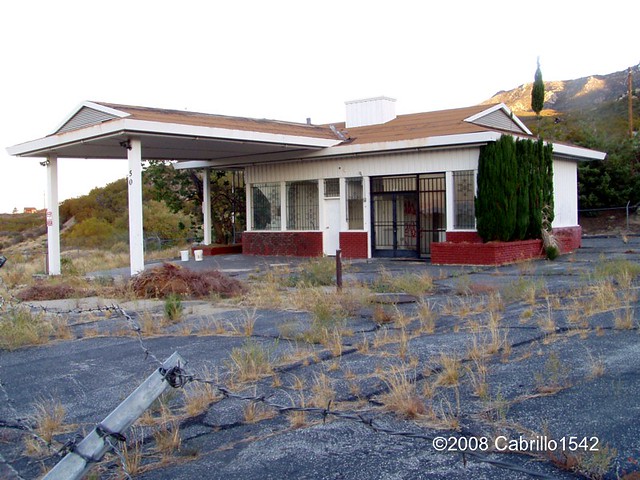
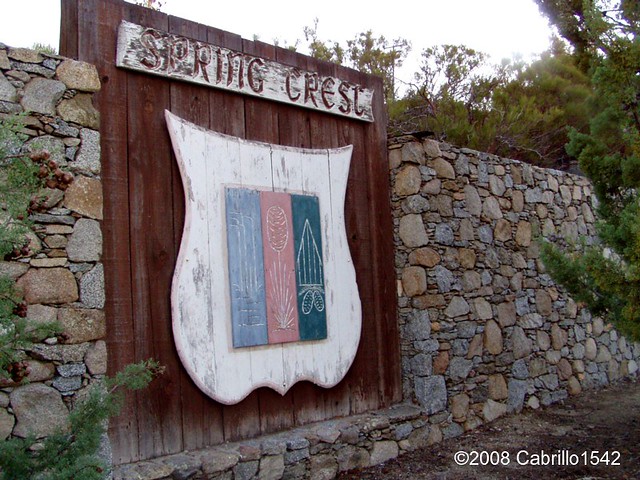
Well that photograph above isn't exactly what people think of when they picture the housing development along Hwy 74 (Palms to Pines Highway) on Santa Rosa Mountain which is more commonly known as Spring Crest. You'll notice of course in the photograph to the right, that the location (which is exactly Spring Crest) was at one time called "Ribbonwood".  Of course that would certainly explain the crossroads sign as located near the old abandoned Gas Station which hasn't been used in decades. 


Oct 2008 - Cabrillo1543
More commonly people are more familiar with the old abandoned Gas Station that hasn't operated in several decades. Take a look below at what most people see when they drive past modern day Spring Crest. Of course several famous folks have had private homes here. Red Skelton had two of them, though I'm not sure if his wife Lothian has them. One was an A-frame house on the top street overlooking this station and another is at the end of the cul-de-sac (deadend street) which is the first street on the right after passing this station. It was always a larger house and sort of a mini ranch home. They never truly lived there, but preferred the modest A-Frame house. Although they purchased that large 660 acre horse ranch in Burnt Valley and I believe this is where Lothian resides now, but I could be wrong. 


Cabrillo1542
Hwy 74 passes right by Spring Crest and it was here that the above photo locates what was originally called Ribbonwood. Highway 74 is part of that "Palms to Pines Scenic Highway" that was built between 1929 and 1932, finally opening in 1932. As with most of the early highways back then, many entrepreneurs seeking to create business along the highway built little roadside gimmicks to get people to stop and purchase any souvenirs or services before heading on down the road. The roadstop station along the Palms to Pines hwy 73 called Ribbonwood was founded by Wilson Howell. It was a sort of early primitive rest stop for tired travelers who I am sure were ragged after enduring the early rough road conditions back in those days.

Rancho Fruit Market in Temecula


Image from Foursquare
This is probably one of the earliest roadside Fruit stands which much much later became very up until this very day. Hmmm, somewhere at the end of this road with a detour left turn at Paradise Corners to Anza and beyond, there use to be the well known stop called Rancho Fruit Market in the Temecula area right on Hwy 79. It has now moved to old town Temecula after a fire and redevelopment of the land it was once on. But Wilson's place was also another place where one could buy fruits and  vegetables, enjoy a cold drink under an old Ramada (probably made of Redshank) or even rent a Cabin or Kamp spot for the night. Maybe even the weekend. Notice the skyline in the background of Santa Rosa Mountain ?

I found another bit of history that I had read many years back and now it has even been more recently updated. I think readers will find it both sad yet interesting at the same time. In 1959 there was a mystery of sorts surrounding the disappearance of a young woman named Louise Teagarden. She was an outdoors person and friend to even Wilson Howell at the Ribbonwood Camp where she learned much of her outback survival skills. Yet strangely enough on this one occasion, she lived for a couple of months in the wilderness before dying. Her remains were not found until 1991 in a cave in the Palm Canyon Drainage area of which the Spring Crest area (Ribbonwood) on Santa Rosa Mountain is very much a part of the upper headwaters. The Sierra Club actually published an interesting story about Louise Teagarden, who was very experienced as having  outdoors survival skills and yet she mysteriously died. Rather than tell the story over, you may read it for yourself here. 
Sierra Club: "Lost and Found" - Louise Teagarden's Death Still a Mystery
For those a bit more on the impatient side (you really should read it though), there was also a video of the recent 2008 search made for that very cave where she was found. It's only about ten minutes. Writer Ann Japenga, Harry Quinn & Theresa Pawley are making an attempt in the video to locate the actual cave where Lousie Teagarden's remains were found over 30 years later. Very interesting and informative video.


Image - SummitPost.org
Hope everyone enjoyed a bit of forgotten history about this Spring Crest area of the Santa Rosa Mountains. On a very special note, I want everyone to know that when I come back for a visit next year, there is a place almost exactly halfway between that Spring Crest Gas Station and the entrance of Santa Rosa Indian Reservation which has a single sentinel Jeffrey Pine tree right next to the road on the side where travelers would be heading east towards Spring Crest. Not far from the Santa Rosa Truck Trail Forestry road actually. You can find it here on  Google Maps . This of course would be the south side of the Highway 74. Incredibly, on this same Google link, you can click on Satellite tab and zoom in as close as possible at the junction of Hwy 74 & Santa Rosa Truck Trail. proceed west and then just around the bend and down a short grade you'll see this Jeffrey Pine tree over on the left side of the highway. 

After 24 years of traveling this highway back and forth to work, I always passed this single lone beautiful tree and wondered about it. Where did it come from and why is it here of all places miles from any other group of Jeffrey Pines ? This isn't the first time I wondered about how and where certain species of out of place species of trees came from. Hwy 74 west of Mountain Center was another example, which I have previously alluded to in in an earlier post of my discovery of the road construction of Hwy 74 which completely & very deliberately diverted an entire stream (almost a small river) by means of a bulldozer and cutting a path towards the South Fork of the San Jacinto River Canyon. The result is an entire mountainside washed & fell away in a landslide at that canyon with no real possible way of repairing it. And amazingly no one noticed or at least has admitted this. More on this after I actually go out and photograph this area next summer. Incredibly, some extensive Chaparral removal has been conducted around this tree and on up the hillside. Some things never change.

Wikipedia

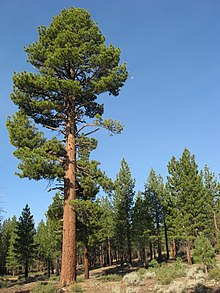
Example of Jeffrey Pine. Much
larger than the stunted Hwy 74
lone pine tree, but from where
did the original seed come from ?
But what I found around the hills and dry washes around this tree and other canyons north of Hwy 74 in the Palm Canyon drainage were several large (actually huge) Jeffrey Pine stumps and the reason for their continued forensic existence. They still existed because they are completely charred by some historical forest fire which burned who knows when. But traveling back and forth on this road and seeing the rugged chaparral all around, one would never in a million years guess such large pines once existed here. Even as I stood there looking at these as I found them, I was still blown away. I have long suspected that forests were more extensive  and existed further on down the mountain at lower elevations, especially several hundred years back when ancient Lake Cahuilla once exited. Who knows, maybe the climate was more moderate back then. I have wondered and even imagined that more than just the Colorado river contributed to the maintenance of ancient Lake Cahuilla. Wondered whether the White Water River was bigger and greater than it is now. Did Palm Canyon Creek, Tahquitz Creek Canyon and Deep Canyon (Horsethief Creek) water courses also contribute to Lake Cahuilla ? Ultimately I don't now, but I'm still intrigued about the ancient possibilities. 

Tomorrow I'll have Part II which will focus attention on the switched back logging road you can easily view from Sugar Loaf Mountain Cafe. I'll tell you about the man who built that road and the conversation we had on why he was contracted to build it. Much of of the story he told sounded like forestry politics as usual. 

~~~~~~~~~~~~~~~~~~~~~~~~~~~~~~~~~~~~~~~~~~~~
Of Further Reading Interest:
http://www.palmspringslife.com/santarosa/
http://www.annjapenga.com/Images/articles/wHwy74.pdf
http://www.riversidecountyhistory.org/SJM.htm
http://www.santarosacahuilla-nsn.gov/home.htm
http://www.annjapenga.com/Images/articles/wLostandFound.pdf

Thursday, November 22, 2012

Roast Turkey, Pumpkin Pie and Other Thanksgiving Traditons I Rejected back in the Late 1960s

This is merely a commentary on a personal decision I made back in 1969 after reviewing some historical truths about the American traditional holiday which had always been a time of warmth and fond memories. This is also not a judgement on others who choose to celebrate. Frankly it's none of my business what others do or don't do. But if you actually study it's origins it is an eye opening revelation of information tutitorial of sorts and something I was reminded of after reading a piece this morning from Allen Juell's blog "Horsetronics"  
'Thanksgiving....no, let's rephrase that.......'

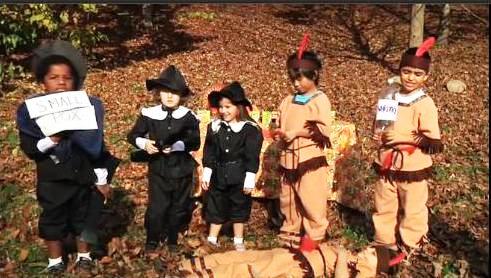
Kids Reenacting the First Thanksgiving

Of course if you look at the theme photo above, growing up this was the common story theme I experienced at Pepper Drive Elementary School as to the history of the Thanksgiving Celebration. Never once was there any admission or revealing of the truth that mattered that ultimately followed this neighbourly dinner event between different cultures. Of course as the official historical narrative tell us, the first Pilgrims to arrive in New Plymouth and conclude a mutual peace agreement treaty with Chief Massasoit, the paramount chief of the local Wampanoag Indian tribe. In the treaty the Pilgrims and the Wampanoag promised not to harm one another, and they formed a mutual alliance for each others protection in case of war with outsiders. Without Chief Massasoit’s friendship, it is highly unlikely that any of the Pilgrims would have survived. These Indians (Native Americans) gave the first settlers native corn to eat and to plant, and the alliance with them helped to prevent the Pilgrims’ perishing at the hands of other tribes.

In the early days, the colonists received much help from the Indians. In the words of then Governor William Bradford, an Indian named Tisquantum taught the colonists:
 “how to set their corne, wher to take fish, and to procure other comodities, and was also their pilott to bring them to unknowne places for their profitt.” 
(the spelling as in original document - American Colonial Prose: John Smith to Thomas Jefferson (1607 - 1865) by Mary Ann Radzinowicz 

The first harvest of Indian corn was good, and the Pilgrims had success in hunting game birds. They (Puritans) were grateful to their God and decided to hold a three-day harvest festival. Massasoit and 90 of his braves came, bringing along five deer to add to the banquet. This is the most common historical version and this part is true. Unfortunately, these previously persecuted Pilgrims (Puritans) from Europe had mistakenly believed that it was their God had given destiny and God-given right to take over and occupy these lands in this New World. This same justification of course was played out over the next few centuries by Europeans seeking fame, fortune and looking to provide ligitmacy of the most horrific actions taken against other human beings during the height of Imperial Colonialism across the planet. Even Darwin provided a twisted version of scientific justification behind the white European foreign land aquisition and occuptation. Seems there is enough inconvenient truth to go around for both sides.

Like the colony itself, the celebration had strong religious overtones. Although the Pilgrims did not hold the festival the next year because of poor crops, Thanksgiving Day later became an annual national and religious holiday in the United States, Canada, and a few other countries. Today, Thanksgiving Day in North America is typically an occasion for a family banquet of turkey, potaties and gravy, cranberry sauce, and pumpkin pie, but in principle, it remains “a time for serious religious thinking, church services, and prayer.”The World Book Encyclopedia, 1994. Interestingly, Thanksgiving is actually rooted in ancient pagan (not Christian) harvest celebrations that honored various gods. Over time, “these ancient folk traditions were taken over by the Christian church.”​ >>> says, "A Great and Godly Adventure​—The Pilgrims and the Myth of the First Thanksgiving.
(see also: An American Thanksgiving)
The Granger Collection, New York
For me however, probably the most shocking thing was what happened to these very same Native American Indians who participated in that original iconic feast and to their descendants some years later. The artwork to the right here is of Chief Metacom, (c. 1638 - 1676), sachem of the Wampanoag people in a coloured engraving by Paul Revere, 1772. This next link is from the Encyclopedia Britannica and is the historical account of what took place between Chief Massasoit's second eldest son and the white colonialists. 
(Source material below)
 Encyclopedia Britannica: Facts Matters = Metacom
Metacom, also called Metacomet, King Philip, or Philip of Pokanoket (born c. 1638, Massachusetts - died August 12, 1676, Rhode Island), sachem (intertribal leader) of a confederation of indigenous peoples that included the Wampanoag and Narraganset. Metacom led one of the most costly wars of resistance in New England history, known as King Philip's War (1675 - 1676).  
Metacom was the second eldest son of Massasoit, a Wampansoag sachem who had managed to keep peace with English colonizers of Massachusetts and Rhode Island for many decades. Upon Massasoit's death (1661) and that of his eldest son Wamsutta (English name Alexander), the following year, Metacom became sachem. He succeeded to the position during a period characterized by increasing exchanges of Indian land for English guns, ammunition, liquor, and blankets. He recognized that these sales threatened indigenous sovereignty and was further disconcerted by the humiliations to which he and his people were continually subjected by the colonizers. He was, for example, summoned to Taunton in 1671 and required to sign a new peace agreement that included the surrender of Indian guns. 
 Metacom's dignity and steadfastness both impressed and frightened the settlers, who eventually demonized him as a menace that could not be controlled. For 13 years he kept the region's towns and villages on edge with fear of an Indian uprising. Finally, in June 1675, violence erupted when three Wampanoag warriors were executed by Plymouth authorities for the murder of John Sassamon, a tribal informer. Metacom's coalition, comprising the Wampanoag, Narraganset, Aenaki, Nipmuck, and Mohawk, was at first victorious. However, after a year of savage fighting during which some 3,000 Indians and 600 colonists were killed, food became scarce, and the indigenous alliance began to disintegrate. Seeing that defeat was imminent, Metacom returned to his ancestral home at Mount Hope, where he was betrayed by an informer and killed in a final battle. He was beheaded and quartered and his head displayed on a pole for 25 years at Plymouth.
Norman Rockwell Painting of Family Thanksgiving


Photo: Eugene Bochkarev/123RF
Who could pass up family get-togethers with all that other great food that goes along with the main course of Roast Turkey ? Pumpkin Pie, Mashed Potatoes and Gravy, Stuffing, Cranberry Sauce, Green Beans, sweet corn and whatever endless list of food goodies the woman folk can think up. I actually love all those things during any time of the colder winter months. I'm not against any of those foods, trust me. I simply don't do them on that particular day for the principle of the thing. When I was a kid growing up, I always thought this holiday should be renamed "Men's Day" !!! Seriously, think for a moment, is there really ever a more perfect day for men in the world than this day in America ? Is this day not truly the real, "Father's Day." Most of the women get up very early in the morning (maybe 4:00am) and slave all day long over a hot stove and oven. Men on the other hand basically sit on their butts the entire day, drink lots of beer, watch three NFL Football Games and then finally as the ultimate insult at the end of that day there is an announcement that  Dinner is served and they then proceed to practically gorge themselves into a coma. So much for spiritual reflection and the giving of thanks to the good Lord.

Image . Landon Nordeman
Now once again, I have no problem with others doing what they wish and the reasons why on this particular day. Ultimately it is none of my business what other folks do, but my choice is a conscience matter. So normally during this time of year I basically leave well enough alone. I do definitely enjoy that food combo at other times throughout the cold winter months. Can we all agree there is no other better food combo during Winter ? Well, with the exception of Mexican food through out the rest of the year. Mexican familes are known for family get-togethers anytime of the year and that works better for me. I get together with family and friends regularly and not just one or two special days of the year. I'm thankful every day for the positives in life now and what will be, despite the negativity brought to us by this world's Media News Reports - 24/7. On a positive note, I do have something to say about Cranberries & Lingonberries and the identical environment and ecosystem from which both came from. I've also other things to say about the Native Americans way of life which first interested me as far as our natural world and living off the land. My facination with Native Plants of the Southwest can be attributed to learning much about how the indigenous peoples used them. But in so many ways (mostly negative), the early Americans were identical to those explorer Europeans in their treatment of one another. I am well aware of this romanticized notion of the Natives as being the ultimate in conservation and land stewardship, but there is actually more to that story which has been generally exaggerated and embellished by many environmental organizations who have found the Native Americans as nothing more than a useful tool in furthering their political and worldview agendas on the rest of mankind. Again, no offense, but that's just the way our world works and always has.
Stay tuned! Here's another Myth I'm not overly fond of - Fire Ecology!
Dances With Myths: Indigenous Native Peoples and Fire Ecology