Tuesday, September 18, 2012

Woodland Berries in Swedish Forests & Gardens

Just when I thought there were no berries this year, I find exceptions to the rule. While the common traditional ones for human consumption were scare this year with a terrible No Show Summer which was mostly rained out (and is continuing to the present), there were some surprises today.

Photo: Mine
Viburnum opulus  Woodland Shrub-like tree. Common name examples  Olvon (Swedish) - Guelder-rose (Dutch) - European Cranberry (British) 
Olvon Bär - Viburnum opulus
This shrub-like tree which I've never seen more than six or seven foot tall here with multiple suckering or spreading clones forming small thickets near my Trolley stop has always been an eye catcher not only this time of year with fruit, but even in spring when in flowers. It's foliage is beautiful and somewhat Maple-like in shape and appearance. I tasted it last year and this year, but it's a bit tart and sour. I didn't die so it's not poisonous. Apparently here it is used for flavouring and some make jelly from it. It is spread by bird usage as food source. I definitely want to collect some berries and propagate, but more likely will get some root cuttings and make some clones which will be faster in spreading it. It would be a perfect background plant along my back fence.


European Elderberry Tree along the
Önskevädersgatan Trolley Stop


This is one of those more familiar trees to many people. These clusters to the left in the photo were not quite ripe. People here are crazy about the Elderberry juice(Saft) here, the Elderberry Jelly or Jam(Sylt) and just general fresh eating of these berry clusters. I never experienced this in all my years of growing up in Southern California where Mexican Elderberry is everywhere and very productive. A drink is also made from the flowers in springtime. This tree is found in the wild everywhere here where the the forest opens up along the fringes of meadows.

Photo by Gabi Mclean

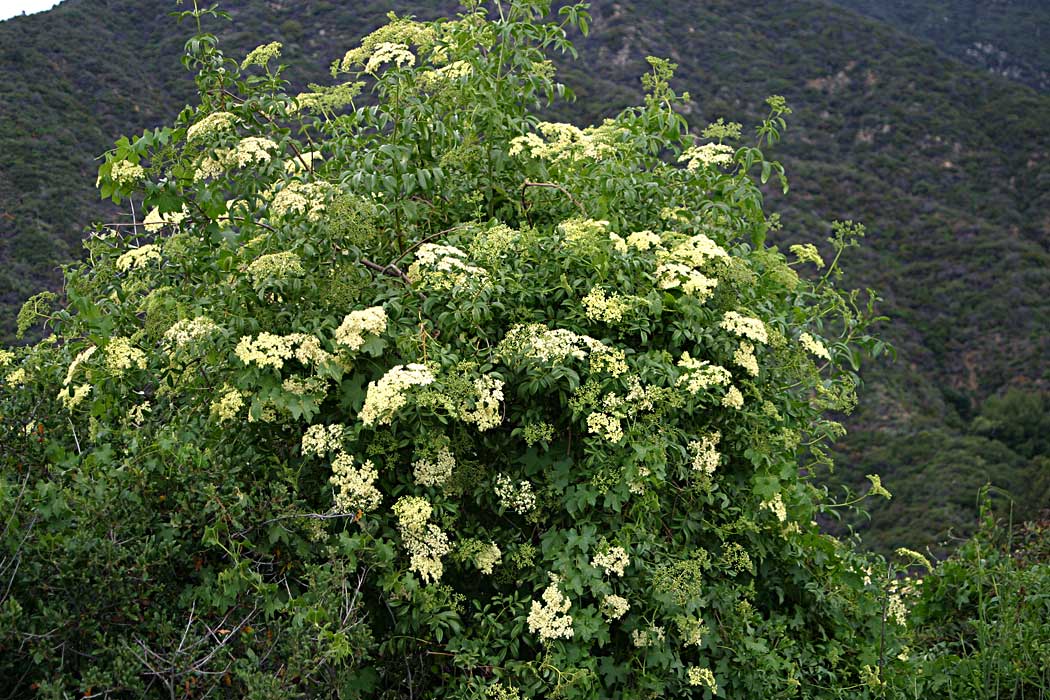
Mexican Elderberry (Sambacus mexicana)

by Gabi McLean
The folks in Southern California pay no attention to the varieties of Elderberry which are native there. Yet I know they see it almost everywhere. But development has taken a bit of a toll. The above picture shows it in association with chaparral. I use to spot it looking for Native American Village sites in San Diego Co. That and Prickly Pear Cactus were a give away as no doubt much of both these plant's abundance was no doubt the result of spread by humans. Both plants most always will be found around Metate grinding holes in granite slab rocks. I have always found the fruit productivity of both the Mexican and European Elderberry to be very much equal. In fact I believe the Mexican Elderberry to be more productive as a result of being out in the open as opposed to many here which are shaped more leggy by forest competition for light. Didn't mean to veer off track here, but I'm determined to get people to know what gems there are in the southwest for their garden. (* See Footnote Bottom of page)

Photo: Mine
I have to admit I'm not sure what this small tree in the woods is, but there were two separate ones which every year have different coloured berries as seen below.


Notice the difference in colour, 
Every year has been the same.


Northern European Hawthorn Tree

Hawthorn
Many will recognize this plant. There are many native varieties to North America and Europe. It is often used to make Hedgerows which bloom white flowers in spring and these deep red berries in fall. Incredibly it is a well known plant used by Herbalists who create a gentle heart tonic that can nurture a person's entire circulatory system. There are countless other uses with this particular plant. It is said for someone with heart trouble, that a ounce of Hawthorn is worth a pound of cure. It's incredible how much knowledge about these wonderful plants has been gained over the centuries and at the same time lost as people put their confidence and trust into some of the very technology which is causing the Earth so many health problem issues. There is a Vietnamese store here which sells many Asian food stuffs here in Gothenburg. One of my flavourites is a fruit leather made of Hawthorn berries.

Honeysuckle Flowers Still Blooming


Honeysuckle vine loaded with Berries

Honeysuckle Berries
These bottom flowers were at a neighbour's place where we live and the top one further on down in another development's gardens. The further on down plant was mostly loaded with berries while the other plant was mostly flowers with no berries. These are another one of those edible flowers and berry plants. The berries taste exactly like the flowers if you've ever plucked one and pulled on the stem to reveal the sweet drop of nectar. As an interesting aside educational point, the Audubon Society article posted some research about how an invasive honeysuckle has changed the colour of bird feathers who feed on these wonderful berries. It has helped us to understand the importance of diet and how great variety in various creatures worldwide is accomplished by epigenetic mechanisms as opposed to long help belief in dumb luck and random mutations in creating species variety.
Audubon: "Mystery Solved: Invasive Berries to Blame for Turning Flickers’ Feathers Pink"

Photo: Mine

I don't really know what this shrub is but it is used as an Ornamental in the commercial landscapes here. This is at the Eketregatan  (Oak Tree Drive) Trolley Stop. I once saw a young lady in a hurry to catch a Bus and she stopped long enough to pick a cluster of these and put one in her mouth. That caught my attention so I did the same and they weren't bad. Now she wasn't exactly Swedish and I find many immigrants will eat the berries here. Near my house in the forest you'll see African Immigrant kids playing with Swedish kids and showing them what Bush foods are safe to eat and what are not. Leave to Africans to know their Bush foods, even in another country. *smile*

Cottoneaster Plant showing off it's Berries
I know this was a berry themed page but I have to show off some beautiful flowers that are blooming with a vengeance despite the lousy weather over here. I couldn't pass these up.
Photo: Mine


Photo: Mine

Healthy example of a Jackdaw
These last two shots are of a Magpie and a Jackdaw birds. Both of these birds were much smaller than normal larger specimens of their respective breeds. They both looked undernourished somehow and feather color not the brightest and sharpest I've ever seen. But they stuck together like friends helping one another scratch the ground and find food. Both bird groups have fairly large plump well fed looking members within their clans.

Both kept close together and followed one another around, almost touching one another. The pictures really don't do the behavior justice. I really needed a film as this was odd and yet entertaining. I felt sorry for them in a way because no doubt they may had been rejected by their own kind, but they found one another for companionship who had what appeared to be the same similar circumstances. Many animal species will have a cooperative behaviour at times for survival. Especially in things such as hunting and gathering food where each one has a unique set of skills the other lacks. Perhaps this is what was going on here. In any event, I wished I had had at the time a video camera to capture and document this spectacle.


Photo: Mine

Neither picture really does justice for what I saw and observed. In fact when I stopped at first having their togetherness presence catch my eye, neither were really afraid of me. They were only 3 feet away going about their business. I just came back from Grocery shopping walking back from the Trolley on a pathway and had to take my camera out again. By that time they moved on. On a last minute note here for western Gardeners. I've got to go back to the Mexican Elderberry as a great landscape and wildlife plant, even IF you don't want to eat them. Here's an example of a great southwestern styled landscape where the Mexican Elderberry fits in nicely.
* Footnote from top
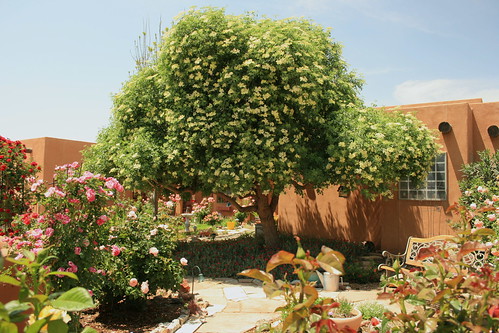
Photo from Dave's Gardens
The normally shrubby to the ground tree can be nicely shaped into a small tree with typical umbrella style pattern. Not bad for a Native Organic Garden or Landscape Theme.

Wednesday, September 12, 2012

It's That Yellow Season Time of Year With a few Sweet Surprises


Rabbitbrush - US Forest Service


I started to notice things around here the other day in the way of colour out in the wilds and also in people's yards that reminded me of home. Well, not in San Diego, but up in the San Jacinto Mountains. It's when the predominant colour in nature that stands out in striking contrast to everything else is yellow. The high desert plants like Golden Rabbit Brush which contrast beautifully with the silver Sagebrush habitat surrounding them. Rabbit Brush always liked the drier locations around chaparral communities.

Golden Rod by Joe Lampl
The native Golden Rod around the San Jacinto Mountains was always in association with wetter meadows of Garner Valley where you'd see it around the fringes or up along the stream banks of Hamilton Creek within the Burnt Valley area of Anza. It's always making an appearance some time around late August on through September and October.

BOX ELDER in Fall colour by cnpsci.org
The other outstanding yellow was mostly a multitrunked shrubby looking tree called by the common name like Box Elder (Acer negundo californicum) which has a beautiful striking fall colour of rich golden orange-yellow. Best places to look for this were at the Jct of Hwy 74 &  Spring Crest Drive (Red Skelton's old residence) looking up at the location of the Spring where the water tanks are located for serving this community. Driving up Morris Ranch Road to Trails End from Hwy 74 from Garner Valley and along the right hand side down in the creek bottom is loaded with Box Elder. Also driving down Bautista Canyon from Anza to Hemet CA.
But yesterday I took photos of the Swedish version of the Yellow Season. Every September 1st here is like someone closed a door and opening another one and that is almost exactly how the weather turns here. Autumn starts way earlier here than over in California where I originate. Cooler, often times colder weather sets in with windy days, like yesterday when I took the photos. It's a sort of sad time of year because for me the winter seems the most dominant season. Okay, well first off there was a giant stand of the Swedish native example of Golden Rod which appears every year in my neighbour's backyard.

Golden Rod view from my Dining Room Window


Photo: Mine
I thought this was a Bee at first until closer inspection reveals a Fly (eine Fliege). Most of the insects are out getting their last gaps of life and liquid nectar before it all withers away.

Photo: Mine
This flower bed was at the corner of a friend's apartment house. Though this is the season of deep golden mustard yellows, there are a number of other colours that actually hang on and truly look like they are in their prime. Many will recognize this Sedum which grows terrific here all year before dying to the ground only to spring back every year. Then there were other surprises like this series of Nightshade photos of both the berries and flowers which made up a rather large and long Hedge Row.

Photo: Mine
This rather large hedge had been hacked and trimmed I presume by the landscapers, but they left these three beautiful objects which caught my sight. And I wasn't even looking for them. So I couldn't resist taking the shots.
There were other out off topic surprises which caught my eye and here they are. This first one looks to be a green coloured coneflower of Echinacea fame or perhaps some type of Gaillardia  or Blanket Flower and the other being Rose hips from a wild woodland rose I pass by on way to the Trolley Stop.

Photo: Mine


Wild Woodland Rose Hips

I have several other shots, but I want to retake them as it was super windy and poured rain not long after that. Typical !!! I'll post them here sometime later this week. Thanks for stopping.


Wednesday, September 5, 2012

New Playground Behind Our Home


New Playground at the end of the Lake

My wife and I were taking a walk around the lake behind our home. It's been some months since springtime when I was last there and surprise surprise. This end of the lake is most popular with families and sometimes they have summer concerts there. Of course the cultural origin of the music is mostly immigrant. 


Photo: Mine
Newer boat dock replaces the old rotten one that was there and the wooden deck in the background along the shoreline with steps and lakeside seats is a new addition which wasn't there previously.


The New Playground. Let's hope it lasts


A common site not mentioned 
in the Tourist brochures
I know I know, it sounds negative. But Sweden has a terrible delinquent problem with it's boredom plagued young people and destruction or vandalism of public Bus or Trolley Stop property.  Not exactly the picture an outsider has of Scandinavia is it ? Or for that matter something the Authorities will admit takes place at all.  Don't you love Tourist Brochures ????????  *smile*


Photo: Mine

We had similar giant log climbing pieces in parks in Southern California. The difference being the absence of mosses and lichens on ours. 


Photo: Mine
Notice in the background a little foot trail with climbing ropes for little kids. It doesn't go to far. Just a small loop.


Photo: Mine
These Swings were really kool. Not exactly created and restricted to little kids. Even adults could enjoy these Swings. Sorry for the sideways image, but they were not that way originally. Below here is an important warning however on this new rubberized matting which apparently has some health issues:
New Study – Many carcinogens found in Yale analysis of crumb rubber infill and playground mulch surfacing 


Bar-B-Q pit
Another nice feature added was an improved picnic area for families who want to Bar-B-Q. The climate here is not exactly conducive to grilling weather and outings, but people still do it. When I go out and Bar-B-Q, I used the usual pine to get it started, but then I go into the woods and cuts some small wild apple tree branches which of course are still damp and create a lot of smoke to add flavour to the meat being slowly cooked over  the slow burning coals. Not many know of Applewood's wonderful qualities when it comes to flavour. Most people here know only fast grilling.


Picnic Area in the background near the lake.


Photos: Mine

The two top photos are examples of islands created out in the middle of this rather long lake. In Springtime this place is crazy with all manner of bird species like Ducks, Geese, Coots, Sea Gulls and other Sea Birds that fly inland away from the sea water coastal areas to nest in shallow freshwater lakes and marshes of which there are literally millions here.