Showing posts with label traditions. Show all posts

Thursday, September 5, 2013

Traditional Swedish Fences

(The Old versus the New in fences)
NM Gärdesgård (Fence)

http://www.nmgardesgard.se/

I'm not a fan of many things in this part of the Earth. I hate the cold [not even a fan of cold in California when it visits], hate the dense overgrown weedy green everywhere[I'm a Desert Rat @ Heart], the Mosquitos are hideous when you go for walks in the woods[never going blueberry picking again] and I've never seen so much wet in my life.[Desert thingy again] and last but not least, Northern European food[I lean towards Mexican]. But once in a while I warm up so to speak to something that does capture my attention and that is the traditional Swedish fences or Gärdesgård. I like things older and traditional. Though the modern culture here has lost most of it's traditional values when it comes to the traditional artistic styling and architectural design to the modern Socialist influenced generic Soviet Styling of everything having to be equal. But some things never change, like the traditional country fences which can often be seen just outside of the cities in suburbs. Click on the link above under the photo which takes you to the site of N.M. Gärdesgård which is also the Swedish word for fence. They got many beautiful examples of traditional fence photos they have built around the country. Most all the construction materials come from local sources. The actual fence poles are made of local pine (which is actually Pinus sylvestris or Scots Pine) and interestingly, the oldest recorded Scots Pine (700 years old) seems to have been in Sweden. The larger sections are lashed together by what a guy who just installed new windows this morning upstairs on the second story of my house, said is called Gran grenar (Fir branches) soaked to be flexible so that it can be tied as illustrated. I've also seen the fences tied together with long slender Spruce branches which are slightly burned over a fire and water to make them pliable for tying the fence poles together. The resulting natural tie ropes are referenced in Swedish as vidjorna.


SÅGKVARNS GÅRD


Sand Dune coastline beaches at Haverdal
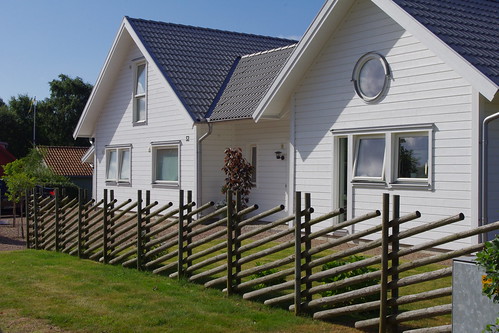
While I like the traditional look and the natural materials used, I've also seen some clever style incorporating the traditional with the modern improvements for stronger longer lasting benefits. This past summer, we went down to a small town north of Halmstad called Haverdal which is very touristy in a Swedish way for the beaches here. I don't think many 'auslanders' know about this area. Mostly it's a native Swede getaway place. Many charming small beach cottages everywhere here. The coastline looks more like something from New England wit rolling sands dunes with bunch grasses everywhere. The only other area I've seen like this is over in Dänemark at the very northern tip of that country called Skagan. Anyway, I took some photos of many examples of modern fence designs around the neighbourhoods there in Haverdal. Here are a few below.


photo: Mine
This house was the home and garden of my wife's ex-inlaws and we came here to pick up both her kids who stayed at grandma & grandpa's place. I actually loved their house and thought about asking to take photos of the beautiful older style of architecture and interior decor, but decided it might be pushy, besides we don't know each other that well. But what impressed me is that their place unlike most Swedish residents is so Un-IKE[oh yeah, not an IKEA fan either]. But at least I got a couple shots of their own 'DIY' Hornbach [equivalent to Home Depot or Lowes] home improvement project. What you will notice with many outdoor building projects here are the hardware components will be steel as are some of the infrastructural skeleton for the fencing, even if a more rough natural material is added as the finishing exterior decor to the fence. One of the greatest challenges here is to counteract the degrading effects of mold and rot made worse by the continual wet climate. So the steel footings and post caps help. But often times the wood also has to be treated with a Copper-Sulfate which gives it that slight green tint-


photo: Mine

photo: Mine
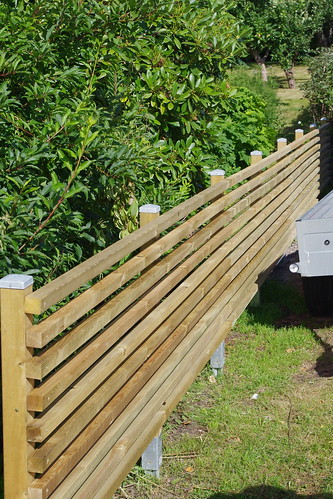
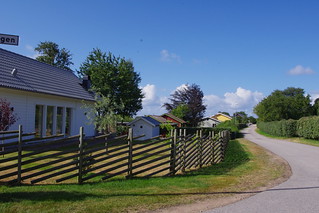
These next two photos, the one above and to the right, are actually around the block from the kid's grandparent's house. While they show the same traditional Swedish style which is popular here, they incorporate a more modern milled lumber look which was purchased from the local Home Improvement Store as opposed to the tradition of going out into the Forest and gathering all manner of Sapling poles which seem at times to number into the millions everywhere you look or venture out into for a walk. But never the less, it still works for me.

photo: Mine
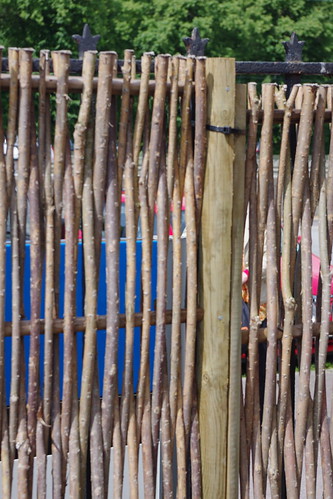
Back home in Gothenburg we took a day to visit this year's look at the Göteborg Botaniska Trädgård and stumble upon something newer they have done to the older ornamental iron fence of the Botanical gardens. As you can see, they appear to have used long slender willow sapling branches in their fence weave pattern. I've seen quite a bit of this natural wood used and I suspect it is willow much like the pliable willow wood furnishings some create in the U.S. I've also seen what appears to be commercially raised willow orchards when we drive up from Gothenborg to Stockholm for various reason on a visit or holiday. Nevertheless, the wood seems very tough and durable in withstanding this climate.


photo: Mine

Closer back view of the iron structure of the fence and
the weaving pattern of the willow decor used for screen

photo: Mine

This is simply a close up shot of the natural material used
which for me still looks to be Willow. What do you think ?

photos: Mine

This is a close up of the weave pattern they did around the
interior metal poles and the wooden split veneer to hide the
steel post and keep the wooden look even.

photo: Mine
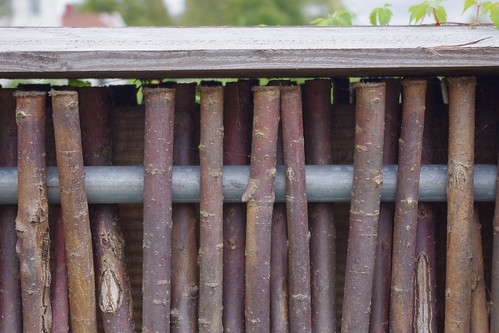
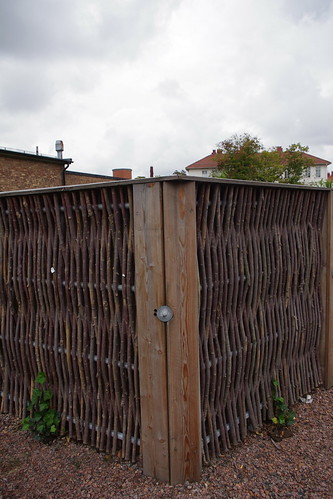
This next series of final photos is going back to Hissingen where we live and the fencing which was built earlier this year to border around what is called in Swedish a Dagis (Child's Daycare Center). This is just east of the major Eketregatan Bus & Trolley Transfer Station. This fencing also had a strong steel infrastructure with the woven overlay of the willow (Vide) branch stems. I've taken several shots to reveal not only the design, but also the interior hardware used if someone out there may be looking for design ideas. As you can see in the photo to the left, the steel or aluminum post framing won't rot inside and the structure will be far more sound as a result. All manner of molds and fungus do a number on things here. Even mosses and lichens will eventually be found on all exterior surfaces no matter how much precaution is taken. I really wish I had stopped when the workers were constructing this and gotten a better perspective on the methods used. I have to assume that the weave around the horizontal poles was done from the top down with the ridge cap being installed last.

photo: Mine

This is the daycare playground fence around where the
children play. I had no idea when I watched them build
this fence that they would train up vines to grow up on it.

photo: Mine

This of course is a close up view of the slender wood pole
strips. The difference here from the view of the botanical
Garden fence is that they have utilized a wood ridge cap.

photo: Mine
This is a close up shot of the corner view of this combination modern metal and natural wooden pole fence structure. Notice the design and hardware they are using which is not over done to detract from the natural aspect of the design they were looking for. I suppose the challenge for folks in the southwestern United States would be to find where you could harvest the willow poles without incurring the displeasure of authorities of eco-activist types. Also, I'm not sure willow would even be the correct material for a drier location, although I see willow garden furniture everywhere. Mostly, like here in Sweden, you'll want some type of steel frame infrastructure to lift your project far above the soil line. Termites are the bigger issue there and it may surprise many to know they don't really have Termites here for the forest recycling program, but rather Wood Ants which build giant wooden pyramid structures with millions of small sticks and twigs the carry back to the Ant mound. Of course the fungus and lichens and other Biological Soil Crusts on steroids here do the rest, but mainly these wood ants are aggressive organic material recyclers.

photo: Mine


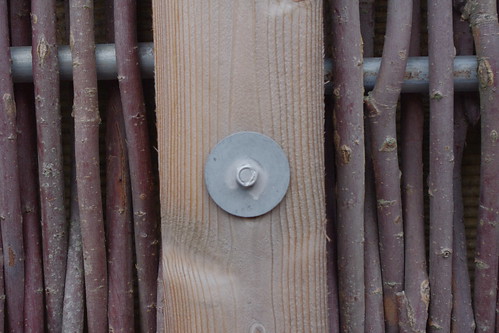
Another close up view of the post and the hardware being
 used here for tying the structure all together. These two
poles are actually separate and come together at the same
point, but other poles went straight through.

photo: Mine


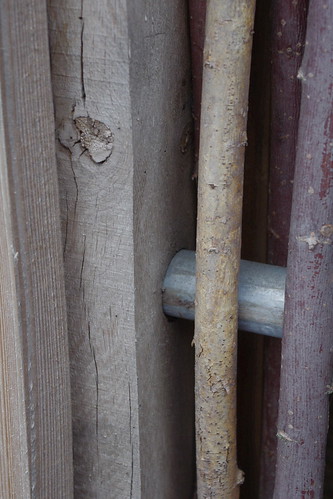
Again, just some close up shots of how the aluminum pole was
introduced into the wooden post through a hole bored all the
way through the post to the next post. This had to be precision
accomplished as these poles used appear to be rather long.

Other Visual Artistic or Creative Designs for Fence Weaveing
Images from Pinterest

Reading References for Design and construction:
Swedish Traditional Gärdesgård from an Italian perspective
http://www.nmgardesgard.se/
Video: Building a Gardesgård (Swedish with english subtitles)
http://www.olhermans.com/
This next video is interesting and fun in a sort of comical way. Seriously, tell me this old guy doesn't remind you of the old Lars Norquist character from the John Wayne and Stewart Granger movie "North to Alaska"
HELGE KARLBERG HÄNGNAR GÄRDESGÅRD