Nursery Potting Soil Preparation
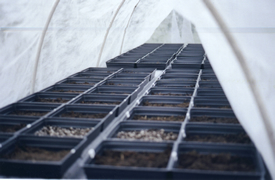
I'll make this real easy. Go to your favourite garden outlet and get some bags of good potting soil. You are going to also need to purchase a large bag of Vermiculite which will look exactly as the material in the photo to the right here. This is nothing more than mica which heated up will have expanded like popcorn. These have air pockets and allow for good aeration of the potting soil to fight off pathogens spores which mostly want a airless anaerobic environment, but that's not enough. I also used Food Grade Hydrogen Peroxide (35%) which I cut with water down to 3%. This also helps further oxygenate and kill any leftover nasties that may want to eat your seedlings. I never water the seedlings with it. I only pre-treated the potting soil inside the germination flats which is itself mix 50%-50% Vermiculite - Potting soil. I also use a slight bit of wood ashes in this mix. I then place potting mix in the flats to the top and proceed to then water with the H2O2 mixture. I like to purchase the food grade Hydrogen Peroxide (35%) because it doesn't have the chemical stabilizers and preservatives that the pharmacy over the counter stuff has. In the past I have bought from Peaceful Valley Nursery Supplies up in Grass Valley California which deals in organic gardening, landscaping and Nursery supplies. It has no preservatives. But you probably could get away with the standard store bought also. I have. I don't really water continuously with this mixture, but simply use it as a disinfecting drench initially in the flat containers packed with potting soil before planting seed in the potting media.
 |
| North Carolina State University |
This way the pathogens are eliminated before planting and more importantly done safely. I have never again been plagued by "Damping Off" which in the past was always a huge and disappointing issue. How refreshing it was to find an alternative to most of the long held practice of conventional science-based poisonous technologies used out on the Horticultural market. On a special note, I don't believe the pathogens are bad or evil. Like other things in nature they just do what they are assigned to do. They provide a great service in natural balance for keeping the plant world in check. If every single seed became a success, we would have stunted trees and shrubs as a result of intense competition with one another. We would never again see the eventual old growth forest we have come to appreciate. Still, in the home garden and Nursery activities, we should always look to safer alternatives from what Science-based Chemical Companies have tried to indoctrinate us with.
 |
| Washing State University |
Next I space each seed about one inch apart in all directions in the flats. All I need is for them to pop up and compete upwards for space and at about three or four inches I transplanted into 1 gallon containers with the same mix. I seriously have seen one seed germinate for every hole I've evenly spaced and planted (100% rate). I didn't like the manner in which they had the 40% rate at the SD Zoo. Seriously folks, I get 100% germination and it's the result of replicating what happens in Nature. Here is what their planting instruction calls for taken from their own page. Notice in the photo how all of their spaced holes with the already provided for containerized tubing has 4-6 seeds in each space ? They are expecting failure and will thin them if more than one comes up. In my method I never expect or plan for any failure. Ideally the ultimate result you are looking for as far as healthy transplants are like the examples of Italian Cypress seedlings below. |
Italian Cypress Seedlings |
Eventually your trees in pots will look something like this photo of Vietnamese Golden Cypress seedlings to the right. At this point you should let them develop just a little bit further, then plant them in those one gallon containers. I water and feed them with a mixture of seaweed extract and they'll also feed on whatever was in the potting soil mix you used. There should be enough nutrition there to get them going until transplant into one gallon pots and then finally into the soil. Once the outplanting has proceeded, then inoculate the plant root area with a good blend of mycorrhizal inoculum applications later, which you really HAVE TO DO folks.

 |
| Image - Orange County Register |
I'm all for helping out nature in view of the multiple negative things working against it. I'm not really wanting to be overly critical of the San Diego Zoo Employees or this All-Expert Dude, but clearly there are better up to date nature-based applications which should be implemented over the old archiac conventional old school science-based failures. These newer methods I referenced above can be tried and experimented on with most native seeds. Even if climatic conditions or ecological environments are different in say Africa or India from these in southern California and the plants are of radically different species. Please, by all means watch, study and observe how nature really works where you live and accomplishes these tasks in the most effient way. Perhaps you are dealing with Umbrella Acacia (Acacia tortilis) , but may you know for a fact that the Elephants eat the bean pods and they run through this animals digestive tract with it's tough acids to break down the hard shelled seed coats and then proceed to germinate in a Elephant's Poop Pile. Then feed pods to your cattle or some other herbivore. Find ways to adapt and improvise. Below here is a further link to the Tecate Cypress recovery project in the Santa Ana Mountains.
 |
| Omage - Orange County Register |
THE PLAN: “This is not rocket science,” said Gary Petersen, a silviculturist with the Forest Service. “You drop a few seeds, cover them up and walk a little farther – just like Johnny Appleseed.” Petersen is working to save rare tecate cypress trees that were damaged in a February wildfire in the Santa Ana Mountains.
Orange County Register.com: "Forest Service helps tecate cypress after fire"
There are still numerous errors to be found in many many science text books within areas of Academia these days which have not been updated for years. Some of the same failed methods used back then should have been changed today with our newer understanding but they haven't. So what should a student do ? Be a thinker outside the conventional science box. Schools seem now days demand students follow unquestioning textbook studies, which provides high test scoes for textbook-based answers. They rarely encourage ongoing growth of the thinking processes that utilize logical simple to understand practical applications found in nature. Be creative based on what you observe out there. Here are a couple of quotes from the San Diego Zoo - Conservation Research Institute about Tecate Cypress which are totally wrong, have been wrong for decades and for whatever reason they resisting any correcting on the part of the credentialed.
"Although adapted to fire with cones that only open and drop seed in intense heat"
This is absolutely untrue. Prior to reading the so-called Fire-Ecology Science literature after the year 2000, I had previously explored all main well know and numerous no so well known Tecate Cypress woodland communities. I've collected cones from all locations, but I always noticed there were always seedlings everywhere and fire was NEVER a requirement or factor in seedling presence. I'll provide a link below.
"Slow growing species like Tecate cypress benefit greatly from having their seed preserved in long-term storage."
This is another untruth, they are an extremely rapid growing species of tree. Especially in their youth. This can actually work against them if conditions are too favourable because they do not develop a deep and extensive enough rootsystem to hold the wait in a windstorm and the trees will usually fall over. This is why they need to grow in conjunction with chaparral shubs like Chamise seen here south of Julian at the Desert Viewpoint or overlook. This is actually another San Diego County native called Cuyamaca Cypress.
 |
| Photo is mine from 2015 |
Real science is NOT the Internet or some Lab, it's field observation as well and that more than anything else improves far greater learning ability that has been lost to many. And by field observation I'm not speaking about some tolen field trip once in a while from the Lan to provide the appearance of legitimacy for a research paper to be published. I'm sorry that many of college students will not be able to observe a natural world in it's fully functional state of being as it was in the past. Nature has been reverse engineered by this world's Industrial Science Academics & Corporate Business Interests for which the majority of mankind have put their faith in at the encouragment of your Professors. Hopefully with helpful suggestions from others in the Native Plant Nursery business who have gone through the hard knocks of industrial science only to realize how biomimicry is far superior to what was once considered the hallowed doctrine of Science, they will be able to provide further helpful assistance to you.
~~~~~~~~~~~~~~~~~~~~~~~~~~~~~~~~~~
Vermiculite:
http://www.vermiculite.org/
Vermiculite & Food Grade Hydrogen Peroxide
Googled Hydrogen Peroxide and Plant Growth
Liquid Smoke and Seed Germination
Stimulation of Empress Tree Seed Germination by Liquid Smoke
Finally, here is an important Note on a post I wrote about the Fire Ecology of Tecate Cypress, which like other plants, the prevailing Science Experts insisted upon that the Tecate Cypress as needing fire to propagate is more fiction than reality. There are many other circumstances and natural anomalies that cause the cypress seed to germinate. You'll be amazed at how common sense this is.
What We Need Here is Wildfire to Propagate !!!
How Tecate Cypress has other Strategies for Germination other than that much Celebrated Evolutionary Religious Concept known as "Burn Baby Burn"
How do ecosystems regenerate when Fire is absent ? Aw, the possibilities!

 I don't know if my collecting days are finished or what. I don't have the resources for establishment anymore. Or even a favourable climate for that matter. But I still have this inner drive to collect seed and small plant specimens. So I guess I'll always have ScrubJay Syndrome, but I think I can live with it. As a result, I have learned so much over the years with this quirky handicap.