Showing posts with label birds. Show all posts

Wednesday, June 6, 2018

Bitter-Sweet Vacation in Southern California (April 2018)

Cambrian College Grapgic Design 
[definition - "pleasant but including or marked by elements of suffering or regret"]
Image - David Broberg
First the Bitter: I suppose this really starts with the world being turned upside down over the past two years since my last visit in early 2016. There has been a constant barrage in the Media of social unrest and combative ideologies claiming to have the moral high ground over the other side and the reality on the ground is that both sides being dead wrong. No wonder I previously lived for 20+ years in a rural mountain environment on the edge of wilderness where TV reception was lousy and summer thundershowers were the main entertainment on the covered porched. On landing at LAX, renting an SUV and driving south to San Diego, it was clear from the start just how far down hill California has really gone into the proverbail cesspit. First indicators of course were the deteriorating visual of the area's native vegetation as we drove along. Seriously the native vegetation has gone incredible down hill, despite all the smokescreening wildflower photos by the local SoCal non-profits who try and reassure their followers on social media that all is still well in Nature because it's so resilient in the face of mass degradation. Then in almost every major city we went through, there are literally 1000s of homeless everywhere. BTW, for everyone's information, Sweden is having the same cancerous pains as everywhere else, despite the propaganda to the contrary. Homelessness and increased crime are found everywhere. My hometown, El Cajon, is overwhelmed with homelessness and the culture has become over 30% Arabic speaking. Not that, that is a negative, but like many other immigrant migrations, the refugee peoples are finding that the grass hasn't been as green as they were first promised it would be in so-called progressive industrial secular nations. Same exact issues exist over here in Sweden, but you won't hear the Media uttering a peep about this. Then came the incredibly sad news of so many friends, family and former neighbours who either have gotten Cancer, Alzheimers, Parkinsons or have simply died. This later news hung over me like a dark cloud my whole trip, much like the cool dark clouds in the SoCal weather which characterized my whole stay when I was so looking forward to a striking contrast of warm hot weather with clear blue skies as opposed to the cold wet of the Scandinavian climate.
Gardening/Landscaping is my only real therapy away from Sweden  
(generally when I return, I need a vacation from my vacation because I work so physically hard)
Image - Mine 2018

Photo - Mine 2018
The Sweet The well known familiar looking plant above is called by a number of common names. Desert Bird of Paradise, Yellow Bird of Paradise, etc, but it's science listing is Caesalpinia gilliesii. This plant is native to Argentina and Uruguay, but has now naturalized in portions of the Chihuahuan and Sonoran Deserts in close proximity to inhabited areas. I've also seen it naturalize in some places around San Diego County in close proximity to urban areas where gardeners have installed it within their landscapes. One of it's amazing qualities aside from being a tough drought and heat resistent small tree or shrub, is it's magnetic attraction to Hooded Orioles. I'm not sure what's in the flower's nectar, but they love it. So it was pleasant to watch them spend a lot of time in my mum's yard at these small trees. Also pleasant to see them finally taking more interest in the native Fan Palms which have grown bigger, allowing them to gathering and harvesting of palm frond fibers for their perfectly woven nests. Maybe one day as the palms gain far more height, they will finally build their nests in these palms. They are shy birds and tough to get close enough for photos. The other long time favourite is the Mexican Red Bird of Paradise or Pride of Barbados whose science name is Caesalpinia pulcherrima. Very heat loving plant and easily propagated from seed and once germinated, grows faily quick with the right care. I've often wondered why folks would purchase one at a nursery when germinating seed is so easy as is the care for this plant. Once innoculate with a healthy mycorrhizal fungal blend, just mulch once a year and NEVER feed it with science-based junk food from the local Home Depot or Lowes. Just leave it alone and carefully prune and thin it once a year like I'm doing above along my mum's driveway. Of course, the strict nativists won't like these plants, but I have no problem with them and neither does it seem the wildlife.
At least a sort of sweet surprise in Idyllwild California - Western Redbud
Photo mine in Idyllwild California 2018

Image Mine 2018
I purchased this Western Redbud from Lawson Valley Native Plant Nursery (1983), donated and planted this one gallon Redbud (Cercis occidentalis) which was about 10" tall, in front of the Kingdom Hall in Idyllwild California in 1983. It's amazing how large and wonderfully healthy it has become with little to no care. It's actually one of the few healthy living things in Idyllwild. I neglected to bring my camera from Sweden, so all photos are from my wife's phone. Most of the pines up there are sickly and dying. I've previously made mention of my conversation with former US Forest Service, Wildlife Biologist, Tom Roberts, back in 1983, who told me that one dat all the pines in and around Idyllwild would eventually die out and their best replacement would be Giant Sequoia (Sequoia giganteum). Well that doesn't seem to have worked either since all the Giant Sequoias in Idyllwild are in steep decline now. (HERE) is a 2009 photo in Wikipedia where the decline of Seqoias in downtown Idyllwild is evident. The newspaper there, Idyllwild Town Crier, however has written an article about the decline back in (2017) and appeared encourage by improved health, which may have come from the higher than normal rainfall after the drought the five years previous. But the Sequoias in that new Park (with restaurant now gone) didn't look at all healthy and vigorous when we were there. As of my visit in April, I'll predict next year that some will most likely be taken down. I've already posted about the massive old Ponderosa that finally had to come down in Fern Valley (HERE). On a bright note, La Casita, our flavourite Mexican Restaurant is still there with great food and atmosphere. Now look below here.


Photo was taken by Frazier Drake  (June 1, 2018) & publiched in My-Idyllwild

Thomas Roberts
More Bitter This is the worst photograph I've ever seen of Idyllwild, California. The entire ecosystem up in the San Jacinto Mountain is collapsing before our very eyes. Actually, this is what I saw on the ground while driving through all the community backroads and streets, but it becomes far more dramatic when a view is taken from a drone by Frazier Drake from Idyllwild Elementary School playground. You can clearly see at the bottom of the photo all of the Giant Sequoias are dying, not to mention 1000s of the Ponderosa and Jeffrey Pines. So much for everyone's Mountain getaway paradise. Garner Valley and Anza Valley are not much different just southeast of here. Tom Roberts was both right and wrong at the same time and that's doubly sad. Well, in a bit of an update, here is Thomas A. Roberts obituary from last year, November 27th, 2017 in Legacy.com. I seriously do not know if there is even anybody left in Idyllwild California who would even remember Tom Roberts. Most of the people I remember from there are dead or gone elsewhere.
Okay it's official, you really can never go home again
Image is mine from 2012

Image Mine 2013
More Bitter Went for a visit on the way to Idyllwild and stopped by my old place in Anza on 60180 Burnt Valley Road and to visit two old neighbours. The first neighbour is a French couple from Paris who moved here before I left and they're doing fine. But the long time Anza postman, Charles Confer, isn't doing so well. He is bedridden and has a terrible time with Parkinsons. He was always such a tall strong man and well liked by everyone. He's so frail now. Standing at his place and looking back up the hill at my place, the property has been stripped of most all of it's native vegetation (Old Growth Chaparral) and numerous greenhouses have been installed for the purpose of growing Marijuana. It made me sick. They did leave all the pines, but the entire perimeter now is giant chainlink fencing with black heavy greenhouse shade fabric to prevent anyone from viewing inside the property. Some Asian investors from Los Angeles bought my old place and they have someone else living and caretaking the plantation now. Dobermans run loose everywhere. It's like some kind of military build up and fortress compound. Amazing how rapidly down hill everything has gone in California. After the amazing documentary "Weed" on Marijuana by CNN's Dr Sanjay where they showed the almost miraculous change effect of children with over 300+ epileptic seisures a week and no normal life or speech making complete turn arounds with a single dose or two of cannibis oil (not the THC junk that makes stoners high), I wrote a post about the amazing effects of the Cannibis Oil parents placed on the child's food. Three months ago I deleted that post because all manner of annonymous dope sellers were posting comments with their filthy website links to sell weed. So Colorado was the first State to legalize and others have dominoed ever since. 

Image from Google Maps

Above is my former acreage and house presently turned into a disgusting Marijuana Farm where most of the manzanita and native pines have been bulldozed for the greenhouses and other side plantings. The disgusting thing about the legalization, especially for the kid's sake, is that during all the petitioning and activist movement towards legalization, all the recreational marijuana using stoners refused get on board unless their addictive recreational use habit could be included in the new regulations and laws. And it was all rammed thru with no real world forethought of things like dangers of driving under the influence, etc. Oh well, that place above and the photo below are no longer mine and ultimately none of my business. So they have the right to do with it as they will. But they did leave a few trees around the house.

Image Mine 2018

This is the view looking up at my old place from Burnt Valley Road at Jim and Margarite Saunder's old place. This view is looking west from the new owners (nice couple from Paris), place at the Geodesic Dome house on Burnt Valley Rd. The smaller Coulter Pines which were not visible from this spot when I left have now risen above the Chaparral (Redshank) and looking quite healthy with five and six years old growth of pine needles still hanging onto the tree and amazingly all that through the worst 4 or 5 years of drought the State has experienced. Through all the negatives I saw however, these native trees I experimented with (Torrey, Coulter, Jeffrey, Tecate Cypress and Aligator Juniper) are still successfully surviving with zero supplemental watering through all those years of horrible drought is a real bonus. Their success provides proof of the value of utilizing native Chaparral to provide hot summer period hydrological services by means of the natural phenomena known as Hydraulic Lift and Redistribution.
Nice Friday evening at Barrett Junction Cafe near Mexico
Image, Elisabet and Mum 2018

Image - Barrett Cafe
More Sweet Barrett Junction Cafe is quiet location away from the insanity of all the cities to the west in San Diego county. All points east from Barrett Junction Cafe on the Hwy 94 drive are Tecate Mexico and the Railroad Museum in Campo and eventually ending in the towns of Boulevard and Jacumba and then back to Interstate 8. The Cafe hasn't changed it's decor nor menu from the day of it's opening. It's like stepping back in time to the 1930s or 40s. I mean the Cafe counter and furniture still look early 1940s. It's loaded with antiques of all sorts, some of them for sale. In the old days it was more packed out on a Friday evening to where the overflow room in the large old military styled Quonset Hut was used more often than now. My wife and I took my mum there to get away from El Cajon. It was truly relaxing. We often vacationed in the past with a month or more to do things, but this time we had less than three weeks visit. So every day we had things to cram into our itinerary. But the Barrett Junction Cafe trip was perfect. Nothing changed.
"I wish there was a way to know that you're in "The Good Old Days" before you've actually left them.." Ed Helms

Image - Barrett Junction Cafe

Yup, Barrett Cafe's Menu's signature plate hasn't changed in decades one iota. And it's not just what is on the menu, but the flavours are exactly the same as I remember them from my very first visit in the 1960s. But it was nice to do something for my mum and sprucing up her landscape. Getting back to Sweden is always a let down weatherwise, but believe it or not  the weather every single day from May 1st to June 6th today has been hot and dry (temps - in the 80s F - 30C), with the except of one day of thunderstorms. The plants here in Scandinavia cannot take heat and they are so entitled (which requires life-support), because it generally rains almost every other day here and is most often cool or cold. They simply wilt and die in prolong heat with no rain, often with many of the forest trees dying. It's pleasant today, work has picked up incredibly, so hard to finish posts like I wanted. The Media over here is still pimping their usual lousy new reports. A recent Gaza Kindergarten Graduation Ceremony news video yesterday was posted over here in Europe, in which the school authorities in Palastine had the kids stage a mock military attack and hostage-taking play. I watched not even 30 seconds of the 5:00 minute video which was all I could stomach. How in all good conscience can mature adults do this with children ??? It's amazing and we keeping hearing about how things are improving and getting better. Yeah boy, "Peace and Security" just around the corner. So anyway, how's your summer vacation going ??? 😆😎

Image MovieStillsDB.com


Friday, September 27, 2013

Nuthatches and Brick Porthole Habitats

image: PaweƂ KuĆșniar
Nuthatch or NöltvÀcka (Euraisan Nuthatch) is a tiny little tree creeper of a bird we have here in Sweden. I mostly notice them in the early Spring when they like so many other birds are into the Springtime nesting mode. That's when I notice them and other tree creepers doing their thing and darting in and out of some of the most tiniest of holes that you'd ever expect any kind of bird to move in and out of. They're an odd shaped bird and yet cute at the same time. When you walk in the woods here, it's a pleasant surprise to find one working and moving inside and outside of it's tiny hole. I say pleasant because they are so entertaining to watch for a few minutes. Amazingly, their odd little frame just seems to defy gravity which never seems to be an issue when they move all around a tree's trunk and undersides of branches. But it's that diving into a tree and disappearing into a tiny porthole of a nesting cavity that draws your attention at first.
Photo: Mine
I've taken numerous pictures of their nesting holes, but without catching one actually at the porthole. They are just that quick. But I can show one such porthole I took in the Oak woodlands we walked through when I wrote about Gunnebo House & Gardens in Sweden where I reside and where we spent the pleasant afternoon with friends. It's still incredible that anything other than a hummingbird would fit in such a tiny little porthole of an entrance. But they do. Interestingly, if they find a hole and like it for a nest, but find the entrance too big, they will build up a mud platform from the bottom up until the proper diameter meets their specifications for safety & security reasons. But they don't always choose tree holes for nesting. They will also seek out tiny crevices within rock walls here or cliffs and even small holes in buildings or bridge foundation structures. An out family's Gunnebo Estate visit they had a large pond which had a dry stone wall bordering all around it. As I was sitting there on a bench mesmerized by the movement of the water, suddenly this little tiny figure flitted into a tiny crevice. I suspected it was a Nuthatch and after waiting for a bit, sure enough a NötvĂ€cka (Nuthatch) popped out. I have a couple of example videos to show here with the first being a video of a Nuthatch Nesting cavity with parents caring for their babies and also notice the mud platform build up at the bottom of the entrance.
Nuthatch Nesting Video
This next video is also very illustrative of the same behavior of the Eurasian Nuthatch's nervous foraging habit of investigating by flitting in and out of cracks a crevices of stone walls or rock piles. But this little bird is different, yet similar in some habits. It's called GĂ€rdsmyg or common Wren. This particular video caught my attention because the ÖnskevĂ€dersgatan Trolley Stop where I wait to ride to city center, I wait at the rail along side a rock line drainage ditch and invariably there are these little Wrens popping in and out of the rocks near the water's edge. The Nuthatch will often to the very same thing.
http://www.youtube.com/watch?v=35tZUqKrh2g
What actually got me interested in writing a piece about this little bird was something I saw a Magazine article about creating a nesting cavity in a brick wall. As natural habitat components for cavity nesting birds become fast disappearing with more and more human development, many of these birds fall into decline. The designer is Aaron Dunkerton, a student at Kingston University in England, who claimed to have found solution and solve the problem with the Bird Brick, a fire-clamped cavity brick that could be built into walls and buildings to provide a sustainable nesting site for the birds. It was a perfect fit for these little cavity nesting birds and could be easily duplicated by anyone who is intuitive enough imagination to replicate such designs. But here is a quick view of what I'm talking about as far as nesting holes incorporated into a brick wall. The Bird Brick is a fire-clamped cavity brick that can be built into walls and buildings to provide a sustainable nesting site for sparrows.

Image: Aaron Dunkerton

The Bird Brick is made from five different bricks that assemble to create an opening for the birds. To clean the cavities, you simply twist the stopper and pull it out. Designer Aaron Dunkerton suggests doing this every two to five years, though sparrows typically take care of it themselves. I remember this was one of my concerns when I first was intrigued with this idea. How in the world could it be maintained and kept hygienic ? I was also curious as to how it could attract other birds like the one on my topic which are much tinier. While there are Sparrows here in Sweden, mostly they are in the cities and not overly numerous in numbers like they are in warmer climates. The other birds like Wrens and Nuthatches are everywhere around my house since we are at the edge of the woods. I really don't know if I've ever seen a sparrow in our yard period. Below is the illustration of the clean out. 

Image: Aaron Dunkerton

Dunkerton’s design consists of five hand-made bricks that assemble to create a small, round opening that’s plugged with a brick stopper. At the bottom of this post I've posted his website link for further details. The hole is 1.25 inches diagonally, which makes it large enough for a sparrow (or other smaller bird varieties) to nest comfortably, but small enough to keep out unwanted visitors. The idea is that builders would install a cluster of three or four Bird Bricks during the construction of new buildings. Ideally, the bricks would sit anywhere from 6 to 15 feet from the ground. Dunkerton says this about sparrow communal habits:  
“House sparrows are extremely sociable birds and like to nest in small little colonies.” 
But have you ever noticed that many of the cavity nesting Birds build nests in the oddest of places. I saw this very thing this past Spring when visiting a friend in Anza California. A family of Mountain Blue Birds had set up house in an old telephone utility box on a light pole that my friend Patrick never got around to using. Amazing, I should have photographed it, but we stood there a gazed at the for along while coming and going, both parents. This artificial nesting site set up was also mentioned by Dunkerton.
“You often find them nesting under loose tiles or in old broken vents in the side of buildings” 
But as buildings are patched up to improve insulation and green space disappears due to urbanization, sparrows are losing a sizable chunk of their nesting options. Apparently, over the last three decades, in the U.K. the house sparrow population has decreased around 70 percent as he shows on his website below, and the bird has found itself on the growing list of endangered species. Seriously, who ever thought Sparrows would become endangered ? 

Anyway, the idea he came up with intrigued me and triggered all manner of other ideas for creating artificial nest habitats. Not just for Sparrows, but all sorts of other birds. This set up would be perfect for garden walls and not just buildings. And of course the size of the hole could be made smaller to accommodate the tinier native Song Bird's like Sweden's Nuthatches. This larger size of course would be shortened up by the Nuthatches with mud, but still, Sparrows and Martins could get there first if the hole was just their right size. Nuthatches collect various nuts and wedge them into tree bark or in holes in walls and will even cover secret larders with bark or moss. Who knows, maybe some of these brick bird holes could become winter storage catches for them. They are just such funny looking birds besides their cuteness. 
Other people have come up with some more elaborate brick bird habitat Uptopias, but the one above by Aaron Dunkerton seemed the easiest to replicate and incorporate without being overly flashy by drawing attention to the area. Below is one beautiful but more complicated one and a link to this company. If a parson has the money and the creative time and patience, there is no limit as to what they can accomplish. Then below this image example, there are some other interesting reading references webpage links if further interested in more creative ideas.


designer Chooi-leng Tan.
Nature-Loving Bricks Bring Wildlife Straight to Your Walls

Nuthatches are endangered in many areas. Especially in the United States where people are obsessed with cutting down any snag for firewood. They are cavity nesting birds and only really need about an inch hole for entrance. Here below is another video of 10,000 Nuthatch Nest Boxes being built for the north Carolina Brown Nuthatch recovery programs there.

Pay close attention to this next video and notice as in the preceding video above, how a metal plate is covering the entrance so that larger birds do not invade and make the hole bigger to make it their own home.
https://www.youtube.com/watch?v=2DrVDf5B97w
 ~~~~~~~~~~~~~~~~~~~~~~~~~~~~~~
Some Interesting Reading References:
http://www.aarondunkerton.com/bird-nesting-brick/
http://inhabitat.com/pixelated-birdhouses-sprout-on-city-trees-in-london
http://vimeo.com/Brick Biotopes
Brick Biotopes: Micaela Nardella & Oana Tudose


Sunday, May 12, 2013

Pecan Tree Volunteer Soaring High Wonderfully Skyward, Thanks to Mycorrhizal Applications

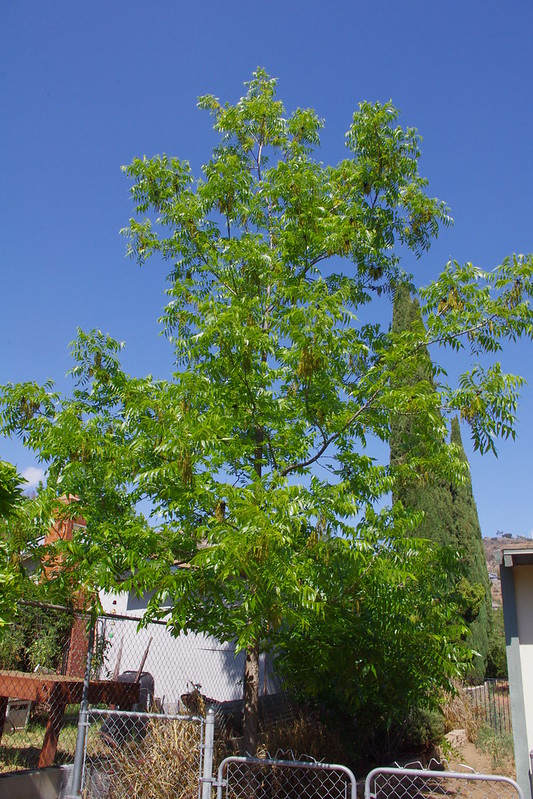
When I think of Pecan Trees, I think of the movie "Lonesome Dove" where Captain Augustus "Gus" McCrae (Robert Duvall) asks  Captain Woodrow F. Call (Tommy Lee Jones) to haul his body back to a little grove of Pecan Trees along a creek in Texas. They also bring back to mind my ex-wife's family who were all Texans and the family reunions we used to have in either Ruidoso New Mexico or Sierra Vista Arizona once a year. Sadly, most of the old timers from that family are gone, but much about their culture reminded me of the characters in that movie in a Western sort of way. I also LOVE Pecan Pie if it's made right. It tastes wooooonderful. Anyway, in my Mum's backyard before I left in 2006, a tree volunteered by way of a Scrub Jay and I left it. It germinated in a concrete stone planter we had against a neighbour's block wall. Anyway, I left it. I truly thought nothing would come of it. At time of my departure to Sweden in May 2006, it was approximately 2 foot high. On subsequent visits back here over 4 years from 2006 to 2009, it was up to my height at over 6 foot. The foliage was never spectacular and it looked a bit ragged, so I had already purchased some of Mycorrhizal Applications Inc's MycoApply multiple species blend of Ecto & Endo Mycorrhizae and beneficial bacteria and so generously inoculated this tree everywhere I figured the feeding root zone would be. Here is the way is looks from 5 Foot three years ago to this resent day.

Photo Credits: Mine!

This is the back back portion of my Mum's yard where no real ornamental landscaping takes place other than fruit trees and garden. Of course all manner of tools and garden equipment also are stored back there. There is a small house out back of the property which is here in the picture and where I stay when I come to visit. The tree has turned out beautifully and produces many Pecan Nuts.

Photo Credit: Mine!

This is a much closer shot of the tree near the gates. The trunk is extremely straight and sturdy and reaching up towards the sky. The foliage is a gorgeous bright shiny green, not like it appeared prior to mycorrhizae inoculation some year back. I utilized MycoApply from Grant Pass Oregon which has a blend of several fungal species and beneficial bacterial spores and with these spores injected into the ground where the feeder roots were located, this trees root absorption and nutrient uptake ability has increased by 200%. This tree is never watered and never shows effects of drought stress.

Photo Credit: Mine!

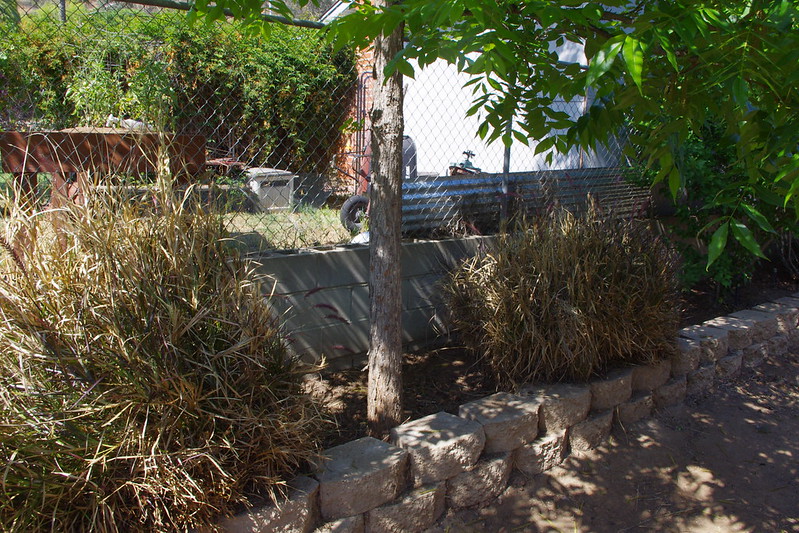
Here is the actual planter area where as you can see, no one in their right mind would EVER plant a tree seed in such a cramped location. The blocks can be easily relocated to extend outward from the tree if necessary. Notice the Burgandy Bunch grasses on either side ? These were already there when the Pecan seed germinated, but there has been a recent change as of today.

Photo Credit: Mine!

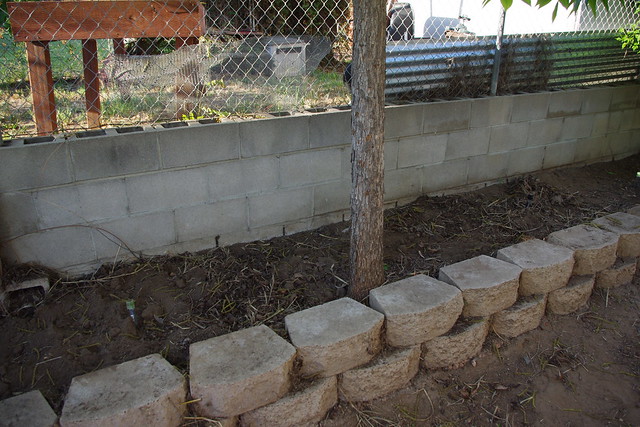
Okay, so here is the planter scene with the Pecan Tree and bunch grasses removed. I have reinoculated the planter and outer foreground where no doubt the feeder roots present reside. I'll just apply some mulch in both the planter and foreground below the wall and water generously only once. The mycorrhizae germination processes will do the rest for me. It's so easy just to walk away.

Photo Credit: Mine!
And here is what the product looks like. MycoApply I purchased from Horizon Irrigation Supply on Engineer road in San Diego, Clairemont off the 805 Freeway to be exact. The cost of this is $28.00 but well worth it. This should last for a year or so, maybe longer. For landscape Supervisors or head gardeners, you should use this specifically and not your employees. Not because it's dangerous, but because they will waste a great effective product by adding way too much and then it's gone. It takes a while and some education to get someone to turn their thinking around to how nature really works. There is so much competition by Celebrities pimping chemical wares for Corporate Giants who will stop at nothing to shove their junk down peoples throats by poisoning their minds with the wrong education.

Photo Credit: Mine!
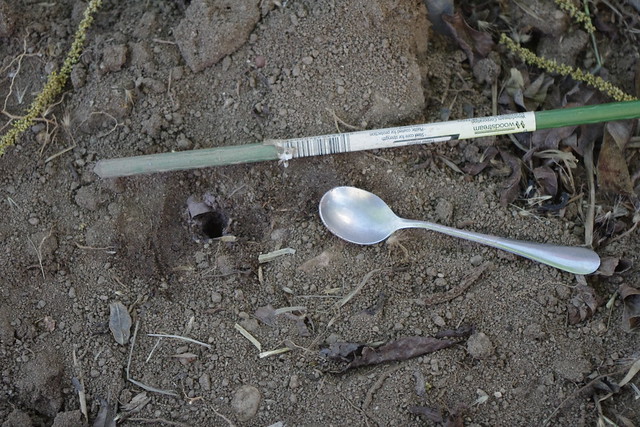
These are the simple tools I have always used. I use a small Tomato Staking stick to poke the 4 inch holes in the ground for which I use a very tiny spoon (not even a teaspoon) to scoop a tiny bit of spore powder and then back fill with fine soil. Then I lightly deep water, mostly with mulch on the surface to prevent much run off. I have a feeling MycoApply utilizes some humic acids in it's powdered form, no down taken from Leonardite (which is a further oxidation of Lignite, which itself is often known as brown coal). It's effectiveness on plant growth is well known as it will stimulate newer root growth. It's this new root growth which contains that root end cap that pushes through the soil and when mycorrhizae spores come in contact with this root end cap, that is what stimulates germination of the symbiotic fungi which should remain on roots for life in the surrounding soil. However, you'll know it's there by the above ground response of any tree or shrub's luxuriant foliage, health and vigor, as is the case with the turn around of my Mum's volunteer Pecan tree.

Image - Tim Brenneman

Pecan truffles (Tuber lyonii)

One of the most frustrating things in the California News for me to hear are all the fights about California nut producers (Walnuts, Pecans, Almonds, etc) and their need for water. And most Farmers for the most part if traditionnal and using the same practices their Grand Daddy and Daddy did, are often tough nuts to crack (pun intended) when it comes to braking the mould and trying to get them to do something different in their methods of farming and perhaps being more open minded when looking at other ways beyond nut monoculture to make money off their land.


Further Readin About Pecans & Truffles

https://www.pecanridgeplantation.com/truffles

https://timbrenneman.org/pecan-truffles/

https://www.pecansouthmagazine.com/magazine/article/pecan-truffle-research/

Sci-News: Researchers Discover Two New Species of Edible Truffles

Mycorrhizal Fungi Have Benefits in Agriculture
Update 2017
Inocultation of Pecan Tree with Pisolithus tinctorius (Dog Turd Fungus) in 2015

photo is mine from 2015 (Julian CA)

image mine 2015
In 2015 I collected a sack full of dried cured Pisolithus tinctorius ectomycorrhzal truffles or mushrooms south of Julian California along a roadside viewpoint within some of the chaparral plant community. It was like the motherlode of a mushroom find. The largest was this one on the right where you see a quarter or 25¢ piece. Pecans are ectomycorrhizal and even though I inoculated with MycoApply, in 2013, I heavily inoculated with these specific ectomycorrhizae in 2015 that I had collected on my visit that summer. This year, 2017, my mum said that this same  tree above has doubled in width and height and is extremely loaded with pecans. An interesting note here is that all the dogs she's ever have loved to eating these pecans. Most nuts can be risky for dogs. But the pecans probably attract them because they are naturally on the sweet side, especially with this tree. Plus this tree's nuts have particularly thin nut shell which are easy to crack. I'm sure birds like ScrubJays are already harvesting them and hiding them somewhere in nut caches like they did originally with this tree which volunteered. When I do acquire an updated photo (maybe Spring 2018), I'll post it for comparison. But the PT Ecto-mycorrhizal fungi have clearly made the difference, coupled with the heavier than normal rainfall amounts this past winter (2016/2017). Below is a video of a pecan nut collector. Rather ingenius and very simple.
Multi Headed Nut Wizard


Sunday, August 5, 2012

Saguaros on Rattle Snake Mountain ?

Prickly Pear Cactus Nopal from Tenerife - Canary Islands
Well first before I get to the Saguaro story, here is the progress of sorts on my wanting a potted Prickly Pear Cactus in my house here in Sweden. We collected it in February when my wife and I went to Tenerife again. Brought it home, let the wound callused over and planted it in a sandy potting soil. Then I waited. 

Here's that parent Cactus plant
We had a lousy Spring which didn't truly come at all until early June. That's when I put the pot outside on the back porch. Even June was horrible as we had to have our heater on the whole month. Towards the end of June it did great as you can see in the above shot and progressed wonderfully until the slugs and snails took their toll on the little pad. Notice below as I took this photo today. 

Photo: Mine
Notice Mr Snail on the young tender Nopal ? Seriously, these things ate spines and all. How does a soft delicate bodied monster like this make it through spines ?


Photo: Mine
On a positive note in the background the Lavender & Strawberry plants are doing wonderfully. Although the giant brown imported Spanish Slugs did get most of the berries which were very few this year.

Photo: Mine
My other cactus collection which truly has never progressed beyond what you see here, but it decorates our Spanish Styled dining room table nicely.

Photo: Mine

On another Tenerife note: Here is a little type of an Agave looking plant that we saw a lot of in most of the Tenerife neighbourhoods. Some of the pups fell from the flower stalks and root nicely in potting soil. I had this in a bag back hidden away in a drawer until we came back from DĂ€nemark and in late June or early July and I planted it. Maybe someone will officially recognize it for me. Interestingly many of the fringes of neighbourhood gardens had the large agave like leaves of these  plants eaten off by some animal like maybe a deer,  cow or perhaps goat, but not sure what animal. Only know that something out there finds them edible.

Okay so none of that has anything to do with a Saguaro growing on Rattlesnake Mountain in El Cajon California. Just wanted folks to see some failures as well as successes with my cactus growing experiences. Most readers will remember this Torrey Pine tree on the mountain but without me in the picture. I took a friend up there to see what I had only vaguely alluded to for decades. This is his photo.

This photograph was taken in June 2011 - First year after 30+ years the tree has developed pine cones. You may also remember the photos of San Diego Coastal Cholla which I rescued from development over in Santee near the Lakes area which is now a housing tract. Very few San Diego Coast Cholla stands remain intact. Some that may be seen are along some of the roads leading up into Sierra Mesa and Linda Vista on south facing slopes of Mission Valley. Update (2013): The tree at the upper left has been cut down by angry residents at the Sky Ranch Housing Development  on Rattlesnake Mountain in Santee who were upset over the presence of the Torrey Pines and the imagined fire hazard which could result. They did this despite the fact that this is protected Conservation Area land with No Trespassing signs.  


Photo: Mine
Colonies of this San Diego Coastal Cholla cactus with Coastal Cactus Wren nests no doubt led to the partitioning off of this area with Conservation Protected Area status before final approval of the housing development boundaries. Wish I had photographed the area when they first taped off. I was blown away by the sight of this protection status. What astonished me more was the presence of Cactus Wrens in the first place as I had never even seen them before as a kid.

Below is what I didn't show you. My friend  took this photo of me standing next to what use to be a large over six foot high Saguaro in early 1990, before some couldn't care less gun happy louts blew it away with either a shotgun or numerous rifle bullets. Either way it was blown to bits to the ground. You can still see the former outline of the previous girth at the base where to my surprise new growth came rocketing back with two arms to replace the single that was lost. This regrowth event happened around 1995. Notice the Rattle Snake Mountain Sky Ranch Housing Development in the background up on the ridge ? Both stems are tough and healthy. Amazingly this plant was never pampered and I established it the same way I did the Coastal Cholla which I'll explain below.


To give some perspective of just how big the size was on the original growth, here is a photo taken during the same time period last summer, but in Anza Borrego State Park. The Cactus here is not a Saguaro, but a rather a typical Desert Barrel Cactus which can grow quite large. Although I would have to imagine very very slowly. Now my height is about 6 foot 3 inches, so that will illustrate the length of this cactus photo as far as height and just how large the Saguaro on Rattlesnake Mountain was previously. I believe Saguaros are much faster growing as they acquire far more moisture by being located within the direct pathway of the entire Summer Monsoon season's airflow.

Photo: Mine

Opuntia (Cylindropuntia) prolifera


 This photo is from a website called "The Cactus Jungle" which is being used here to offer a close up illustration of the jointed nature of this type of cactus. Like other Chollas it has joints which easily break off either to roll down a hill away from the parent or get itself caught on some animal or human only to be shaken off and rooting itself somewhere new to create another Cholla plant. The Cholla Cactus Community on Rattlesnake Mountain is well over an acre in diameter in it's spread from the originals.

What I did was collect numerous Cholla Arms or rather joints that had broken off and load them into a brown paper bag. The key to successful plant establishment is to disconnect yourself from that self taught nurturing gardener nursemaid thing you love to do so well which wants to baby everything and practically keep the yard on life-support. You'll be surprised how many plants actually don't necessarily need nor want this. Simple find a dry hot location on your property (you know, where the soil is rocky and shallow and nothing else will grow there ?) where you want to establish a permanent colony and dig a hold with a spoon only a couple inches deep. Then with tongs clasp the cactus joint and place it in the hole UPRIGHT (I hope I don't have to explain which end is upright. I'll be obvious) and proceed to push some soil back up against the cactus joint. Use the spoon for this, not your fingers.

NEXT  --> DON'T EVER WATER IT!!! Leave it alone until next rainy season. The same technique was done with the Saguaro I had friends purchase for me and bring over from Tucson Arizona. The key is NEVER water after planting. You'll create rot. The plant has enough fluids in them to sustain them. In fact though you will NOT notice anything on the surface, you can be sure that certain mechanisms are triggered in it's DNA to start root production based on the resources it already has at it's disposal so that by the time the rainy season does come the network is already well established and functional, though you may not actually see it unless you dig around its base.
Well for the moment that is it. I've been convention busy for a month and sick this past week.
Update: Nice article from Southwest Trees and Turf which was contributed by Juan Barba a consulting arborist in Tucson, AZ on transplanting "Dos & Don'ts" of Saguaro removal, transplanting and general health care there after.
http://www.cactusjungle.com/