Showing posts with label Tenerife. Show all posts

Saturday, February 28, 2015

Squaw Tea (Ephedra californica) or maybe something else ?

Funny how some images can trigger totally unrelated information than what you were originally Google researching for


Face Palm
Finishing some work on one of my latest articles on the Canary Islands, in particular Tenerife, I was researching some of the names of plants I had photographed on a recent visit. I hit Google images for Plants of Tenerife and one image stood out which immediately brought up one common name for a high desert plant native to the region where I come from in Southern California. The infamous Squaw Tea. The plant I was familiar with grows abundantly in an area east of Terwilliger Road in the Anza area. The plant is Ephedra californica, but it is known by common historical common names as "Mormon Tea" and the other common name which immediately rushed through my brain, "Squaw Tea". Yes, Yes, I know, I know. We don't call it that anymore, but old common names and terms are hard to shake off. This particular photo of the girl above is a Spanish Model on a website with other girls in outdoor Canary Island nature settings. But the pattern of the shrub and the Native American styling of the girl just fit like a glove. Most foreigners reading here won't understand the comparison, but Southwesterners will put two and two together. I don't believe the common name with the Native American reference is encouraged these days, but never the less the old names are hard to shake. So I thought, why not, write a short piece on the plant. I'm not particularly partial to Mormon Tea either. Desert Tea appears to be another preferred name for Ephedra californica. But the similarities of structural patterns in foliage, branches and habitat are where it ends. The flowering time of year will yield radical differences. The southwest has a few varieties of Ephedra. In many desert locations both species (E. californica and Ephedra virides) exist together. The species, "Ephedra nevadensis" is found from the Mojave Desert north to the eastern side of the Sierra Nevadas into Nevada's Great Basin. I'll post the Green Mormon Tea plant in full bloom below and contrast it with Teide Broom when it is in full flower to illustrate some difference.

Teide Broom, Tenerife - (Spartocytisus supranbius)
The plant I was actually looking for when doing my Google search is native to the area of the volcanic caldera on Tenerife and it's listed as the Teide Broom (Spartocytisus supranubius) shrub. It thrives best on the dry xerophytic lava and scoria zone (2000-2500 meters above sea level). But it bares a striking resemblance to the southwestern desert Mormon Tea shrub of those high desert regions. The Ephedra californica that I am familiar with grows in the eastern reaches of Terwilliger Valley on down to Anza Borrego State Park. Throughout the world there are several species of Ephedra, which are related to the Ephedra sinica which is from the region of Mongolia, Russia and northerneastern desert regions of China. This plant is well known to Chinese medicine, but by a more familiar botanical herbal name called "Ma Huang". Here is how one reference describes it's usage and I'll post the reference under the Caution heading:
"A shrub, the stem of which contains ephedrine, which is a bronchodilator, diaphoretic, diuretic and vasoconstrictor; it is used to treat asthma, bronchitis, fever, fluid retention, hypotension, paraesthesias, to stimulate the central nervous system and to suppress the appetite."
Wiki-commons
This plant is responsible for providing the raw ingredient for the well known weight loss drug called ephedrine. In the USA, many of these drug potions which added Caffeine and other powerful stimulants for weight loss have been outlawed because they caused dangerous health conditions in some folks with heart trouble, high blood pressure, rapid breathing issues, etc. This is why many probably get a lot of Spam email advertising Ephedrine as an appetite suppressant. People want a quick fix pill to rapidly take care of a situation for which they have no patience in making lifestyle changes. While there is evidence of short term weight loss, there is really no evidence of any long term keeping the weight off. As far as the Tea from the Mormon Tea, for me it has a sort of mild Alfalfa taste to it and the potency is not near as strong as the Ma Huang drug manufactured for Chinese medicine. 
~~~~~~~~~~~~~~~~~~~~~~~~~~~~~~~~
image Bert Wilson: Green Mormon Tea (Ephedra viridis)
~~~~~~~~~~~~~~~~~~~~~~~~~~~~~~~~~
image: Mundani Gardens - Teide Broom (Spartocytisus supranubius)
I think the Canary Islands are my new favourite Nature region. I have been here many times and it feels more and more with each visit more like Home to me than where I originally come from. There are so many interesting plants here and each time I want to know more and more about them. Technical and mechanism type stuff really. I always walk away with more questions than I came with. The chaparral environment is so familiar with where I come from, especially when so many plants here are so common in most California urban landscape. Anyway, tomorrow I have some fascinating information on Pinus canariensis, fire ecology and it's influence with the island's hydrology. But first, a little more on some historical ecosystem understanding of Mormon Tea diet by giant ground sloths now extinct.
Giant Ground Sloths dined on Mormon Tea
Photo by Leslie Shaw of Hi-Desert Star
"The Joshua tree drew a record-setting crowd for the Morongo Basin Historical Society’s lecture series Jan. 14 at the Hi-Desert Nature Museum. Chris Clarke spoke about how the tree got its name, how it is distributed, its two varieties, its pests and enemies and hopes for its future."

Photo by Chip Clark
Just a few side points on the Southwestern United States and what the now extinct Giant Ground Sloths dined on. Throughout many areas of the southwestern United States there have been found numerous caves discovered where these giant ground Sloth's once lived and in them mummified dung left behind. The dung really is not a fossil dung in the sense of fossils like petrified forest wood or other biological material with has been turned into stone, but rather mummified and preserved by the very dry sheltered environment of these caves. One famous cave is Rampart Cave in the Grand Canyon, another cave in between Benson & Sierra Vista Arizona called Kartchner Caverns, old lava tubes in New Mexico, etc. The animal's diet seemed to have consisted of plants from the various rugged chaparral plant communities (especially high deserts) such as Desert Globe Mallow, Joshua Trees & other Yuccas, Agaves and Mormon Tea. Other plants commonly eaten by these sloths found in Nevada were capers and mustards, along with lilies, grasses, mints, and a member of the grape family. This has all been verified by the examination of the invaluable mummified dung found in these caves. One wonders what happened as a result of this animal's extinction (which many now believe to be human caused because of it's slothful nature and easy hunting), what effect this has had on western ecosystems. Same is true of other now extinct megafauna like the Mastadon which was a browser as opposed to a grazer.
~~~~~~~~~~~~~~~~~~~~~~~~~~~~~~~~
Some interesting as well as important links
The Biogeography of California Jointfir (Ephedra californica)
http://www.laspilitas.com/nature-of-california/plants/262--ephedra-californica
Chris Clarke: "On the Dry Side" 
Some Caution
http://www.drugs.com/ephedrine.html
http://www.emedicinehealth.com/drug-ma_huang_ephedra/article_em.htm

Friday, June 8, 2012

Bougainvillea: A Bold Stand Alone Statement Plant

This plant is quite capable of making a bold statement on it's own without any help from any neighbours or friends.
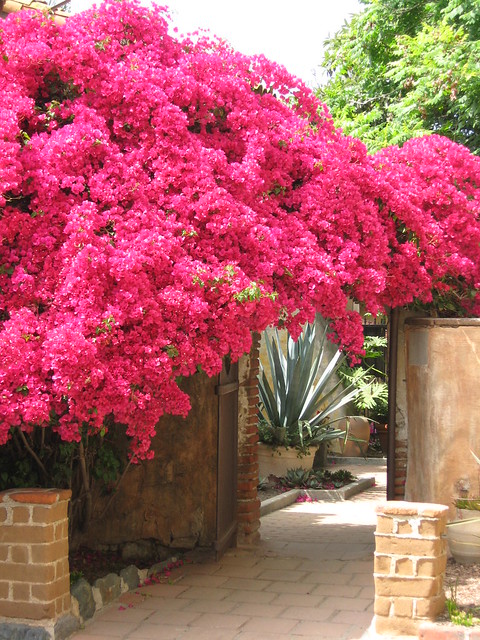
photo by Jeff (Non Paratus)
I have mostly practiced a gardening standard and principle of community planting in the urban landscape. I mean that is how nature does it in the wild. We now know that plants can  compliment each other not only in the garden, but from a scientific perspective they do very well in the wild as an interconnected community which cooperates together for each other's survival. But the Bougainvillea is simply not that kind of plant. Oh I'm sure it somehow cooperates with others in it's natural environment somewhere down in the South American lands of Brazil, Argentina, or Peru. I'm also sure it has it's own natural checks & balances which keep it in it's place. But even in the wild it must be a sort of wandering maverick if it's habit of overwhelming other plants in an urban landscape tells us anything.

 The best places I've ever seen it used is among the landscape settings down in the Canary Islands. I mean the plant must have Hispanic ethnicity encoded in it's very DNA. Can you imagine this plant not in a setting of Spanish Architecture ? It was everywhere in the Canary Isle of Tenerife. Take a look at one of our favourite Gardens next to Hotel Atalaya where we stayed on our very first ever trip. This is the perimeter wall around the very private gardens and pool areas. Not only was it a thing of immense beauty, but it was a formidable security defense barrier.


Photo: Mine
When I worked as the head gardener at the Property management company in San Diego, the equipment necessary for managing Bougainvillea were long blue jeans, long sleeve shirt and a pair of thick leather gloves and Corona Hand Clippers which were never far from heavy leather belt holster. You know how it is, a landscaper with out his Corona Clippers and holster is like a Tombstone Gunfighter with nothing more than a water pistola.
I remember one year where we had problems with neighbouring apartment properties where their residents, who were generally young people that used to climb a wall or chain link fence on a front border and jump an Ivy covered fence in the back of this one Mobile Home Senior Park we managed. The place was made into a regular thoroughfare because they didn't want to walk the extra mile around the block to get to the stores on the other side. Unfortunately many of these individuals were shady characters and they spooked some of the residents who were retired. The front chain-linked fence was next to the Park Resident's Launderette and it was the easiest to discourage the Jumpers by putting this super sticky substance called Bird Repellent made for discouraging Pigeons from roosting on ledges. Put this on the any fence's top cross bar and when it's grabbed you almost can't get this stuff off your hands without some sort of solvent. However they got clever and started using Newspapers or old Advert magazines as a sort of half glove for jumping over the fence anyway. 

But the back wall was a different animal all together. It was also a chained linked fence, but this was English Ivy covered and there were no places to put this sticky substance which didn't work anyway since they had found ways around that. Trying to come up with a solution was tough, but one day I was trimming a Bougainvillea which had really gotten out of hand with six to eight foot or longer branch suckers. Then it suddenly occurred to me that I could utilize these rather lengthy cuttings with a bit of clever weaving work into the top of the Ivy where they would be hidden. Let me show you why !!!


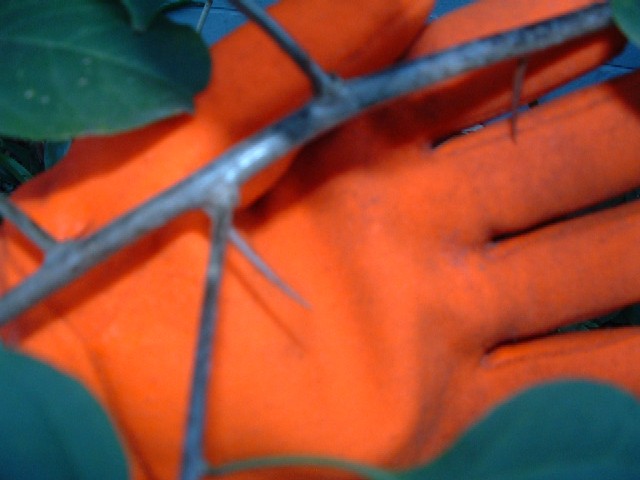
Nobody messes with these thorns. It's like an Ocotillo on Steroids. If the Bougainvillea plant had a face on  it to warn people off from it's nasty sometimes slightly toxic thorns , it would like this!!!

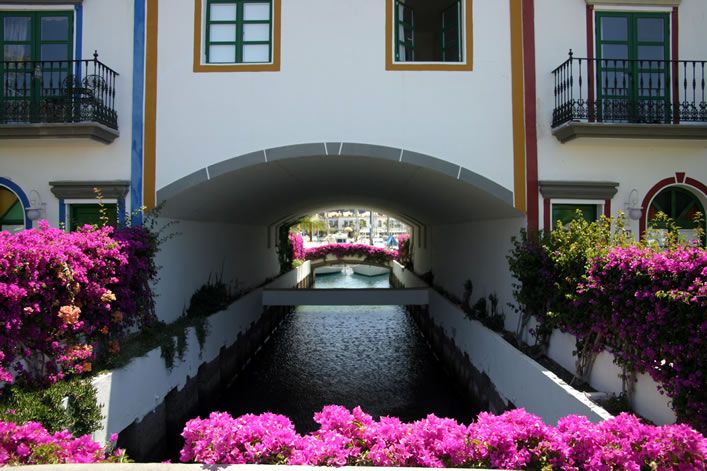
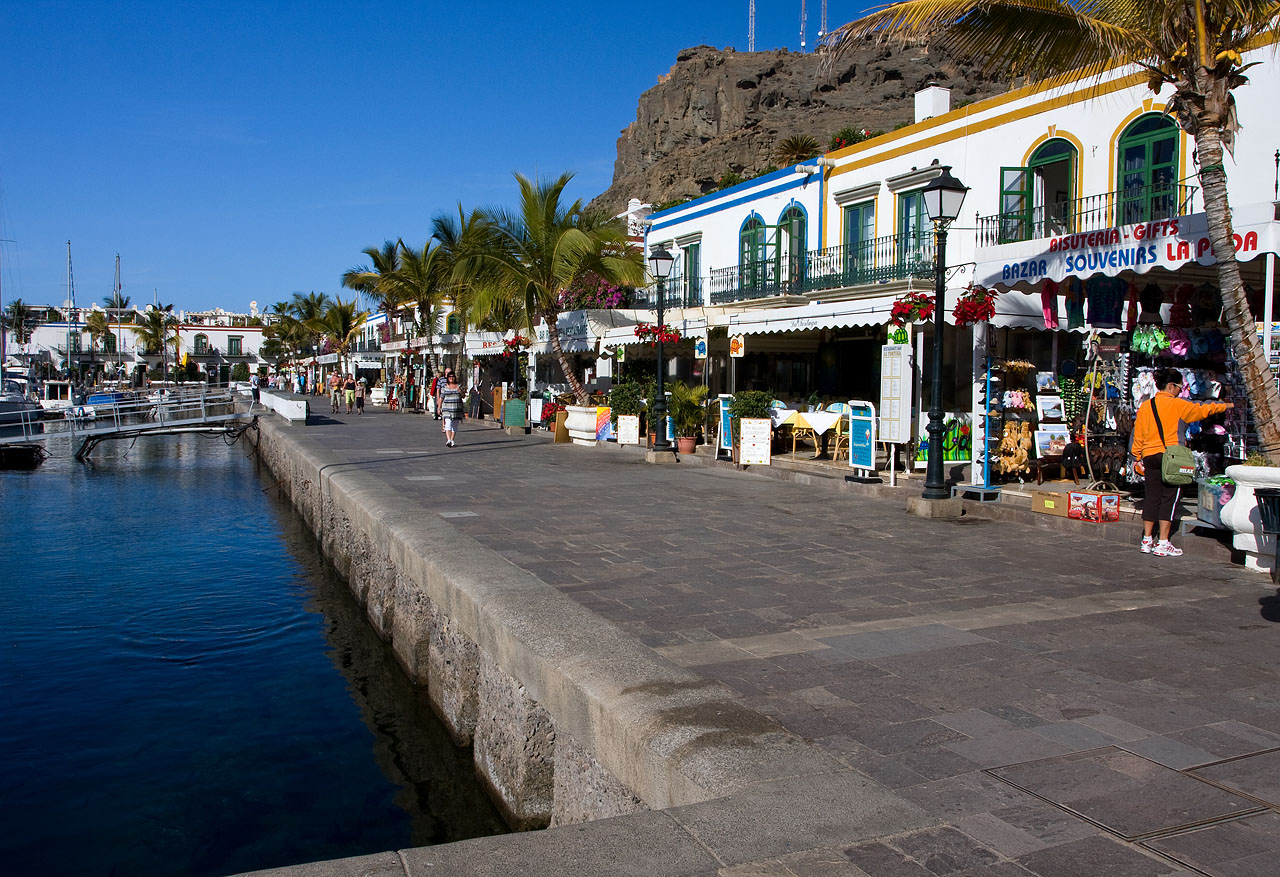
Nobody ever messed with that wall ever again and there was no clever defense around they could come up with. It's like messing with what appears to be a cute little doggie that actually has a feisty bite. Those wicked thorns would go through any newspaper. But back to Bougainvillea as a statement plant. The best place I've ever seen on the planet where this plant is used to it's full potential is the Canary Islands, especially Gran Canaria in a beach town called Puerto de Mogan. Take a look here, sit back and soak up some of the views.


What is it with ethnic Hispanic folk and their bright colours ? On the other hand, what is it with northern Europeans and their lack of artistic imagination ? Hmmmmm ? I'm in the wrong land.

These next pictures are of what are called Canals in Puerto de Mogán because of their striking similarity to canals in Venice.


Puerto de Mogán is also called Little Venice or the Venice of The Canarias because of it's obvious similarity with the canals which link the fishing harbour to their Marina. A person seriously does not have to be a camera expert to find just that right shot.  Taking walks down beautiful side streets and over  small canal bridges, everything, not just Bougainvillea here is in bloom, flowers of all sorts are everywhere,  Citrus trees, Coconut & Canary Island Date palms, crystal clear waters at the marina and for that matter all along the coast line of the Canaries seem to be so pristine, clean and refreshing to the spirit. And this is in winter. You can get yourself so lost that the CNN & BBC World News negativity brought to you continually on a daily basis doesn't even seem to exist anymore. I'm actually surprised more American Tourist don't come here. Mostly it's Europeans like German, British and incredibly Finnish. 

Well it's springtime here and for the past couple of weeks we've had our home heater on. Man this really stinks.  But hey, don't forget about planting or adding Bougainvillea to your landscape if your climate allows. Keep in mind that it will need regular care, especially with pruning. And I don't mean hack job pruning. I'm talking about sculpting for a creative artistic effect. Not everyone has this intuitive ability, but at least with Bougainvillea if you make mistakes, wait a few weeks. It'll give you another blank canvas to work with. As far as feeding, there is no real feeding that I have ever known other than your native soil when I worked with it. Mycorrhizal applications will always be a must, as they are for every plant on Earth. Unless I've missed something, others may contribute their experiences here in the comments section with their experiences and care techniques.

I don't know what it is about the Canary Islands. They have a draw for me like no other place. I could actually live here and have it feel like home. My present northern European location has never really felt that way, though I am close to our friends and family there and that makes a difference.But the Canaries are a feeling of home where I would rarely feel homesick for the land of my roots. *sigh* For now, all I have is my imagination to keep me company. I really need a new office location and work station cubical !!!


Saturday, May 19, 2012

Tenerife Landscaping and Nature Viewing: Part 3

Photo: Mine
This is a finishing up of our last trip through Tenerife this past February. Heading out from Peurta de La Cruz we started in San Cristobal de La Laguna where my wife wanted to see some tourist places. Interesting looking colonial type town, but extremely narrow streets, often one way direction and an almost impossible maze to try and get out of. So we left this city and made it to the ridgeline highway called TF-12 which rides the ridgeline backbone of the mountains heading through the remote area known for it's lush looking Laurel Forests with almost rainforest vegetation on the left side facing north and drier desert type vegetation on the right which was south facing. The road eventually circled around back to Santa Cruz de Tenerfie, which is the capitol of this island, then back to the hotel in Puerta de La Cruz.


The one striking feature that you can say about the buildings of Tenerife is the various striking bright colours found everywhere. A definite relief from the dull unimaginative of typical modern Scandinavian architecture back where we live.


Many of the areas driving along the north side of Hwy TF-12 seem to have a high tropical mountain temperate look about them as if in some northern South American country like Columbia, but minus all the chaos, crime and poverty so prevalent in those areas of the hispanic world. The south side by contrast has less vegetation, yet different type of vegetation as well, winding all the way down to the sea coast behind Santa Cruz. Notice many of the steep mountainside properties need a large amount of terracing if anything usable is to be done with the land. Finally at the bottom at the southern coastline the variety of colours throughout the town.


From this point we headed back and took some tour of the various neighbourhoods around our hotel to view the Spanish style homes and appartments and the type of landscaping they do to accent those buildings. Many people grow many common fruit trees like Papaya, Mango, Bananas, etc which also have a ornamental value besides the obvious food reasons for incorporating them into the yard.


Well basically this is a further view of what we enjoyed and experienced down there in the Canaries, but more colour to come on my next Bougainvillea trek in Tenerife and Gran CanariaBougainvillea is one of those interesting plants that doesn't necessarily need any company as it tends to make bold statements all by itself.


Just got back from Helsinki Finland today after being gone for a week. Weather this spring in Scandinavia has been wet and cold, well 50 F. That's cold for me. I'll be taking more pics of the forests here this summer and sharing some of what is left of any healthy pockets of any old growth  and also several takes on the industrial forestry which is pretty much the failed Socialistic standard fare for custodialship of nature here and will compare the two. However, it's nice to escape the failing E.U. once in a while.


Enjoy!

Wednesday, April 25, 2012

Travels in Canary Islands - Part II

Canary Island Pines landscape plantings on the exit of Interstate-8 & Tavern Rd in Alpine, California
Image from Wikipedia.org

Heading east from San Diego California and turning off at the main exit 30 to central town center at Tavern Road in Alpine, you will see all four east and west bound on & off ramp exists landscaped with these tough non-native pines from the Canary Islands. They were water in the beginning by the Road Maintenance crew from Cal-Trans using a tanker truck when they were first planted. I doubt they use this today. In fact I'm sure the pines are left to their own to merely survive off what ever minimal rainfall the area gets each winter and spring.  Here is a google maps link to the location. Couldn't find any images on the web where someone has photographed and published them, but I'm sure someone have before. Click on the magnification to bring the on & off ramp exit into full view and adjust directional arrows accordingly. Notice the thin narrow form of the pines as opposed to how they appear in many landscape and in the Canary Islands themselves.
Interstate-8 and Tavern Road, Alpine, California
Now a really kool thing to do is once you've magnified that image as close as you can of the Motorway and Tavern Road exit, look over to the upper left hand corner where that Zoom in-out control is and click on the golden yellow man and hold and drag this clipart down to the point on the map where the arrow should still be on the exit. For those who've never taken a Google Maps road tour, this will be fun. Once there you can use those controls to pan around in any direction. You'll first want to point it towards the exit approach off the freeway heading to the top of the ramp. Half way up you should pan to the left and see the Canary Island pines I mentioned above. For those who don't know, you can drive forwards on the road by click the arrow on the pavement on the imaginary golden yellow line. If you just click the arrow, you'll move slowly. Move your mouse forwards on that line and click further ahead will allow you to go faster. I hope this instruction made sense, because now you know how to further take a road trip anywhere in the world where they have applied this technology on a road cruise.

Charlie Hohn of  Slow Water Movement - blog  did an article also on the Chaparral issues I wrote about previously. He had a picture in there of some Canary Island Pines for which the US Forest Service had planted I presume as an experiment plantation way high up in the San Gabriel Mountains above Los Angeles. Here is the picture from Charlie's blog photo which can be seen from his Flicker page.

Photo by Charlie Hohn

You'll notice the same slender pattern in both outplantings by Cal-Trans and the US Forest Service Plantation up in the San Gabriel Mountains - Angeles National Forest which experimented with many different trees back in the 1920s. Yet once again under landscape irrigation they appear much like their parents over in the Canary Islands. Clearly even as tough a survivalist as they are, they apparently require more moisture than the wilds of Southern California rainy season contribute for them. The Canary Islands themselves are a more Subtropical ecosystem than the dry mediterranean of So-Cal. And of course that is the point of this post as an addition to my previous Canary Island trips and photos. On a special note - They colonize great with Pisolithus tictorius (Dog Turd Fungus) even in the city, which is something I doubt exists on their roots in those photos above.
Okay, now to the Canaria Travel from February 2012- 
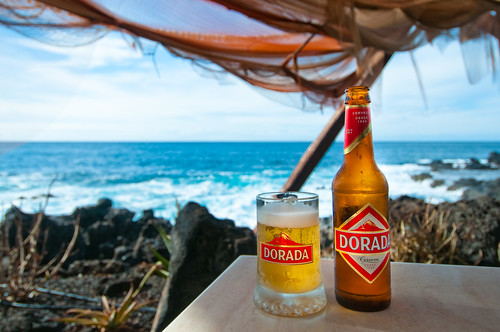
These next photos will be a collect of our first and second trips there and what we saw and experienced driving up into the narrow steep passes of the volcanic mountains themselves. First off, there is a place we stop at along the coast called Restaurant El Burgado, Buenavista del Norte, Tenerife. It was right next door to the Golf Club there in a public beach access park. The weather was perfect 25Celsius ( 77 Fahrenheit). Definitely T-Shirt, Short Pants and sandles weather. Humidity was perfect also since that is what makes it so comfortable. We heard back at our Hotel in Puerta de la Cruz that a storm could be moving in and we wanted to get ahead of it by driving towards the west and then south. We did spend a couple of hours there as the scenery and fresh air were just perfect for relaxing and kicking back. One of those times you could easily fall asleep and dream. So here is what we saw starting with pulling up to the restaurant El Burgado which is at the foot of the Buena Vista Golf Club. At first it wasn't open for food so we just had a couple of cerveza Doradas.


Once we walked up into the restaurant patio, I couldn't believe they landscaped with Tamarisk trees. Seriously , TAMARISKS ????? Okay to each his own and it is more native to Africa a part of which those islands are situated off the coast of Africa. But then what came next made me forget. *smile*


We actually got a front row seat too for watching the incredible rugged volcanic coastline and growing waves as the storm surge was approaching from the northeast. This first shot is the view looking straight ahead at an area we would later drive up and pass through a tunnel to the other side which is pretty isolated, but kool.

Now to my left of that shot are the crashing waves that kept getting bigger until we decided it was time to leave.


So then in the last picture you can see the dark clouds and storm surge getting stronger and we decided to head out of there quickly.
This next photo comes from a Tenerife web shot page, but it is a view from the air looking at what is on the other side of that tunnel up high and looking back at where we had been. Really kool picture. To the left of this tunnel shot were two more much longer narrow tunnels we had to drive through with our lights on. The picture shows all of the Green Houses and Banana Plantations which are all over the island. In many ways this place looks and feels like Hawaii with a squeaky clean hispanic twist.


Here are the light house and other steep cliffs looking towards the south point of the island.

Photo Mine 2012

Image Mine 2012

Image is Mine 2012

This side of the island was kool for no other reason than it was mostly wild. The steepness of the volcanic island mountains dropping abruptly into the sea was amazing and water was crytal clear and beautiful. Definitely a sort of Hawaiian Islands look about it. We unfortunately had to head back out those tunnels we came through and then back track through a steep narrow valley on our way to Masca which I wrote about in part one. Here are some pictures along the way.


The roads can be a bit spooky, but they also remind me of some of the old James Bond or other 1960s spy / intrigue flicks from the 1960s with those car chase scenes along the steep coast around the Mediterranean. Even Cary Grant's movie "To Catch A Thief" with the car chase from the police. The road above where the rock wall is we quickly had to dodge a public bus which had to make several back and forth maneuvers to make the hairpin turn. 
More later in a part three series of the Laurel Forest side of the islands and the gardens in Puerta de la Cruz.