Saturday, February 28, 2015

Squaw Tea (Ephedra californica) or maybe something else ?

Funny how some images can trigger totally unrelated information than what you were originally Google researching for


Face Palm
Finishing some work on one of my latest articles on the Canary Islands, in particular Tenerife, I was researching some of the names of plants I had photographed on a recent visit. I hit Google images for Plants of Tenerife and one image stood out which immediately brought up one common name for a high desert plant native to the region where I come from in Southern California. The infamous Squaw Tea. The plant I was familiar with grows abundantly in an area east of Terwilliger Road in the Anza area. The plant is Ephedra californica, but it is known by common historical common names as "Mormon Tea" and the other common name which immediately rushed through my brain, "Squaw Tea". Yes, Yes, I know, I know. We don't call it that anymore, but old common names and terms are hard to shake off. This particular photo of the girl above is a Spanish Model on a website with other girls in outdoor Canary Island nature settings. But the pattern of the shrub and the Native American styling of the girl just fit like a glove. Most foreigners reading here won't understand the comparison, but Southwesterners will put two and two together. I don't believe the common name with the Native American reference is encouraged these days, but never the less the old names are hard to shake. So I thought, why not, write a short piece on the plant. I'm not particularly partial to Mormon Tea either. Desert Tea appears to be another preferred name for Ephedra californica. But the similarities of structural patterns in foliage, branches and habitat are where it ends. The flowering time of year will yield radical differences. The southwest has a few varieties of Ephedra. In many desert locations both species (E. californica and Ephedra virides) exist together. The species, "Ephedra nevadensis" is found from the Mojave Desert north to the eastern side of the Sierra Nevadas into Nevada's Great Basin. I'll post the Green Mormon Tea plant in full bloom below and contrast it with Teide Broom when it is in full flower to illustrate some difference.

Teide Broom, Tenerife - (Spartocytisus supranbius)
The plant I was actually looking for when doing my Google search is native to the area of the volcanic caldera on Tenerife and it's listed as the Teide Broom (Spartocytisus supranubius) shrub. It thrives best on the dry xerophytic lava and scoria zone (2000-2500 meters above sea level). But it bares a striking resemblance to the southwestern desert Mormon Tea shrub of those high desert regions. The Ephedra californica that I am familiar with grows in the eastern reaches of Terwilliger Valley on down to Anza Borrego State Park. Throughout the world there are several species of Ephedra, which are related to the Ephedra sinica which is from the region of Mongolia, Russia and northerneastern desert regions of China. This plant is well known to Chinese medicine, but by a more familiar botanical herbal name called "Ma Huang". Here is how one reference describes it's usage and I'll post the reference under the Caution heading:
"A shrub, the stem of which contains ephedrine, which is a bronchodilator, diaphoretic, diuretic and vasoconstrictor; it is used to treat asthma, bronchitis, fever, fluid retention, hypotension, paraesthesias, to stimulate the central nervous system and to suppress the appetite."
Wiki-commons
This plant is responsible for providing the raw ingredient for the well known weight loss drug called ephedrine. In the USA, many of these drug potions which added Caffeine and other powerful stimulants for weight loss have been outlawed because they caused dangerous health conditions in some folks with heart trouble, high blood pressure, rapid breathing issues, etc. This is why many probably get a lot of Spam email advertising Ephedrine as an appetite suppressant. People want a quick fix pill to rapidly take care of a situation for which they have no patience in making lifestyle changes. While there is evidence of short term weight loss, there is really no evidence of any long term keeping the weight off. As far as the Tea from the Mormon Tea, for me it has a sort of mild Alfalfa taste to it and the potency is not near as strong as the Ma Huang drug manufactured for Chinese medicine. 
~~~~~~~~~~~~~~~~~~~~~~~~~~~~~~~~
image Bert Wilson: Green Mormon Tea (Ephedra viridis)
~~~~~~~~~~~~~~~~~~~~~~~~~~~~~~~~~
image: Mundani Gardens - Teide Broom (Spartocytisus supranubius)
I think the Canary Islands are my new favourite Nature region. I have been here many times and it feels more and more with each visit more like Home to me than where I originally come from. There are so many interesting plants here and each time I want to know more and more about them. Technical and mechanism type stuff really. I always walk away with more questions than I came with. The chaparral environment is so familiar with where I come from, especially when so many plants here are so common in most California urban landscape. Anyway, tomorrow I have some fascinating information on Pinus canariensis, fire ecology and it's influence with the island's hydrology. But first, a little more on some historical ecosystem understanding of Mormon Tea diet by giant ground sloths now extinct.
Giant Ground Sloths dined on Mormon Tea
Photo by Leslie Shaw of Hi-Desert Star
"The Joshua tree drew a record-setting crowd for the Morongo Basin Historical Society’s lecture series Jan. 14 at the Hi-Desert Nature Museum. Chris Clarke spoke about how the tree got its name, how it is distributed, its two varieties, its pests and enemies and hopes for its future."

Photo by Chip Clark
Just a few side points on the Southwestern United States and what the now extinct Giant Ground Sloths dined on. Throughout many areas of the southwestern United States there have been found numerous caves discovered where these giant ground Sloth's once lived and in them mummified dung left behind. The dung really is not a fossil dung in the sense of fossils like petrified forest wood or other biological material with has been turned into stone, but rather mummified and preserved by the very dry sheltered environment of these caves. One famous cave is Rampart Cave in the Grand Canyon, another cave in between Benson & Sierra Vista Arizona called Kartchner Caverns, old lava tubes in New Mexico, etc. The animal's diet seemed to have consisted of plants from the various rugged chaparral plant communities (especially high deserts) such as Desert Globe Mallow, Joshua Trees & other Yuccas, Agaves and Mormon Tea. Other plants commonly eaten by these sloths found in Nevada were capers and mustards, along with lilies, grasses, mints, and a member of the grape family. This has all been verified by the examination of the invaluable mummified dung found in these caves. One wonders what happened as a result of this animal's extinction (which many now believe to be human caused because of it's slothful nature and easy hunting), what effect this has had on western ecosystems. Same is true of other now extinct megafauna like the Mastadon which was a browser as opposed to a grazer.
~~~~~~~~~~~~~~~~~~~~~~~~~~~~~~~~
Some interesting as well as important links
The Biogeography of California Jointfir (Ephedra californica)
http://www.laspilitas.com/nature-of-california/plants/262--ephedra-californica
Chris Clarke: "On the Dry Side" 
Some Caution
http://www.drugs.com/ephedrine.html
http://www.emedicinehealth.com/drug-ma_huang_ephedra/article_em.htm

Thursday, September 4, 2014

Coastal Sage Scrub & Chaparral Exhibit @ San Diego Safari Park

image mine

San Diego Safari Park Chaparral Nativescape Exhibit

I've visited here many many times in the past and unfortunately I've always known that the Safari Park's Sage Scrub exhibit was the least visited of all the Park theme areas. But this time was worse and I'll actually go as far as to fault those in charge of oversight for this exhibit. Way back at the beginning of creating & constructing this exhibit, it's apparent that not a lot of attention regarding forward future thinking was undertook into the design planning that went into the layout. This isn't unique to San Diego Safari Park (former Wild Animal Park). I've found some of the same identical gross errors at the city of San Diego's Mission Trails Park near Santee, particularly near the old Padre Dam parking area. Next time you visit the parking area of the old Padre Dam area, see if you don't notice something odd about the Sycamores there. Same exact problem that exists here at the Sage Scrub Exhibit. But first, take a look at this *cough-cough* California Fan Palm below.
That's Not a California Fan Palm 😕
image: Mine

Listed as Washingtonia filifera or in Spanish as it's
common name of 'Palma de Abanko', but in reality it's a 

Guadalupe Island Fan Palm (Brahea edulis) from Baja California

There is a very interesting and truthful ancient biblical text which can be used to draw a comparison of what we observe in the botanical world and ability and insight in providing a true identification for the plant by the fruit it bears. Of course the original application was in identifying kinds of people by their actions, but it still never goes out of style when it comes to field identification. It reads like this:
"You’ll recognize them by their fruit. Are grapes gathered from thornbushes or figs from thistles?" Matt 7:16
Not very tough to tell what is meant by the text above, but can anyone tell me what is wrong with the botanical label stake at the foot of this Fan Palm tree when you compare it to the photo above ? It is listed as Washingtonia filifera, but I know better. The fruits of California Fan Palm are black and much tinier than the large round dates seen here. The Spanish name given on this label, 'Palma de Abanko' is apparently misspelled and should be "Palma de Abanico" which is basically a translation of the palm native to southern Baja California which we all know as Mexican Fan Palm or Washingtonia robusta. Mexican Fan Palm likewise does NOT have large dates on it's flowering fronds. They are like the California small and black little seeds. These palms were 5 together in the Baja part of the display. It is certainly similar in frond shape, but much smaller than the filifera and the spread is smaller. Clearly what it lacks in frond size and spread is more than made up for in date size. This is none other than Guadalupe Island Fan Palm (Brahea edulis). The main point here is the so-called University educated professionals who no doubt are paid high wages for their expertise in putting this display together dropped the ball big time on this one. In the Chaparral section where a typical desert oasis is incorporated within the SoCal Chaparral exhibit, those palms are indeed correctly labeled  as a visit would reveal. 

Image: Mine

I hope everyone appreciates what I am criticizing here is the lack of responsible expertise as I simply expect more out of Science Experts and Professionals who are promoted as being above the visiting layman public Park visitors when it comes to their understanding and knowledge of any particular section of this Safari Park. Now look at another extremely glaring example of incompetence below here. I often find this in other public venue areas such as the Mission Trails Regional Park in San Diego. This photograph below was listed as a California Sycamore (Plantanus racemosa). So can anyone tell me what's wrong with this picture ? Many in Southern California have a negative opinion on the chaparral plant community mainly because they lack in education on how to care for it. An exhibit which is badly maintained and choice of specimens planted in the wrong geologic location is yet another reason the plants look so dry jagged and rangy and many of the former lush types of species are now dead because of the wrong irrigation methods.
Is That Really a California Sycamore ??? 😲
Now take note of the photograph below of what is supposed to be a native California Sycamore (Platanus racemosa) planted within an Oasis setting with California Fan Palms in the San Diego County native plants Chaparral/Sage Scrub exhibit. Can anyone tell me what's wrong with this picture here ???


image mine:

 San Diego Safari Park Chaparral
 exhibit @ Oasis setting 
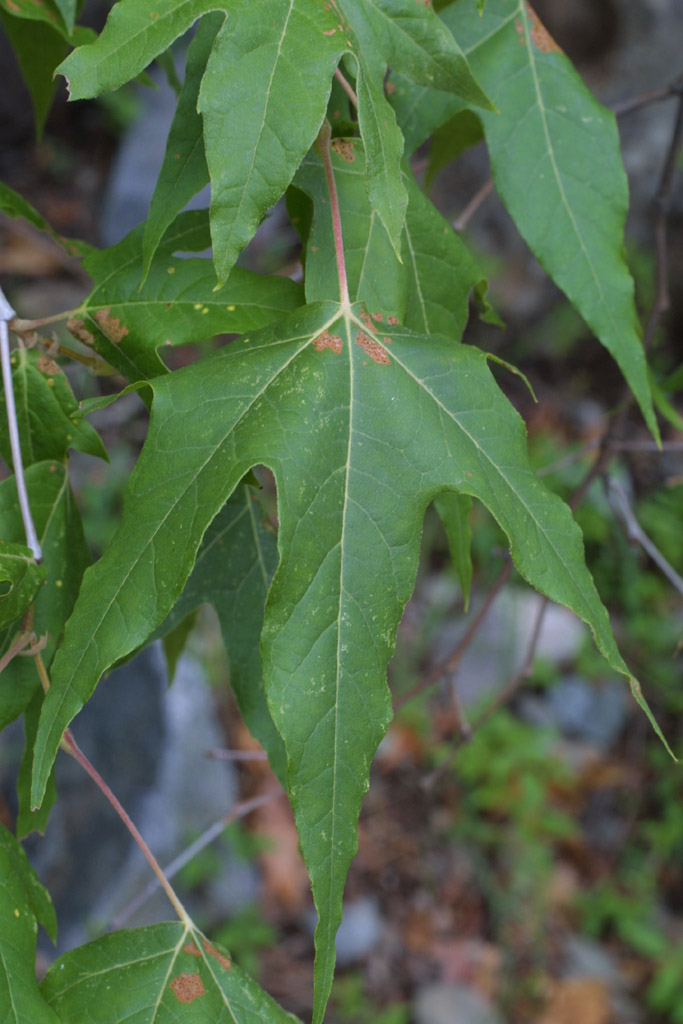
Let me help you out. Below are just three examples of three separate Sycamore trees which have a characteristic Maple leaf pattern which a California Sycamore does not have:
Mexican Sycamore (Platanus mexicana)
American Sycamore (Platanus occidentalis)
London Plane (Platanus acerfolia)
At worst both trees (SD Safari Park & Mission Trails) are in reality a cross bred hybrid of these non-native species of Sycamores with the characteristic Maple Leaf pattern with one of the Southwestern native Sycamores listed below here which in shape and form are almost identical in leaf pattern:
California Sycamore (Platanus racemosa)
Arizona Sycamore (Platanus wrightii)

image - landscaperesource.com
This is the same exact mistake or blunder at the San Diego Mission Trails Regional Park near the Padre Dam Parking area when I visited there in June and along also the old winding Mission Gorge Rd in the Mission Gorge Canyon just west of Santee. I have also seen this same common mistake in many of the conventional retail Nurseries with a label advertising California Sycamore when clearly it was one of the eastern North American or European varieties. Now I could almost excuse a mistake if Arizona Sycamore was being mislabeled as a California since both these Western Sycamores have a long fingered leaf design as opposed to the obvious maple leaf pattern. But there is no excuse whatsoever for the mistaken identity by credentialed university educated staff who were hired to be in charge of such an important native plant exhibit for the purpose of educating John/Jane Q-Public. The other thing is that the eastern North American and European [maybe even Eurasian Sycamore] are a darker green instead of the lighter green which is characteristic of western Sycamores. Also the non-native leaf is thicker, smoother surface & has more of a glossy texture on the surface than the native Sycamores. The natives also have a more fuzzy velvety leaf hairs covering the entire leaf surface. Again, I can forgive a rookie gardener or greenhorn landscaper for this type of mistake, but it's flat out irresponsible and lazy coming from those people in charge of exhibits or displays at public locations where biologists and botanists are supposed to be in charge of oversight and in the business of nature education of the public. Even Landscape Company owners or supervisors and owners of Retail Nurseries should have a measure of responsibility for the glaring mistakes where I often see California Sycamore labels on what clearly is a London Plane or American Sycamore tree. At times I have stumbled upon a mistaken label and mentioned this to Nurserymen. But my experience has been that they don't exactly appreciate you pointing this out and dismiss the complaint as nonsense. Whatever !!! It should be noted however that at Native Plant Nurseries, I have never seen this since their reputation is at stake and they pretty much have an intense passion for their native subject and know their specific plant IDs. Another give away of incorrect tree identification is the tree's overall silhouette, shape and form when older. California Sycamores as well as Arizona have a more picturesque twisting contorted shape or form and often can be multi-trunked with competing leaders, but of course as in anything, it's not always the rule. In the urban landscape where most of the non-natives with Maple-like leaves are found, they are generally a long single straight trunk tree with rounded ball-like crown or conventional tree form that most people consider ideal in the landscape. Even when young the differences are obvious. 
It's not just me saying this folks:  
Evidence for genetic erosion of a California native tree, Platanus racemosa, via recent, ongoing introgressive hybridization with an introduced ornamental species

Irresponsible Irrigation Infrastructure 😞
But back to the other problems I had with the chaparral display at the San Diego Safari Park. They unfortunately use an inappropriate exposed drip irrigation system on the ground's surface which is normally a horrible idea for native California plants anyway. The result is an  unsightly, in decline and rangy dead appearance of the shrubs on display for the public to view. I'm not a real fan of drip irrigation as a permanent maintenance solution. While starting out it has the appearance of being the perfect fit, it creates a type of welfare dependency in the plants which does not encourage the plant to pursue a deeper more effective root system infrastructure like they have in the wild.

image mine: chaparral display with exposed improper irrigation

One of the main goals of any public landscape exhibit is to educate  and instill deeper appreciation of the subject being displayed. The Chaparral Plant Community in general gets bad press from an ignorant public relations land management service whose loyalties generally lay within groups with vested interests in money making. The Park's exhibit had a rangy appearance and degradation of the Chaparral and other native plants in the area which taken together  only serve to reinforce pre-existing negative viewpoints of the native plant life of Southern California in my opinion. I have posted time and again how imperative deep pipe irrigation is to California Natives and an irrigation system which should not be used all the time on a continuous basis. The other factor which hurts many of these plants they have selected is the exhibit's location on a southern slope exposure which have geologically shallow soils with a massive granite bedrock base below a few inches of soil in some places. For the Cacti displays that's great, like the one below of the Baja Exhibit.


Image - SD Safari Park

One of the things they could have done in preparation prior to planting is something home builders often do in rural environments where soil percolation for septic lines needs vast improvement. They drill fairly deep holes in strategic locations within an area and place specific sized explosive charge in each hole. The goal is not to blow things up, but rather to simply fracture the underground down deep. Had this preparation been done here, the chaparral and other native tree roots would have had an easier time of penetrating more deeply through the surface to subsoil layers. Water would also have a better chance at percolating down into deeper layers of the earth where native plants prefer it for summer survival. Now here was another disappointment for me below.

Image Mine: Former Tecate Cypress display which contained at least half a dozen trees which are all now dead and removed.

This was sad. All Tecate Cypress with the exception of the small one to the right here are all dead and removed. There are still some Cuyamaca Cypress, but even some of them are gone and the ones that are left are unfortunately defoliating. Once again the culprit is poor maintenance and an inept irrigation system which had an "enabling effect" on the trees which probably grew to fast and out performed the root system which could not later support the needs of the larger trees. Drip irrigation can be compared to putting and keeping plants on life-support. Take them of that drip life-support and they die just like a critically ill patient at a hospital. Despite the present California mega-drought, the power of an urban landscape garden is that it doesn't have to reflect how poorly things are doing in the wild. This doesn't mean they need to water during summer, but they could have supplemented the poor showing of winter rains by irrigating slowly and deeply during the cooler months of the season. Below here is an example of what is left from the Cuyamaca Cypress display in the garden which was always right next to the Tecate Cypress location along the service road.


Cuyamaca Cypress

Unfortunately, this Cuyamaca Cypress above is also in dire straights as it sheds foliage to weather the drought period until the next winter season's rains offer some hopeful respite from the heat. But to restate the main purpose behind an educational display such as this nativescape should always reflect the beauty of a Chaparral and other coastal sage scrub native plant community which will draw the average person into appreciating such ecosystems more fully. Maybe even encouraging them to use natives in their own garden landscapes. After all, this is a replica not so much of the wild, but of an urban landscape setting where people have the power to control the climate settings. Heat is no obstacle to chaparral and other native plants as long as they have deep access to available subsoil moisture. In fact that was the very purpose of creating the Nativescape Gardens in the first place. As their own website states, their goal is to influence as many visitors as possible to replicate this Nativescape Garden in their own urban landscape back home. Here is what the website and page on Nativescape project actually says:
"The garden's 4 acres (1.6 hectares) show off Southern California's plant communities: chaparral, coastal sage scrub, cypress, desert transition, high desert, island, low desert, montane, palm oasis, and riparian. With names like Apache plume, California buckeye, and monkey flower, these intriguing but often overlooked plants show that there's considerable variety and splendor to California's native landscape. Once you've experienced these unique plants, you can help restore some of California's botanical heritage by including them in your own garden!"
San Diego Safari Park: Nativescapes Garden
Now on a Positive Note 😄
image: Mine

One exceptionally bright spot in this garden was the health and vigor of the Parry Pinyon which once numbered in the 1000s up in and around Anza Valley where I lived for 20+ years. Unfortunately as I last informed readers on Parry Pinyon's health condition and survival up there in Anza, they are in a major steep decline. Many Parry Pinyon skeletons are everywhere on the southeastern end of the Thomas Mountain range where they once dominated. But it's still nice to see this one could indeed inspired landscape designers in building a nativescape and using this tree as a choice addition. I've always considered the Parry Pinyon the most beautiful of all the Pinyons and yet under used as a potential landscape tree. The closest pinyon competitor which is also beautiful would be the darker green Pinus edulis which is native to New Mexico thru Arizona on into the Mojave Desert's backyard in the New York Mountains. But still, the Parry is so unique and probably has smallest concentrated locations more than many of the  Pinyons.

Parry Pinyon (Pinus quadrafolia)

There were of course some other bright spots like many of the Native Oaks which looked healthy and some Manzanitas which also looked to be in healthy peak condition, but could have done with a bit of trimming and sprucing up. There were also some other negatives like the California Holly, Lemonade Berry, Dudleya and other plants needing cages around them to prevent the local wild Mule deer population from eating the display. Well you can't blame them, like the opportunistic gopher, they just do what they do. Every living thing is desperate in California at the moment. Again, while I understand the need to show or illustrate the wildness of the chaparral and other native trees and plants, the idea is to impress and inspire the public to develop deep appreciate for a beautiful but misunderstood and often demonized plant community. The demonization has always been unfair and the motives behind the Critics [who generally have no expertise on the subject] have always been influenced by power and money. I admit that I've been a critic myself of the way things are done at the San Diego Safari Park in other areas before, but not because I dislike what they are attempting, which I believe goes well beyond entertainment and a mere profit making venture. But I'm just jealous for things to succeed and work out towards a positive outcome. But I do hold what clearly must be the cream of the crop highly educated ones whom the Park hired in the first place because of their specific education and expertise in certain areas who were hired and placed in positions of  responsibility and oversight, for making what I consider countless rookie greenhorn mistakes that one would find at a high school level. If it's a landscape workers or laborers issue, then educational programs should be mandated as a requirement for anyone hired for a specific area of maintenance. Deep appreciation has to be instilled within the figurative heart of those assigned to care for such an area or the result is exactly as what exists now. In fact it should be a employment hiring qualification. Again, this is the one area of that entire massive Safari Park which has always been the least visited. I have been there maybe 100+ times, often as a yearly member since 1972 and people will stop short of the Baja exhibit and turn right around and go back to Park Central because nothing inspires them to continue beyond that point. Below here is a website which offers Garden Tours and one of them was this past season's winter period when moisture however slightly greened up the area a bit. It illustrates how beautiful the area could be. And using the wrong plants and labels ? go figure - rookie stuff
http://www.gardenvisit.com/garden/wild_animal_park_gardens


 Just so that everyone is aware, this region up on that hill is still my favourite area of the entire Safari or Wild animal Park whatever you want to call it. I'm a freak for native chaparral woodland environments and so again if I'm critical, it's because I want their entire program up there to succeed and not fail. Generally when I come with family I have to tolerate several hours of seeing all the bottomland exhibits with the birds and animals before climbing up the hill to where I wanted go in the first place. But at least in the end I get my way. 😉
~~~~~~~~~~~~~~~~~~~~~~~~~~~~~~~~~~
Further Reading Educational References of Interest
http://www.californiachaparral.org/
Deep Irrigation Methods for Training Deeper Rooting networks 
California Native Plant Resources
http://www.laspilitas.com/
http://www.matilijanursery.com/
Tree of Life Nursery: California Native Plants

Thursday, August 7, 2014

Should Firefighters be expected to save Homes which are located in fire trap geography and where the owner cared less about landscape hygiene ?

Image: NBC San Diego
The above photo was taken up in the Coronado Hills above San Marcos back in the middle of May 2014 when the Cocos Fire erupted during one of the earliest heat waves driven by abnormal unseasonal Santa Ana Winds. I actually watched this fire creep up to this place on the Live News from NBC's helicopter. In the beginning, there was only a small spot fire, but it was headed towards these dead Aleppo Pines which the owner didn't bother to chop down. These trees went up like giant Roman Candles and from the vantage point of the helicopter, you could see 1000s of embers breaking free from these dead dried Aleppo Pines which exploded high up into the air spreading spot fires on both sides of this house & beyond that is pictured there behind the fire. These trees actually made the fire worse and prolonged it's life at the risk to firefighters on the ground. From the live News feeds you could see there were firefighters up around the driveway next to the house at the top, which is not surprising since heroics is part of most firefighter's nature anyway. But fortunately their commanders who had a better vantage point to survey the conditions ordered them to get out of there quickly. Luckily the house at the top of the hill was spared, but not the one closest to those trees. It should also be noted that there are some situations where homes with vast amounts of acreage that have home owners who clearly could have cared less about their landscape's lack of hygiene or landscape neatness which deserve to be left to chance. So should anyone consider such  properties really worth any firefighter's life for the sake of saving  material possessions ? Personally I say no. There is a vast difference in putting one's life on the line for them personally or saving their possessions. Houses can be replaced, but a firefighter who is a father, mother, son, daughter, friend etc cannot be replaced. This wasn't the only poor example up in those hills either, but it's an outstanding example of what I mean. For example, I saw multiple disease infested Oleander hedge rows used as a privacy barrier to outsiders which were mostly brown and dead. This phenomena with Oleanders isn't new. The blight attacking them has been spreading for years in Southern California, even Cal Trans has removed many median hedge barriers. Take the example below which as it was a couple years ago. Today it is almost totally yellow/brown & dead.

Google Earth
This photo from Google Earth is at the end of my mother's street across from Pepper Drive School in El Cajon California. This is at the foot of Rattlesnake Mountain. I neglected to take a photo on the very day we came back to Sweden the first week of July 2014, but not only is this exact same hedge almost totally brown and dead, but foxtail grasses which have been mowed down in the above photo, are two foot high leading clear up to this same hedge which is now almost totally dead. Now this location is an easier defensive position, but many places with such flammable landscape components in many remote property areas are in more fire trap locations where homes should have been allowed to be built in the first place. Of course never underestimate the power of future tax revenues when permits are issued. Now take a fast look at another fire which burned down in Lakeside at the very same week as the Cocos & Carlsbad Fires.


Image by Billy Ortiz Lakeside California Old Hwy 80 & Aurora Drive
When my wife and I flew into Southern California, we came during a period of intense heat and Santa Ana winds which are more characteristic of Sept/Oct/Nov. San Marcos, Carlsbad, Rancho Bernardo and Camp Pendleton were raging with fires. But a much smaller fire exploded further down south in Lakeside near old Hwy 80 & Los Coches Road. Oddly enough, I wrote exactly about this very spot where numerous dead and dying Eucalyptus could be found everywhere and the potential for future wildfire catastrophe. Low and behold lookie how accurate that prophecy came true. I wrote about this exact location back on May 29th, 2013 of last year and the issues regarding Red Gum Lerp infested Eucalyptus which seem to be everywhere and nobody taking any notice or actions to remove them. This would also include the San Diego Safari Park in Escondido: 
It's the Lerp Psyllid's fault ? So ? And ? (Nature takes the hit again in blame game) 

Image: Billy Ortiz - Fire along old Hwy 80 & Aurora Drive May 2014
Here again above is the wildfire as photographed by Billy Ortiz of Lakeside/El Cajon. Below here I drove by and took photos of the wildfire's aftermath. Both sides of the Highway were burned which means embers easily made it to the other side no doubt helped by winds burning dead Eucalyptus branches and twigs which exploded when the fire torched them. The very tall dead eucalyptus seen in Billy Ortiz's photo no doubt facilitated the fire's spread when it exploded into the atmosphere and carried along by the unseasonal Santa Ana Winds at that time of year. Fortunately they got the fire out, but it could have been much worse.


Photo Mine

Highway Eight Business Route, olde 80 & Aurora Drive


Photo Mine

This is the east side of old Highway route 80


Photo Mine

These next two photos are of the west side of
Old Hwy Route 80


Photo Mime
~~~~~~~~~~~~~~~~~~~~~~~~~~~~~~~~
Now Back to Coronado Hills & the Landscape
My Son and other family members of mine have a house up in those Coronado Hills on Cycad Drive which was very much in the News. In fact, their house specifically was the focus of attention on the News during this firestorm. They lost three sheds, a truck, their  gazebo, and the back eve's of the house were burnt. Below is a News 8 team's 4:00 minute video of the fire moving up the opposite side of the canyon where the camera vantage point was right on Coronado Hills drive on the west side. The fire moves right up through their backyard which is on the east side of this heavily vegetated Canyon. Oddly enough, they did have a considerable firebreak on the north and west sides, but the neighbour to the south had a huge forest of giant Bamboo, which by the way has sprung back to life.


 From the very start of the video above to the 30 second mark, you can actually see the Coulter Pine my Son and I planted over a decade ago and I've written about in the past. The Cocos Fire never really burned the tree, as we had a lot of clearance right down to the bare soil all around this tree. But it took everything else around that tree. The tree itself was scorched by the intense heat. Like the tree, the house was miraculously spared with only the interior window blinds being melted inside, along with some exterior roofing. If you look very closely at the photo below here of the branch end tips, they still have life in them and are green. This happened in the 1982 with many of the Jeffrey and Coulter pine in the Mountain Center Fire. Many trees which looked dead were merely experiencing needle scorch. They sprang back to life and today a younger forest which was helped along by chaparral that was left intact and not interfered with for doing it's job of Sapling encouragement. Notice the green interior of the pine bud above ? Now look below at the branch ends of the young scorched Coulter Pine.


Image Mine


Image - J Santino 2013
Once again, the photo above here is of the Coulter Pine that by all appearances and logic seems a lost cause. But take closer note of the still viable greeen bud material at all the tips. This tree was not so much burned as heat scortched. Here on the right is what this Coulter Pine looked like when I photographed it in 2013, one year prior to this fire in the Spring of 2014. But after the intense heat of the Cocos Wildfire up that canyon where Coronado Hills Drive winds back and forth on the other side, the brown needles appear to signal the death knell for this young Coulter. But all is not lost as I've just updates a year later from a photograph I received from the property owner here below. One big mstake many people make is immediate removal of all dead looking material in the landscape, but be patient for a few months and see what and where plants sprout back to life.
 Brilliant Update May 11, 2015 Coulter Pine Survival Status

Photo - Jeannette Santino (2015)

Never ever underestimate the power of life regeneration after fire when conventional wisdom convinces you all is lost. Now take a close look at some other interesting feature plant components within their landscape. For example, most folks here know of or have at least seen Sea Fig which has naturalized down along the SoCal beach coastlines or commonly used along SoCal Freeways. We also call them iceplant and they seem like such a perfect fit in a wildfire prone area's landscape. You may need to rethink that.


Image Mine

The above photo is of what use to be the bank's Sea Fig Ice Plant which burned like anything else on the property. In fact the immediate garden or landscape was surrounded by massive amounts of this plant which skirted the entire canyon side of the landscape. While it has the appearance of being the prefect fire barrier for it's seeming water storage capacity, what most folks don't often realize about all ice plants is that they have a heavy dead thatch building up underneath their top green exterior. I cannot find the News video, but one News outlet was showing firefighters during mopping up operations on some properties which had smoking and smoldering ice plant which had heavy thatch underneath the seeming protective mass of green water storage plants. Nothing is a guarantee if weather conditions are right. He are some more shots of the Sea Fig below.
Photo Mine

Looking west from property across
the canyon at Coronado Hills Drive


Photo Mine
Take a close look at these next two photographs below here. Both are of two different locations in their front yard which wasn't at all a part of the direct hit frontal attack from the fire coming up the canyon, but there were spot fires from embers. This is where landscape tidiness is imperative, but not always a guarantee. It's just the way things are. Blowing sparks and embers can find their way anywhere.


Photo Mine
Both of these photos tell a story of fire defense spaces. The one above was where a Manzanita with the usual amount of natural dander [mulch] underneath it branches once stood. Now I like dander underneath my native landscape plants, that's the way things work in Nature, but fire will find these spots and ignite a fire, just so you know. The other one below has succulents which had their own version of dead older leaves and thatch underneath. The main reason you'd never take notice of such older dead material is because the overall top cover was always pretty and green to the eye. It mirrors the very same deceptive problems common with the Ice Plant banks. But where ever dead thatch is present, wind blown embers are sure to find. BTW the homeowners mentioned in the property above did have a well maintained clean landscape, but nothing is a guarantee when it comes to poor location.


Photo Mine
Below here now is another interesting example of a landscape tree in the same neighbourhood which looks to have been enveloped by the intense heat which turned the needles brown like the Coulter Pine in the backyard. You can tell that the fire never actually touched this tree, otherwise we wouldn't be viewing anything in the way of pine needles now. In actual fact I have been told that this tree is still alive and well, although it's tough to view it that way from this photo. Canary Island pines are tough and one of the few to sprout back from the truck and branches after going through a forest fire. But fire prone areas even on the Canary Island are what this tree is adapted well to. I love Canary Island Pines, in fact so much that I traveled to the Canary Islands to see them in their natural habitat to see and view just how they live. Incredibly as tough & drought resistant as they are, I don't think I'd recommend them for rural properties with wildfire hazard potential. The main reason is that of all pines I have ever dealt with, they are the most intense producers of Pine Straw thatch on the ground below themselves. Their pine straw also completely coats and smothers other shrubs underneath them which makes those plants more prone to catching fire.


Photo Mine
When I was landscape head gardener in San Diego, we had numerous Canary Island Pines around the pool and clubhouse area. It was an almost daily chore to deal with the massive amounts of needles that were shed almost every single day. Below gives you an idea of the overwhelming task of maintaining under these Canary Island Pine trees. And yet I admire them greatly. They are beautiful and tough survivors and if you don't mind the regular maintenance, then by all means utilize them in your landscape. But be forewarned of their fire encouraging potential if you don't clean up after them. 
Brilliant Update - March 2015 Canary Island Pine Survival Status

Photo - Jeannette Santino (2015)
Once again, this homeowner was in a hurry to clean up. They assumed the this Canary Island Pine was a lost cause. Under normal circumstances with many trees and shrubs, this might be true, but almost never with this species of pine tree. Now the tree has been sadly topped and for no good reasons than mere assumptions. The only winner here was the tree trimming company who made out like a bandit with the cash.

David Lange, Santa Barbara California

Below here is my trip to the Canary Island of Tenerife. The photograph was taken inside the ancient super volcanic caldera which collapsed in on itself and formed this massive several miles across in diameter enclosed valley. A later pyramid shaped volcano developed and is actually to the right, but out of the picture below. What fascinated me is the almost absence of any other shrubs on the slopes with the exception of this tree in pure stands. The forest floor under these trees was heavily littered with Canary Island pine needles which was extremely dense and thick. They tend to cover up and soften the geological ruggedness of the fractured volcanic soil landscape which then better allows for rain to soak in and percolate. Very little run off here from what I observed with no riparian vegetation that I could ever see in most of the washes and canyons on the island. When I maintained the landscape at the Mobile Home Park in El Cajon which was one of the properties our company maintained, it was always a chore to clean up needles off of all the shrubs and even within the entire Chainlink fencing which surrounded the pool deck area. This alone should give clues as to the present danger of fire ignition possibilities when maintenance lacks around these trees. Again, I'm not against Canary Island Pines, but Just Say'in.


Photo Mine (Tenerife 2012)


image mine: 2014 SD Safari Park
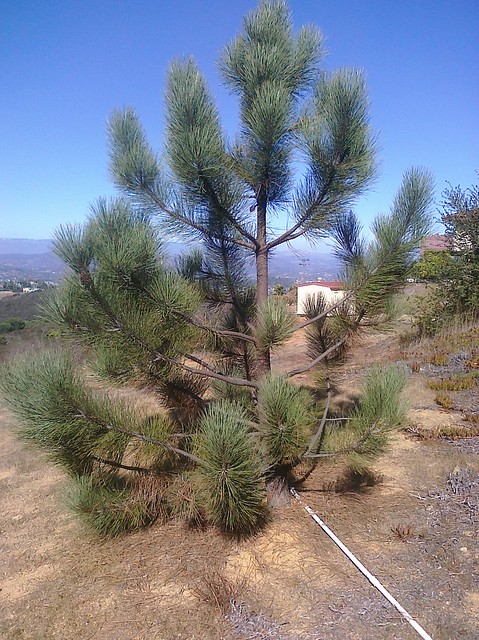
My favourite Pine for the rural landscape would be a Torrey Pine over a Canary Island Pine. The reason is they don't have as dense a needles production and their heavier needle bundles will fall through Chaparral easier than the lighter longer Canary Island Pine needles which will float and land on top of the shrub. When they are young they will tend to be long and leggy as you see here in the photograph I took of a staked young Torrey Pine at the San Diego Safari Park near Escondido. In the wild it's the large Chaparral Scrub which not only provides and nurtures these trees with water and nutrients, but also provide them with the natural mechanical staking that we do otherwise in our urban landscapes artificially with wooden or steel posts and ties. From a moderate to light wildfire perspective, they could endure much better because they have a much cleaner smoother bark and trunk than many other pines and they'll merely shed their lower branches with any heat or smoke damage. The smoke and heat even further prunes them naturally into a more clean streamlined tall look far above the ground. I had an experience with this in the photograph below when I lived up in Anza California. Those are the first Torrey Pines I planted back in 1986.


Photo Mine

Torrey Pines - Anza California, Burnt Valley Road

When the four Torrey Pines were as tall as the one pictured in the Safari Park photo above, there was a rather large Hedgehog Cactus at the bottom of this back below where that was is now. There were foxtail grasses which were only 5 or 6 inches high, but they had grown into the cactus spines and it was a tedious stickery job to get them out. Thinking I had a clever idea [please do not try this stupid dumb stunt at home], I decided one late night after the neighbourhood was in bed, to strike a match and take care of the foxtails cleanly. Didn't happen. The long large spines of the cactus caught fire, created a rather large high flame which in turn created it's own powerful stiff breeze which swished the lower Torrey Pine branches back and forth till it finally died down. The next morning I came out and found the cactus a total loss and though the Torrey Pine branches didn't burn, they did turn brown. Eventually those lower branches never came back and actually died. I had to prune them. Not all chaparral fires burn up through the Scrub canopy. Many small fires if conditions are right will burn the undergrowth only. I saw this several times in Anza where the weather conditions with high humidity and little wind allowed lightning fires to only burn chaparral understory. Even still, maintenance is a must for fire protection and defensible space and everyone in the rural areas should get this. 
Further Update: Monday 25, August 2014
The headlines everywhere read, "Small Actions can Reduce Wildfire Risks" and along with it the latest favourite poster child photo of a house that escaped because of it's landscaping. Well, that's only partially correct. Wind direction and luck played a bigger role.

AP File Photo Taylor Bridge Fire

USA Today
Lately there has been a reemergence of a double before and after photograph [above] of a house on a hillside above Bettas Road near Cle Elum Washington during the Taylor Bridge Fire which doesn't exactly tell the whole. The upper photo shows a roaring fire about ready to pounce on a helpless looking house. The lower photo gives the impression that the clever smart landscaping of the homeowners is what saved the day. The lower photo shows a completely blackened area which that raging fire consumed all around the home. While the landscaping was fairly clean and neat, those pictures and the story told in the articles don't reveal or expose the truth of the matter. You see, all but one [USA Today] news journal left out another important photo which reveals the fire wasn't as bad as first photographed. It was burning down hill and against the wind direction. The photo at the above right here shows a completely subdued slow moving fire with no firetrucks or firemen saving the day. What saved this house was the weather conditions more than anything else. Believe it or not I actually wrote about this exact fire and the circumstances back in August 2012 and yet still the incomplete story still prevails today:
Modern Day Megafires: Understanding Some Basic Fundamentals for Survival

In summing up, there are a couple of things rural homeowners need to come to grips with here. First, if you choose a high profile view lot, then you have chosen a wildfire magnet which wants to drive uphill. That's the nature of what most all fires will do. It's called physics. Fires thrive on defying gravity. You should also chose a property that is not a fire trap. The photo to the right here is in San Diego County California and is located behind the Sheriff Sub-Station on San Felipe Road or S-2. It has an impossible access with no escape route. I asked my brother in nearby Ranchita about this lot and nobody seems to know what they owners has in mind here.  If the person chooses to build and  to live here, then they should  be prepared to accept the financial property loss consequences and do NOT expect firefighters to be heroes and save your dream home by quite possibly sacrificing their lives literally. Many will try and save it anyway, because that's in their nature to rescue people and their material possessions. But j just don't take advantage of this. Even on my property in Anza, I always knew being at the top of a knoll with a fantastic 180 degree view also brought inevitable consequences which I accepted. Also, you need to understand there is no such thing as fire resistant landscapes. Everything organic under the right conditions will burn. Some do have more volatile oils than others, but everything burns, even the cryptonite immune ice plant on steroids burns. In southern California I have always found the Natives do the best under the climate conditions that exist there. Many non-natives will stress and partially die at best without constant water availability. But mostly you will have to accept the inevitable when and where you choose to live. With climate change and urban environments, there is no guarantee as we have seen on the News.
~~~~~~~~~~~~~~~~~~~~~~~~~~~~~~~~~
Update August 25, 2014
Lincoln Bramwell, US Forest Service Historian: “Wilderburbs: Communities on Nature’s Edge”


http://www.nhbs.com/wilderburbs_communities_on_natures_edge_tefno_199783.html