Tuesday, August 14, 2012

Göteborg - Desert Life Part II

The theme here is TRÄD-GOURDS

Squash Vine Göteborg Botaniska Trädgård
Believe it or not, part of the desert theme was typical vegetable gardening done down in the deserts of the southwest and elsewhere. Gourds (a here play on the Swedish word Gård which is essentially pronounced identically but differing meaning) were a central theme in the vegetable gardening area of the Bontanical Garden Desert Life here in Göteborg. For me and my experience, plants such as squashes, pumpkins, mellons and yes - Gourds are vining plants that need a long hot growing season. I've seen seeds sold in the Trädgård (garden) centers like Hornback & Bauhaus here but never attempted to purchase any seeds because I've never had the ideal sunny location in my personal backyard setting for such success. The summers to me here have always been less than ideal for even growing tomatoes, let alone plants in the squash family.

Southwestern Vegetable Garden Display- These are Gourds

Typical Bottle Gourd
The idea behind this year's theme and even the very colour green incorporated in the title of this years 'Ökenliv' (Desert Life) theme on the local billboards was indeed to celebrate that the deserts around the global are rich and abundant in life despite many of the negative attitudes associated with imagined desert environs by those out of touch with the reality of true Desert Life. But clearly there is much much more as this display revealed.  

Like many northern European residents, Swedes are out of touch with the reality of the rest of the world when it comes to water. It's taken for granted here as it is clean and abundant almost everywhere. They turn on the tap and out comes crystal clear sweet water. There basically are no gardens here that have an outside water spigot with garden hose for the average garden (trädgård) and there are no irrigation systems to speak of. It rains all the time.  It would be exactly the reverse opposite if a native Arizonan did not truly appreciate the sun and taking advantage of Solar Energy solutions and countless other sunshine benefits. Not that such a thing happens in Arizona of course - *cough - cough*

Water Purifying Alum
I recently watched a small video documentary from friends who are Missionaries in the African Country of Tanzania next to Kenya. They showed us video where this village goes through a daily ritual of carrying numerous 5 gallon buckets of water from a filthy dirty pond infested with all manner of froggys, bugs and bacteria. They run it through a sieve to strain off the large debris, take a mineral rock made of Alum which is used as a chemical flocculant and used to clarify water by neutralizing the electrical double layer surrounding very fine suspended particles, allowing them to floccuate (stick together). After flocculation, the particles are suspended in the water and will be large enough to settle or float and can be removed after leaving it over night. The water miraculously turns fairly clear over night without any agitation. Siphoning off the clear water and putting a type of chlorine purification tablets is necessary after that and then putting it in clear plastic bottles to allow UV rays to kill any micro-organisms left. Deserts are definitely a challenge for many but possible if you have knowledge for surviving it.
photo: Mine
This trellis was created into a sort of hooped arbor and the gourd vines trained so as to grow up and over to the other side. I hope they make it before Autumn comes quickly here. Often in September. Notice other varieties of gourds hanging from the trellis ?
Interior of Trellis was loaded with several types of gourds


photo: Mine
Another see thru view with the flowers and gourds on the walls and ceiling of the Trellis
Another abundant feature of the gardens this year were the countless insects which massed all over the flower beds. Up above those cactus mosaics I referenced in my Part 1 of this blog on the hillside above the pond and to the left was another flower garden with the same bright colour theme, but incorporated with more sage varieties and other insect attracting plants. Some of the flowers looked like variety of coneflower as in Mexican Hat which is native to New Mexico and other areas of southwest. First time I ever saw Mexican Hat it in great abundance in woods around Ruidosa NM in among the Gambel Oaks. Other plants were Sages which attracted quite a bit of Bumble Bees. I actually see far more of them in Sweden than I do the common European Honey Bee.

Only thing missing in the flower beds were Hummingbirds


photo: Mine


Native BumbleBee
There are a great variety my wife and I saw that gave us some terrific ideas for doing more in an otherwise shallow soil of our backyard which is mostly composed of granite bedrock. One of the plants at the Botanical Garden that does quite well was Lavender. This plant I would never have guessed would do well here when I first came to live. It's so Mediterranean looking. But look here below at the south facing wall of our house.


photo: Mine
The light greenish looking plants at both ends of the row of Lavender are believe it or not Sedum 'Autum Joy' which dies back to the ground every winter and grows back with a vengeance every Spring/Summer with absolutely not care other than trimming the dead stems in the winter.

This is up towards the Cafe area of the gardens.

photo: Mine
I've really got to get this plant here sometime this year or next in my garden. I see it everywhere. The plant is called Crocosmia 'Lucifer' and is technically native to South Africa but amazingly does well here in this climate. I truly dislike the name given it. Why not call it something like Scarlet Sword or some other non-offensive title other than Lucifer.
They can be either evergreen or deciduous perennials that grow from basal underground corms as referenced here to the right in the photo. You'll notice the younger corms at the top and older towards the bottom. Some can be a challenge as they can become invasive in certain climates by easily breaking off forming newer plants. Perfect looking hummingbird plant though. I didn't really notice any insects going for these at the Gardens here. Clearly the tubular flowers favour a Hummer somewhere.

I love Boulders
Part three tomorrow should be interesting. It'll look a lot like parts of Sedona Arizona created in a Boreal Forest backyard.  Lots of great ideas for substitutes with this years visit to Göteborg Bontanical Garden. First focus will be on rock and boulder placement and not going cheezy on some things. If you're gonna do it, do it right!!!


Monday, August 13, 2012

Göteborgs Botaniska Trädgård > Desert Life 2012

Or Gothenburg's Botanical Gardens

The above banner for months could be seen all over Göteborg at most Bus and Trolley stops. For me it was an eye catcher and a real motivator for visiting the place I have been to countless times in Göteborg. One of the few retreats and escapes for someone who has a terrible dislike of cities anywhere on the planet. Well some I like. Most I don't. I have to admit I have not been there for sometime. I imagine for many most folks are into the spring displays in the gardens where all manner of flowers plants from Bulbs like tulips and such and loads of Rhododendrons & Azaleas flower profusely everywhere under the giant old growth tree canopies. While I'm okay with that sort of gardens, it's not necessarily my favourite. But I'll take it over the city any day.


This year however has been radically different. The poster was most inviting for me and I finally caved in last week and visited. But I've been putting off the visit as the weather this summer has been cool and constantly wet. What intrigued me most this year were some of the great creative ideas of recreating a type of ecosystem theme that won't normally exist here, but by substituting other plants that will survive but have similar patterned characteristics of  plants you would be familiar with in warmer climates, you can pull off a sort of smoke and mirrors of magic so to speak. I'll write about that on another post as some theme ideas deserve their very own subject matter.
photo: Mine
The photo above is of the long slender pool which greets the visitor. At the very end of the pool you can see the clever way they used plants to carefully illustrate through art this years Desert View theme. Take a close look below. Many succulents and other smaller plants used to recreate the cactus giants found in the warmer climates. Speaking personally, I think I would have made the Saguaro a little beefier looking. It's entirely made up of small agave type succulents more closely related to Dudleyas. Skinny or slender cactus pipe type examples are not the nature of a giant Saguaro.  But still looked good.


The Prickly Pear Cactus is something anyone could easily recreate as a permanent feature on a bank location. The setting looks like something you see on a bank of a Southwestern College Campus, but they probably would use the real thing anyway and would never consider such a arttistic display. Still, such a giant feature would look great at the open end of a football stadium. The Saguaro looks like goalposts anyway. Maybe even something for the enclosed interior of a shopping mall somewhere. I know because I've seen indoor enclosed ecosystem landscapes inside hotels and malls in Scottsdale Arizona where the harsh dry desert heat and bitter winter colds would not allow tropical settings to exist. Possibilities are endless.


Another kool feature aside from the usual displays like the water lilies in the pond were the flower arrangements in this years entrance feature in front of the pond that not only incorporated the use of Cactus and Agaves in among brightly coloured flowers giving the appearance of a desert spring, but the brilliant deep earth tones of the gravel and flower choice colour schemes not necessarily associated with Sweden and other northern climates. It was a refreshing change. Uusally here in Sweden such bright reds and organges only appear in the wild landscape's fruitage in the form of berries and other fruit. Flower colours are usually yellows, blues, purples, violets, soft lavenders and pinks/whites. Take a look below at the gallery of such southwestern mimiced combinations.


Photo: Mine

Blue Agave incorporated among traditional bright hispanic coloured garden themes.


A bit of an organ pipe patterned cactus here


Agave varieties are bright yellows, organges and reds


A varigated striped Agave used here


Photo: Mine
Makes me wish I was back home where such features are a permanent feature which won't have to be dug up and stored away for 6+ months or more.

Photo: Mine

This flower and similar ones in their displays brought back to mind Gaillardia 'Firewheel' , 'Arizona Sun'  or 'Blanket Flower' which are native to parts southwest. First time I saw them was at a roadside stop between Lordsburg & Deming New Mexico.
~~~~~~~~~~~~~~~~~~~~~~~~~~~~~~~~~~
Link to Göteborgs Botaniska Trädgård:
Well I have more subjects and pictures, but they all deserve to be separated. Some are specimen and an Urban landscape's Hardscape features story. 
Enjoy!

Friday, August 10, 2012

Uptopian Visions of Futuristic Eco-Green Buildings

It always amazes me how just the right landscape elements with regard to the correct plant choices can create beauty in what would be an otherwise mundane modern Architectural monstrosity. I've never been a modern architectural fan , but . . . ?

The School of Art & Design , Singapore


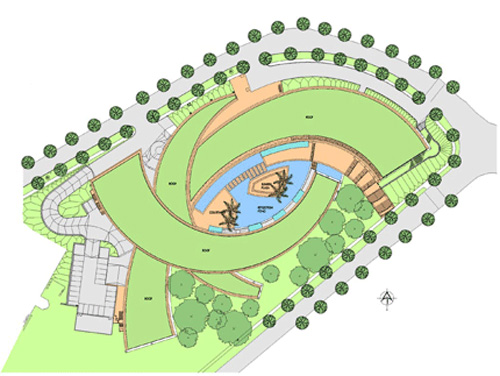
Basic Architectural Layout of The School of Art, Design, Singapore


I think the above architectural design concept is kool and doesn't appear to offer a Landscape Maintenance Nightmare. I say garden maintenance nightmare because whenever I see such common everyday proposed animated Eco-Green Futuristic looking Utopian Dreamscapes present on various websites on the Internet, the first thing my Property Management background Mind wants to know after I get past the obvious "Eye-Candy" sales pitch is, "Just how do you maintain such monstrosities ?"


For years Hollywood has depicted many futuristic human societies in it's films or TV Series shows as having progressed from it's primitive neanderthal past and becoming sophisticated in their understanding of the environment and having created a Utopian style of governance. Yet nothing in todays reality or historical past indicates they will ever achieve such an ultimate high bar set goal. 

But getting back to the architecture. While I don't like most modern buildings, plants surely soften the abrasive sharp lines, angles and general overall cleaned up Soviet Housing Project styled buildings which were merely meant to be functional at housing a sea of growing humanity in what amounted to nothing more than upgraded livestock paddocks. Plants also hide the flaws and inability of the modern day Architect who truly has no creative intuitiveness of any artistic worth or ability for which to bring comfort, warmth and a surrounding environment of serenity to the people they are meant to serve in the end. Take a look at some artist concepts of these plantbuilding marriages of future  Utopian Projects.


Stefano Boeri - Vertical Forest


Biomimicry: Answer to World's Problems ?


Monsanto's Version of "Silent Running" run by their LabCoats for own Humanities good.


by Getty Images
So what are some of the obstacles that a former Property Management Landscaper sees in such Uptopian Dreamscapes ? Mega-maintenance challenge nightmares. Take that top illustration as an example. Instead of those large window maintenance crew carriages lowered from permanently mounted cranes on top of or on the sides of Skyscapers, the carriages are retrofitted for landscape workers with all manner of the same equipment utilized now. Obviously they have to work on plants and small trees. But I have questions. What about dangerous sharp tools like saws, clippers, etc ? Are there also ground crews available on the streets below to intercept such dangerous life threatening debri from the skies above ? Who catches all the branches and other small trimmings ?  What happens way up high when such debri is picked up be high winds ? What kind of Medical & Liability Insurances will be required by the company contracted to carry out this monumental maintence nightmare ? How will this effect Corporate Building owner costs or Condo owner's monthly fees or Association dues ?

What about chemical pesticidal usuage, fungicidal fumigants, or other manner of pest control issues ? Will the building have to be evacuated of it's human inhabitants at specific times where such practices are necessitated ? What about irrigation system maintenance ? Most Irrigation systems still aren't  perfected for being self-maintaining as daily inspections are still required on most normal projects, will this drive up costs ? How often will home/condo owners be disturbed by maintenance workers needing access for maintenance ? What responsibilities & duties will be required by the home/condo owners ? How will you motivate these people do their part especially in this world's growing  atmosphere of  'Freedom Mentality' and "don't tell me what I should and shouldn't - can or can't  do"  ?????

I know, I've ruined everyone's virtual reality utopian dreamscape fantasy. Well, that's how I was viewed over at Inhabitat's forum discussion site when I asked these very questions. Instead of healthy discussion and viable sollutions, I was the recipient of anger, irritation, name calling and accusations of being a rabblerouser, etc.

Click if you agree


***********************
 

Illustration # 2 = Biomimicry

Definition: 
examination of Nature, its models, systems, processes, and elements to emulate or take inspiration from in order to solve human problems


Makes sense. Our best inventions are mostly carbon copies of the amazingly brilliant, complex and sophisticated design realities we find everywhere in nature. Yet often times such designs are misused and abused by those championing them. Biomimicry is great, but instead of more inventions and innovations being used in attacking the symptoms, why not use biomimicry to restore the functions once found in nature's various ecosystems which were destroyed in puruit of the raw materials for manufacturing biomimiced consumer goods ?????  

One main feature on Earth to be restored would be various plant ecosystems around the globe which actually drive and moderate our planet's climate mechanisms. These have been rapidly dismantled at the blessing of most human governments interested ONLY in creating bohemoth National economies running on steroids. That's what keeps politicians elected and staying there.

**********************


Illustration # 3 - Monsanto's Vision of Utopia


Wow, who truly wants to even go to a world where this is how agriculture run and by who or whom ? Enough written about these people, so no need to elaberate any. Other questions do come up though. With all these Utopian ideas, where do the third world people fit in ? Were they even remotely thought of by the architechs when they dreamed up visions of modern cityscape life ? Or are such schemes entirely designed for Euro & North American countries or the super-rich of the wealthier Asian cities ONLY ? 

People forget that the planet is so interconnected in all it's incredible mechanisms. It's biology is tied to it's geology with all of it's incredible phenomena of physics. Dismantling incredible amounts of sophisticated biological systems piece by piece has proven this. Modifying biology into something certain selfish Intellects envision isn't the answer either as it is obvious much of the damage they've already done in this GMO field will most likely never be undone and corrected. 

There's ultimately nothing wrong with creativity and dreaming of future possiblities. I still basically like the site http://inhabitat.com/ and still view beautiful pictures & storylines from time to time. Pictures can inspire one's own creativity and inspire or trigger something in the imagination in another direction. But escaping into utopian dreams and ignoring our world's reality only delays the inevitable. Mankind's ways of problem solving were beautifully illustrated in that Losing the Lake Mead game I posted yesterday. The rules were simple and biomimiced imperfect human problem solving which often trips off into quickfix fantasy as opposed to real world sollution fixing reality by stopping the cause of problems. The game had rules. When you play, you'll be able to make decisions both as a home owner and water manager. However it won't allow you to make population growth control restrictions and such. Everything moves along at normal pace without hinderances and it's your job to not solve the problem, but delay the catastrophic inevitability which is the lake disappearing.

Okay shifting gears here. I'm off to Björngårdsvillan Cafe in Slottsskogen Park here in Göteborg Sweden. But only after I go to the Göteborg Botanincal Garden. BTW - Here's a photo of that Cafe and Art School building below. The first one is the present modern look brought to you by superior modern day Scandinavian Architecture. The second photo are of the original building on the same exact land that the modern building replaced. Which do you prefer ??????


Björngårdsvillan Building 1963  - Slottsskogen Park


Which one has more class & artisitc taste ? Seriously, most Scandinavians hate the second type. In a couple weeks I'll have a post on and about the present Cafe which is alot like the Seattle Coffee House as far as atmosphere as the one on the show "Fraiser"


Cheers!
--


Thursday, August 9, 2012

Mexican Ingenuity: If Anyone Can a Mexi-Can !

If it can be done, leave it to Mexicans to figure it out and for free. --  somexican.com
And I have to admit this just isn't about folks from Mexico, but people from around the globe who reside in countries where your personal situation in life and the cards you were dealt so to speak at your birth just seems (from a purely material standpoint)  to have the card deck stacked against you. Yet somehow these people survive where most Yankees and Euros by their modern day nature expect their respective governments to spoon feed them when they get a slight nose bleed or skinned up knee. Folks in the third world still rely on alot of tradition, much of that coming from their large extended families. Sadly this is something else those of European descent have long forgotten thru all their secularism.
somexicam.com
Take those two little girls in the photo here to the right working together to overcome an seemingly impossible obstacle. They no doubt learned such problem solving by watching their parents and other adults from their culture. This was also my first experience in problem solving with seemingly impossible odds by watching the Mexican culture as I grew up as a child and looking from my culture as an outsider looking into theirs. As I grew my opinions began to change as I became more and more influenced by my hispanic neighbours and fellow workmates whose many cultural qualities & ways I still admire to this day.

When I was growing up of course it was common for them to be made fun of  because perhaps they didn't have as nice of things as we and made to do with what always seemed second hand stuff. Why even your old things sent to Goodwill charities you figured probably ended up in Mexico. Still it was an ignorant unkindness for Anglo folks of my culture and generation back then to poke fun and joke at their expense, but it none the less was done. It's the way things were.

Later on in the late 1970s-80s to 1990 when I worked with automotive restoration, I had numerous business accounts down in Imperial Valley California in the cities of El Centro and Brawley which exposed me all the more so to the real Mexican Culture which was far different from the coast and closer to Mexico itself.  Often when traveling once a week to service those accounts, I'd pass this common breakdownalong the side of a highway 111 or 86 somewhere out in the middle of nowhere between Brawley & Indio with a car or truck broken down with it's hood up and two men walking in opposite directions with eyes intently fixated at the ground looking for something of value. Meanwhile in the car sat two wives of these men with a lot of kids in the heat. I know someone out there knows what I'm trying to illustrate. Usually these cars were the older technologynvehicles, but simple and easier to work on when broken down. No computers necessary.

image by Highway Maintenance Blog - Cuba

But I would see this scene playout so regularly. Finally I asked after some years of seeing this to one of my friends after work one day an acquaintance named Clemente Jaime who was at one time El Centro Motors (Ford Dealer) former Service Manager and then had his own Automotive Repair shop, "Just what are those guys always looking for walking up and down the road ?" He told me they most likely cannot afford the expense of being towed to the nearest town and couldn't afford the repairs if they were towed, so they were looking for something dropped along side the road that could be used to Jerry-Rigged ( a crude or improvised manner) the engine enough temporarily till a permanent solution could be found. He gave a few small example fixes and the answers sufficed. And there were other experiences I would later learn as the years went on.

Then one day in Hemet California I had to pull into the DMV Building parking lot before going home which was an hour & a half drive up the mountain and take care of my registration. As I made the left turn with my large blue Ford Econoline Van and pulled into the driveway entrance where the curb dipped sharply before going upwards to the parking area from the street, I suddenly heard this loud CLANK. I went straight forwards, but now found I could NOT turn left or right. So I went forwards to get well out of the street yet I'm still in the main parking lot driveway lane. I got out and noticed on the ground laying there was my drag link pin which was a major mechanical component of my steering mechanism which had worn out of it's socket. I picked it back up and shoved it back into it's socket so that I could at least get into a parking space and out of other folks way. 


Of course I could have afforded a AAA Tow to Jack Gosch Ford in Hemet and had them fix it, but that would be days and I needed my Van NOW, plus how would I get home anyway ? WOW !!!  But before I let my purebred Gringo panic get in the way of clear rational thinking, the first thing that popped into my head was - "What would a Mexican do ?" Seriously, those were the EXACT words that came to mind. I meditated and reasoned  that the pin fit back into the socket well enough but wouldn't stay there and driving would be dangerous, but how could I make it stay. Standing there at my driver door and looking down at the ground I suddenly saw my Tennis Shoe strings as a temporary measure. Took shoe strings out of both shoes and tightened snugly the drag link pin and worn socket together, drove slowly down the block, got out and started looking for coat hangers somewhere on the ground in an alley and vacant lot as they would be a better and safer temporary fix. Found two coat hangers and the rest was history. Stopped by Ford on the way home and ordered the part which came next day. Then drove home slowly but safely. Saved money on large Tow fee and Motel. Also saved on calling wife who would be irritated to come off the mountain and pick me up only to take me back the next day.

Next day made the repair myself and saved on repair bill labor with the exception of part cost. Still I was excited. In my mind I was now officially baptized as a Mexican by means of this against all odds experience and I finally truly knew just how how clever and educated they really truly were and how all that time they must have been laughing back at Gringos for being "no so smart". 

I told this story later on to some hispanic car managers who in turn gave me some personal experiences of their own. One was Used Car Manager Bob Sanders of Lakeside Chevrolet in Perris CA. He told me of things he saw invested as temporary fixes for living and driving on rough un-maintained roads. For example getting holes in oil pans or gas tanks can be a common occurrence in Mexico as a result of horrible roads. So somewhere at some point some Mexican found a recipe for a extremely hard strong Epoxy as a temporary fix. One cup of Gasoline, one cup of Sugar and one ground up bar of Ivory Soap. Seriously it works as a strong temporary patch.

Another experience was from a Used Car Manager at Womack Chevrolet in El Centro, California. His name was Joe Cortez. He said once while traveling in Mexico in a remote area where Gas stations are scarce and electricity even scarcer, he stumbled upon a gas station which utilized an old 1920s hand pumped filled gravity fed gas pump. But it was out of action because it needed a new washer and seal. But where on modern day Earth would you go for such an antiquated part ? There was an old man sitting next to the pump with a large sheet of leather. He was punching out circles of leather and custom making these O Rings with his sharp pocket knife. Each time he made a ring, he put the works all back together and it still wouldn't work and he'd take it apart and make another ring to add to the thickness of the previous rings until it finally worked. He said he had to be patient, had no choice, but the old man did it and he filled his tank and was on his way. 

There are countless stories like this. Cubans are good example of people who have been driving 1940s and 50s model cars for decades and just kept maintaining them with ingeneous precision and ingenuity. Visit any old farm or ranch with older equipment laying around and notice all the creative addons resourceful farmers invented to make their equipment more efficient that the manufacturer never intended or dreamed of only to copy later. Even Anglos were intelligent in those days but their prosperity in later generations made them stupid. Joe Cortez laughed and told me he came from a race of McGuyvers. 

I've had friends send me photos of similar examples in Africa where they often have to Jerry Rig things because they have no choice and of course it no doubt is meant as a joke. In some cases it's still humorous and even those folks will laugh. But I most admire their ingenuity at creating work for themselves as some of the photos reveal here. I also admire their continued recycling in this modern cheap through away society. So I it is easy to make the mistake of thinking that those who live in what we would consider a hut are lazy and stupid. Fortunately, that is often far from the truth. In fact, they are often very resourceful of folk. Again the pics speak volumes.


Carlitos Adrian and Juan José! Water hauling business
 started when big water company shut down


Mobile Car Wash

Incredibly the Africans here in Sweden are the same. Of course Africans are here to do jobs native Swedes refuse, just like the States although the Media there will never report this. And amazingly most of the newer Africans here don't want their right to the welfare handout system the way most of the native indigenous Swedes will demand. Like the States, I have heard locals accuse them of wanting Gov benefits. Yet, I have personally spoken to several that view being tied down to the welfare system as embarrassing and humiliating. They truly want to work no matter how tough the job. Of course as all you Yankees all know, they often use this McGuyverish ability to counter anything you do to stop them from crossing the border.


by Joe Ortiz

**************************************

Just one final story from Clemente's Jaime Automotive Repair shop. Back then I also sold a line of Details Supplies and worked with his son Joe Jaime from time to time who was a Snap-on Tools Distributor.Often we'd meet at his dad's shop after work. The guys from all around would come by and drink a beer or two in the 100+ degree dry heat and shade of this old style Truss built warehouse turned into repair shop. 

This one Friday I was telling Joe the stories I'd heard in Dallas Texas where the company Auto-Magic had it's headquarters and annual company convention. The distributors were telling of the purchase differences in product preferences between Anglo Auto Detailers and those who were Black or Hispanic Auto Detailers. Whites prefered Auto polishes, waxes, dressings, cleaners and car scent fragrances that were chemical in aroma, dull in colouration and mostly institutional in appearences. Blacks and Hispanics on the other hand wanted brightly coloured products with fragrances that were rich in sweetness and perfume. Everyone across the nation at this meeting agreed that was their experience also. Anyway it got laughs from the small group of 5 in that garage.

There were more Mexican workers coming that Friday afternoon to the auto shop after work as their wivies were going to bring to the shop all manner of Tortillas, Beans, Carne Asada Salsa, etc for a Bar-B-Q they were throwing and Joe Jaime had an idea. He decided to do a scientific experiment to see if my story could be proved true. He took a gallon jug of Auto-Magic Floral Scent and one gallon of Cherry Scent and placed them on a table by his father's shop desk across the large Garage floor from where the guys and Bar-B-Q were. 

Now the two jugs were side by side on that table and as more guys came in Joe would take them over and ask them the question which did they prefer. The Floral Scent was a dull green and smelled of a soft bouquet of flowers. The Cherry Scent on the other hand was bright red and had the over powering smell of Suckrets Cherry Cough Drops. We got a laugh out of every Mexican who came in and chose the Cherry over floral without question. Then we'd tell them the whole story of Anglos vrs Mexicans and they'd laugh to. I was the only anglo there. Interestingly after 20 guys came thru and took that silly test, a tow truck came in with a broke down motorhome of a Canadian snowbird couple. 

After Clemete and Joe took care of the customers needs and concerns and what repairs would be needed, Joe said, "Folks come on over here. We are doing a test today to see what our customers would prefer as a fragrance for our auto detail side of our business." The couple took the test seriously, whispered to each other, took one more whiff and the wife informed Joe, "We decided we liked the Floral". Now you have to understand that at this whole time you could here a pin drop as all the Mexican auto repair workers were waiting in silence as to what choice would be made as every one of them had chosen the bright red sticky sweet cherry. When the Canadians revealed their choice, great laughter and cheering broke out. We were in stitches and some in tears.

When Joe Jaime explained the scientific test to the Canadians, they clearly were NOT as amused as the Mexicans with the results. Wow, Mexicans even have more fun in simple things in life than Anglos.


I miss Mexicans


Sunday, August 5, 2012

Saguaros on Rattle Snake Mountain ?

Prickly Pear Cactus Nopal from Tenerife - Canary Islands
Well first before I get to the Saguaro story, here is the progress of sorts on my wanting a potted Prickly Pear Cactus in my house here in Sweden. We collected it in February when my wife and I went to Tenerife again. Brought it home, let the wound callused over and planted it in a sandy potting soil. Then I waited. 

Here's that parent Cactus plant
We had a lousy Spring which didn't truly come at all until early June. That's when I put the pot outside on the back porch. Even June was horrible as we had to have our heater on the whole month. Towards the end of June it did great as you can see in the above shot and progressed wonderfully until the slugs and snails took their toll on the little pad. Notice below as I took this photo today. 

Photo: Mine
Notice Mr Snail on the young tender Nopal ? Seriously, these things ate spines and all. How does a soft delicate bodied monster like this make it through spines ?


Photo: Mine
On a positive note in the background the Lavender & Strawberry plants are doing wonderfully. Although the giant brown imported Spanish Slugs did get most of the berries which were very few this year.

Photo: Mine
My other cactus collection which truly has never progressed beyond what you see here, but it decorates our Spanish Styled dining room table nicely.

Photo: Mine

On another Tenerife note: Here is a little type of an Agave looking plant that we saw a lot of in most of the Tenerife neighbourhoods. Some of the pups fell from the flower stalks and root nicely in potting soil. I had this in a bag back hidden away in a drawer until we came back from Dänemark and in late June or early July and I planted it. Maybe someone will officially recognize it for me. Interestingly many of the fringes of neighbourhood gardens had the large agave like leaves of these  plants eaten off by some animal like maybe a deer,  cow or perhaps goat, but not sure what animal. Only know that something out there finds them edible.

Okay so none of that has anything to do with a Saguaro growing on Rattlesnake Mountain in El Cajon California. Just wanted folks to see some failures as well as successes with my cactus growing experiences. Most readers will remember this Torrey Pine tree on the mountain but without me in the picture. I took a friend up there to see what I had only vaguely alluded to for decades. This is his photo.

This photograph was taken in June 2011 - First year after 30+ years the tree has developed pine cones. You may also remember the photos of San Diego Coastal Cholla which I rescued from development over in Santee near the Lakes area which is now a housing tract. Very few San Diego Coast Cholla stands remain intact. Some that may be seen are along some of the roads leading up into Sierra Mesa and Linda Vista on south facing slopes of Mission Valley. Update (2013): The tree at the upper left has been cut down by angry residents at the Sky Ranch Housing Development  on Rattlesnake Mountain in Santee who were upset over the presence of the Torrey Pines and the imagined fire hazard which could result. They did this despite the fact that this is protected Conservation Area land with No Trespassing signs.  


Photo: Mine
Colonies of this San Diego Coastal Cholla cactus with Coastal Cactus Wren nests no doubt led to the partitioning off of this area with Conservation Protected Area status before final approval of the housing development boundaries. Wish I had photographed the area when they first taped off. I was blown away by the sight of this protection status. What astonished me more was the presence of Cactus Wrens in the first place as I had never even seen them before as a kid.

Below is what I didn't show you. My friend  took this photo of me standing next to what use to be a large over six foot high Saguaro in early 1990, before some couldn't care less gun happy louts blew it away with either a shotgun or numerous rifle bullets. Either way it was blown to bits to the ground. You can still see the former outline of the previous girth at the base where to my surprise new growth came rocketing back with two arms to replace the single that was lost. This regrowth event happened around 1995. Notice the Rattle Snake Mountain Sky Ranch Housing Development in the background up on the ridge ? Both stems are tough and healthy. Amazingly this plant was never pampered and I established it the same way I did the Coastal Cholla which I'll explain below.


To give some perspective of just how big the size was on the original growth, here is a photo taken during the same time period last summer, but in Anza Borrego State Park. The Cactus here is not a Saguaro, but a rather a typical Desert Barrel Cactus which can grow quite large. Although I would have to imagine very very slowly. Now my height is about 6 foot 3 inches, so that will illustrate the length of this cactus photo as far as height and just how large the Saguaro on Rattlesnake Mountain was previously. I believe Saguaros are much faster growing as they acquire far more moisture by being located within the direct pathway of the entire Summer Monsoon season's airflow.

Photo: Mine

Opuntia (Cylindropuntia) prolifera


 This photo is from a website called "The Cactus Jungle" which is being used here to offer a close up illustration of the jointed nature of this type of cactus. Like other Chollas it has joints which easily break off either to roll down a hill away from the parent or get itself caught on some animal or human only to be shaken off and rooting itself somewhere new to create another Cholla plant. The Cholla Cactus Community on Rattlesnake Mountain is well over an acre in diameter in it's spread from the originals.

What I did was collect numerous Cholla Arms or rather joints that had broken off and load them into a brown paper bag. The key to successful plant establishment is to disconnect yourself from that self taught nurturing gardener nursemaid thing you love to do so well which wants to baby everything and practically keep the yard on life-support. You'll be surprised how many plants actually don't necessarily need nor want this. Simple find a dry hot location on your property (you know, where the soil is rocky and shallow and nothing else will grow there ?) where you want to establish a permanent colony and dig a hold with a spoon only a couple inches deep. Then with tongs clasp the cactus joint and place it in the hole UPRIGHT (I hope I don't have to explain which end is upright. I'll be obvious) and proceed to push some soil back up against the cactus joint. Use the spoon for this, not your fingers.

NEXT  --> DON'T EVER WATER IT!!! Leave it alone until next rainy season. The same technique was done with the Saguaro I had friends purchase for me and bring over from Tucson Arizona. The key is NEVER water after planting. You'll create rot. The plant has enough fluids in them to sustain them. In fact though you will NOT notice anything on the surface, you can be sure that certain mechanisms are triggered in it's DNA to start root production based on the resources it already has at it's disposal so that by the time the rainy season does come the network is already well established and functional, though you may not actually see it unless you dig around its base.
Well for the moment that is it. I've been convention busy for a month and sick this past week.
Update: Nice article from Southwest Trees and Turf which was contributed by Juan Barba a consulting arborist in Tucson, AZ on transplanting "Dos & Don'ts" of Saguaro removal, transplanting and general health care there after.
http://www.cactusjungle.com/